
When shopping for a used forklift, most buyers focus on the obvious things:
While those things matter, they’re rarely what determines whether you’ve found a good machine. What separates a great deal from a financial nightmare is what’s hiding beneath the sheet metal. After more than 20 years in the forklift industry, I’ve seen companies save a few thousand dollars buying a cheaper forklift only to spend tens of thousands fixing major components shortly afterward.
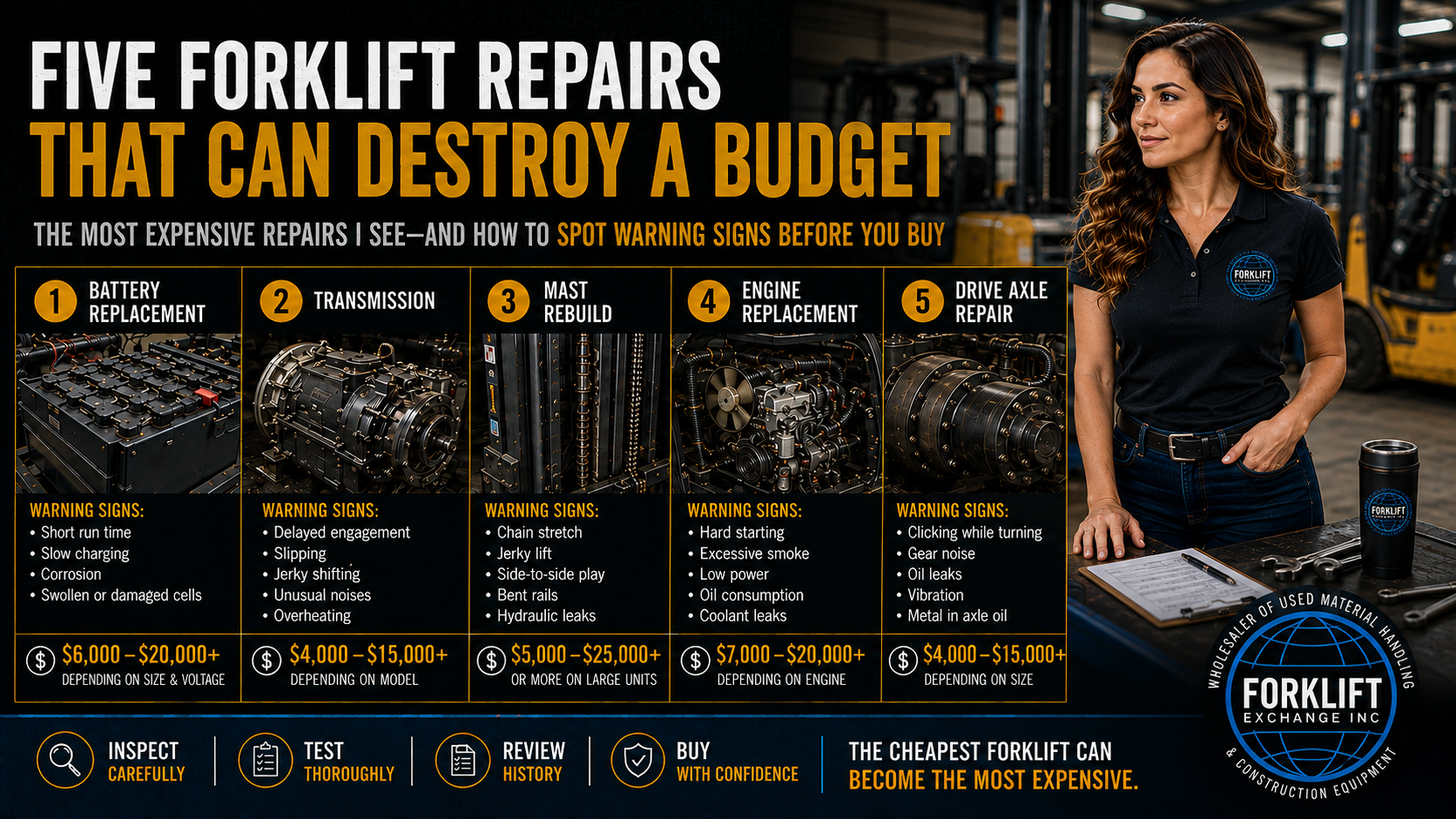
Here are the five repairs that can destroy a forklift budget, and more importantly, how to spot the warning signs before you buy.
An electric forklift’s battery is often the single most expensive wear item on the machine. Depending on the voltage, capacity, and/or type; replacing an industrial battery can cost anywhere from $6,000 to well over $20,000. Very large batteries can even cost considerably more.
Many buyers assume that because an electric forklift starts and drives, the battery must be healthy. Unfortunately, that’s not always the case.
Whenever possible, request:
A forklift with a weak battery can quickly become much more expensive than one with a higher purchase price and a healthy battery.
Few repairs surprise buyers more than a failed transmission. Whether it’s a powershift, hydrostatic, or electric drive system, transmission repairs can easily reach several thousand dollars and much more on larger forklifts.
Always operate the forklift long enough for the transmission to reach operating temperature. Many problems don’t appear until the machine has been working for 15–20 minutes.
The mast is the heart of every forklift. It’s also one of the most expensive assemblies to rebuild.
Repairs may include:
On larger forklifts, mast repairs can become extremely expensive due to the size and weight of the components.
Raise the mast fully if possible. Problems often become much more noticeable near maximum lift height.
Internal combustion forklifts are incredibly durable but engines eventually wear out. Replacing an engine isn’t just expensive because of the engine itself.
There’s also:
A compression test can reveal far more than simply listening to the engine idle.
The drive axle quietly handles enormous loads every day. When it fails, repairs can be substantial. Large-capacity forklifts, especially those used in steel mills, ports, and heavy industrial applications, place tremendous stress on drive axles.
Drive axle repairs never get cheaper if they’re ignored.
One of the biggest mistakes buyers make is assuming a forklift is in excellent condition because it looks clean.
Fresh paint can hide:
Cosmetics matter far less than mechanical condition. I’d rather buy an honest forklift with scratched paint than a freshly painted machine hiding major problems.
Before recommending any used forklift, I spend far more time looking at its mechanical condition than its appearance.
Some of the items I inspect include:
Every one of these components tells part of the forklift’s story.
The best way to avoid these costly repairs is to identify problems before signing the purchase order.
That means performing a complete inspection, test driving the forklift and reviewing maintenance records. Look beyond cosmetic appearance and buy from someone who understands the equipment. The cheapest forklift on the market often becomes the most expensive one to own.
Every used forklift has a history. The question is whether you’re buying a machine that’s been properly maintained or inheriting someone else’s expensive repair bill. A quality forklift isn’t simply the one with the lowest hours or the lowest price. It’s the one that’s been cared for, inspected thoroughly, and matched to the application it was built to handle.
That’s why I encourage buyers to look beyond the paint, beyond the hour meter, and beyond the asking price. The real value of a forklift lies in its mechanical condition and the confidence you have in its future reliability.
Jason Flaska
Forklift Exchange, Inc.
📞 630-842-0779
📧 jasonf@forkliftexchange.com
At Forklift Exchange, we inspect equipment with the same mindset we’d use if we were buying it ourselves. Whether you’re considering a single warehouse forklift or a heavy-capacity machine for demanding industrial applications, we’re happy to provide an honest evaluation before you make a significant investment.
#HighCapacityForklifts #HeavyLifting #Rigging #MachineryMoving #SteelCoilHandling #BulkMaterialHandling #SteelCoilHandling #Transloading #MachineryMovingAndRigging #HighCapacityForklifts #HoistMaterialHandling #HoistForklifts
Comments are closed