
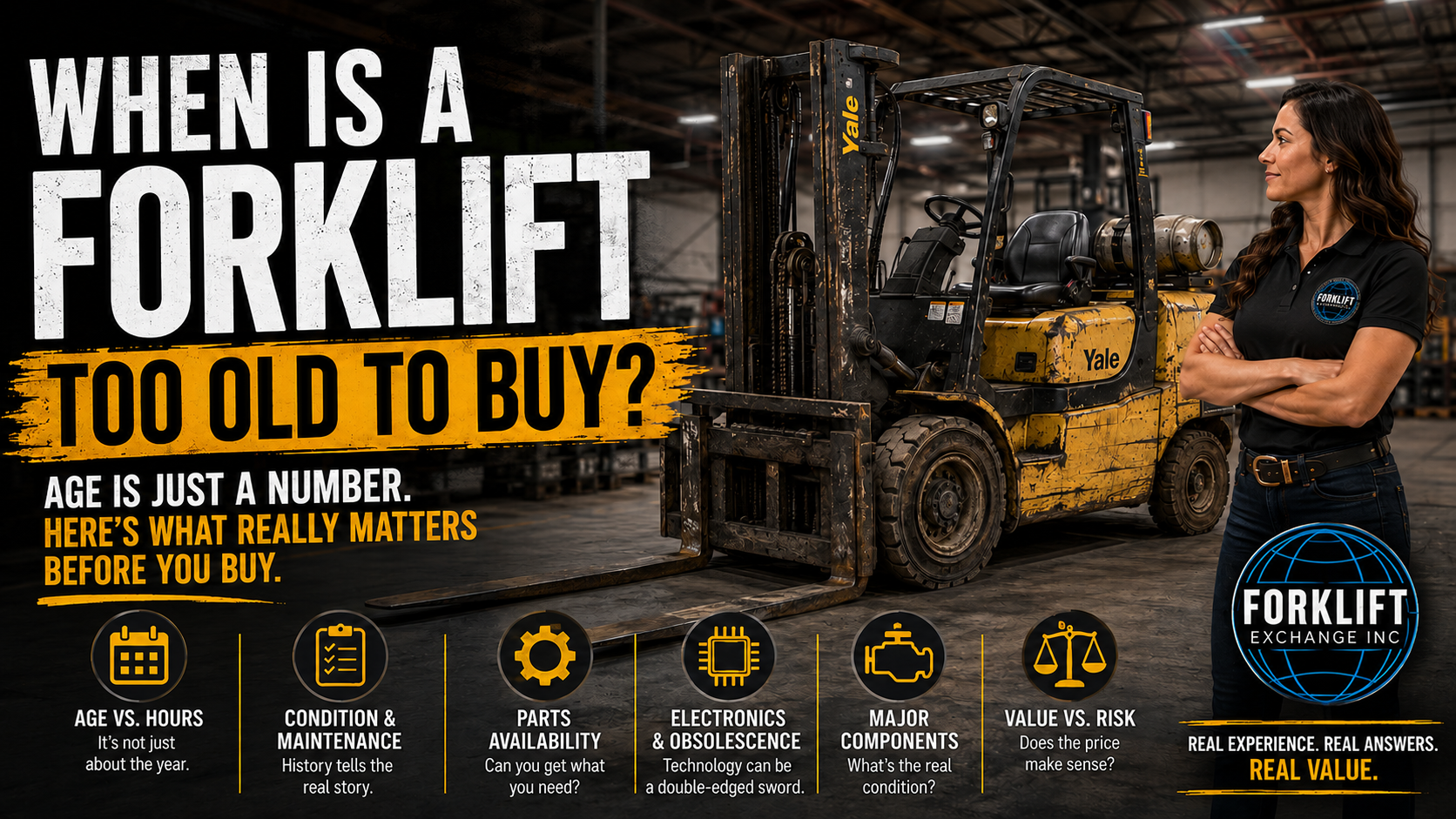
One of the questions I hear all the time is, “How old is too old for a used forklift?” My answer usually surprises people. Age alone doesn’t tell me very much.
I’ve seen 20-year-old forklifts that I would be comfortable putting into an operation tomorrow, and I’ve seen forklifts less than 10 years old that I wouldn’t recommend buying at almost any price.
When I’m evaluating a used forklift, the year matters, but it’s only one piece of the equation. After more than 20 years around forklifts, here are the things I look at before deciding whether a machine is simply older or actually too old to buy.
Two forklifts built in the same year can have completely different lives. Imagine two identical 15-year-old forklifts. One spent its life moving pallets five or six hours a day in a clean warehouse. The other ran multiple shifts in a steel operation, lumber yard, foundry, recycling facility, or other demanding environment.
Same year. Completely different machine.
That’s why I want to know:
The environment a forklift came from can tell me as much as the hour meter.
Buyers naturally look at hours and they should. But I wouldn’t automatically buy a 4,000-hour forklift over a 9,000-hour forklift. Give me a properly maintained 9,000-hour machine with documented service history over a neglected 4,000-hour machine every time.
Low hours don’t repair a bad transmission. Low hours don’t straighten a damaged mast. Low hours don’t fix years of neglected maintenance. And low hours certainly don’t guarantee that a forklift is a good buy.
Condition and maintenance history have to be considered alongside the hour meter.
This is one of the biggest factors buyers overlook. A forklift can run perfectly today but the question is, What happens when it doesn’t? Before buying an older forklift, I want to know whether major components and replacement parts are still readily available.
That includes things like:
Some older forklifts were produced in huge numbers and still have excellent parts support. Others can become extremely difficult and expensive to keep running. A forklift isn’t necessarily too old because of its birthday. It may become too old when keeping it operational becomes impractical.
This is especially important when comparing generations of equipment. Older forklifts were often mechanically simpler and that can actually work in their favor. A relatively simple engine, transmission and hydraulic system can often be repaired or rebuilt by an experienced technician.
As forklifts became more sophisticated, manufacturers added controllers, sensors, displays, emissions equipment and increasingly integrated electronic systems. Those systems provide tremendous benefits, but on an aging machine, obsolete electronics can sometimes create a problem. If a proprietary controller fails and the component is no longer supported, you may have a perfectly good forklift sitting in the corner because one electronic component can’t be sourced.
That’s something I investigate before recommending certain older machines.
When I’m evaluating an older forklift, I’m much more interested in the condition of its major systems than the year stamped on the data plate.
These are the areas where an inexpensive older forklift can quickly become an expensive one.
This is something people don’t always expect to hear from someone selling equipment. Newer isn’t automatically better for every application. Suppose a company needs a forklift 10 hours per week.
Do they necessarily need to spend substantially more for a late-model machine?
Maybe not.
A well-maintained older forklift with readily available parts and a proven drivetrain might provide years of economical service. I’ve seen plenty of older forklifts continue working reliably because they were well built, properly maintained and operating in applications that weren’t beating them to death every day.
For the right customer, that can represent tremendous value.
There are situations where I simply wouldn’t recommend buying the machine.
Some of my biggest concerns are:
Obsolete parts.
If critical components are becoming impossible to source, that’s a problem.
Major structural damage.
A questionable mast, carriage, overhead guard, frame or counterweight isn’t something I want to gamble with.
Multiple major systems approaching failure.
An engine problem may be manageable. A transmission problem may be manageable. A mast problem may be manageable.
But when you’re looking at all three simultaneously, the economics can change very quickly.
Poor maintenance history combined with high usage.
High hours don’t automatically scare me. High hours with obvious neglect do.
Repair costs approaching the replacement value.
At some point, putting more money into an old forklift simply doesn’t make financial sense.
When someone asks me whether a forklift is too old, I usually think they’re asking the wrong question. Instead, I would ask…
A 20-year-old forklift that costs $15,000 and gives you another five productive years could be an excellent investment.
A 7-year-old forklift that costs $25,000 and immediately needs $15,000 worth of repairs isn’t.
The year doesn’t determine the value. The machine does.
There is no magic age when every forklift suddenly becomes obsolete. Some machines are worn out at relatively young ages. Others remain productive decades after they were built.
That’s why I wouldn’t eliminate a forklift simply because it’s older and I wouldn’t recommend one simply because it’s newer. You have to evaluate the entire machine.
At Forklift Exchange, we help customers determine whether new, used, refurbished, or rebuilt equipment makes the most sense for their application. If you’re considering an older forklift and aren’t sure whether the price and condition make sense, I’d be happy to give you a second opinion.
Jason Flaska
Forklift Exchange, Inc.
📞 630-842-0779
📧 jasonf@forkliftexchange.com
#ForkliftExchange #Forklifts #MaterialHandling #HighCapacityForklifts #HeavyLifting #FleetManagement #Usedforklifts #IndustrialEquipment #SupplyChain #ForkliftAuthority #Rigging #MachineryMoving #SteelCoilHandling #Transloading #HoistForklifts
Visit some of my other articles
Comments are closed