
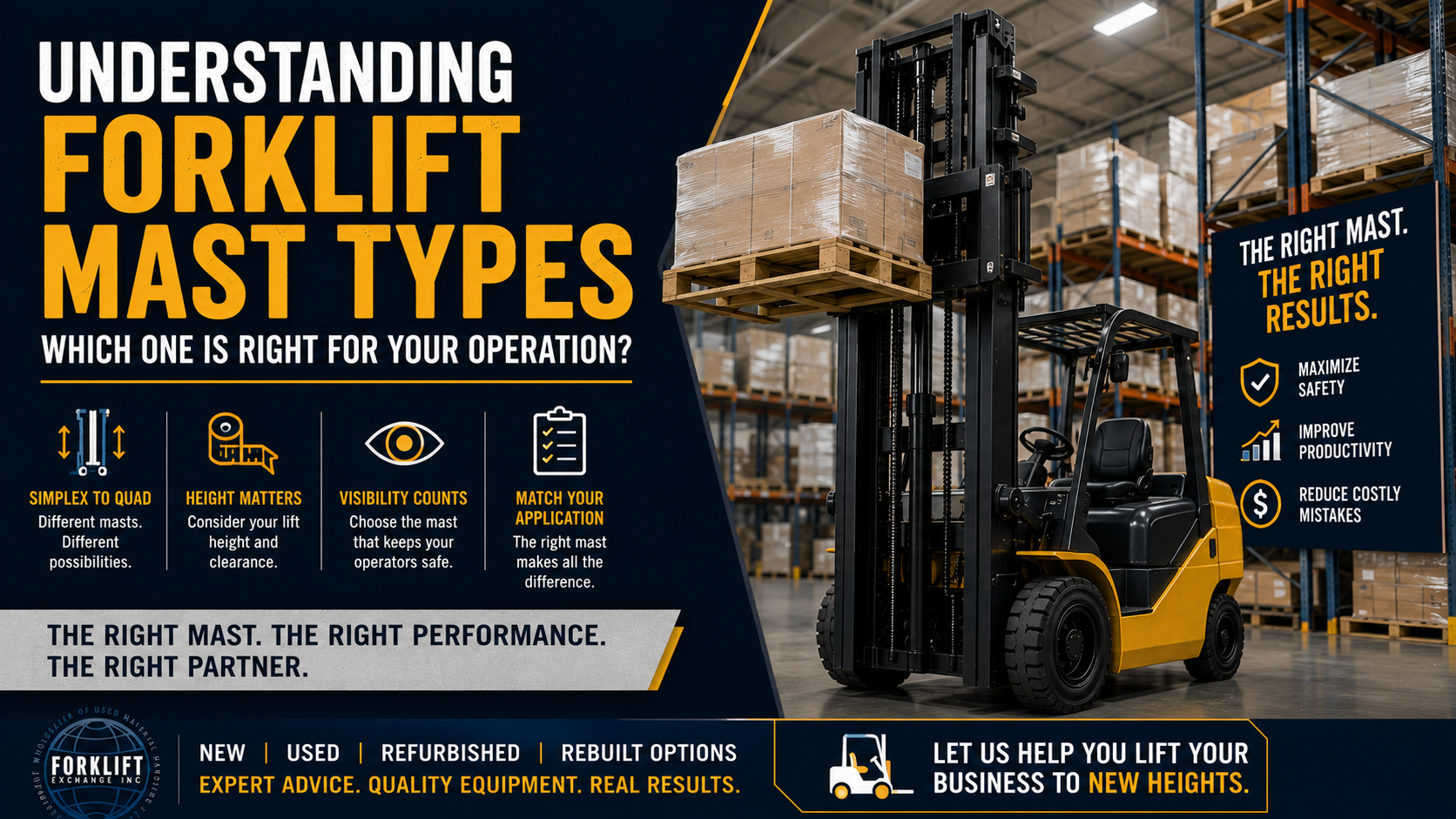
When most companies purchase a forklift, they focus on capacity, fuel type, or price. While those are all important considerations, one of the most overlooked decisions is selecting the correct mast. The wrong mast can reduce visibility, prevent you from accessing storage racks, limit your lifting capabilities, or even create clearance issues with doorways and trailers.
Over the years, I’ve helped customers who initially requested one mast style only to discover another option was a much better fit for their application. Understanding the differences before purchasing can save both time and money.
But what are the real differences between a Simplex Mast, Duplex Mast & Tripple Stage Mast? Let’s look at the most common forklift mast configurations and where each performs best.
A simplex mast has a single stage and typically offers the lowest maximum lift height.
If your operation rarely stacks material above 8 to 10 feet, a simplex mast may be all you need.
A duplex mast features two stages and provides greater lift height than a simplex while maintaining relatively good visibility.
Some duplex masts include Full Free Lift “FFL”(see section 5 for more details), allowing the forks to raise several feet before the overall mast height increases.
The triplex mast is the most common configuration found in today’s warehouses. It provides excellent lift height while collapsing to a relatively compact overall height.
Many 5,000-pound warehouse forklifts are equipped with triplex masts ranging from approximately 185″ to over 300″ of lift height.
A quad mast uses four stages to achieve extremely high lift heights while maintaining manageable collapsed dimensions.
One specification many buyers overlook is free lift. Free lift allows the forks to rise without increasing the overall height of the mast.
This is extremely valuable when working:
Without free lift, the mast will strike the ceiling before the load is fully raised.
These two measurements are often confused.
The overall height of the mast when fully lowered.
This determines whether the forklift can pass through:
The highest point the forks can safely raise a load. These two dimensions work together and should always be evaluated before purchasing equipment.
While higher-stage masts offer greater flexibility, they also introduce more steel channels, hydraulic hoses, and lift chains into the operator’s line of sight. For applications requiring precise positioning or frequent pedestrian traffic, visibility becomes an important safety consideration. Modern mast designs have significantly improved visibility compared to older forklifts, but selecting only as much mast as your application requires is still good practice.
Attachments can dramatically change how a mast performs.
Examples include:
These attachments often reduce the forklift’s usable capacity and may require a different mast or revised capacity rating. Always evaluate the entire package, not just the forklift itself.
Before purchasing, consider:
Answering these questions will often determine the best mast configuration for your operation.
The mast is much more than the lifting mechanism on a forklift, it’s one of the most important components affecting productivity, safety, and overall performance. Selecting the proper mast ensures your forklift fits your facility, safely handles your loads, and operates efficiently for years to come.
Special Note: If you’re still reading, like and share. It’s appreciated. At Forklift Exchange, we help companies determine whether new, used, refurbished, or rebuilt equipment makes the most sense for their application. Choosing the right mast is just one example of how matching the equipment to the job can prevent costly mistakes and improve long-term performance. If you have any questions or need help determining what type of equipment you need, send me a message.
Jason Flaska Forklift Exchange 📞 630-842-0779 📧 jasonf@forkliftexchange.com
#UsedForklifts #ForkliftInspection #MaterialHandling #WarehouseOperations #IndustrialEquipment #ForkliftMaintenance #ForkliftExchange
Comments are closed