
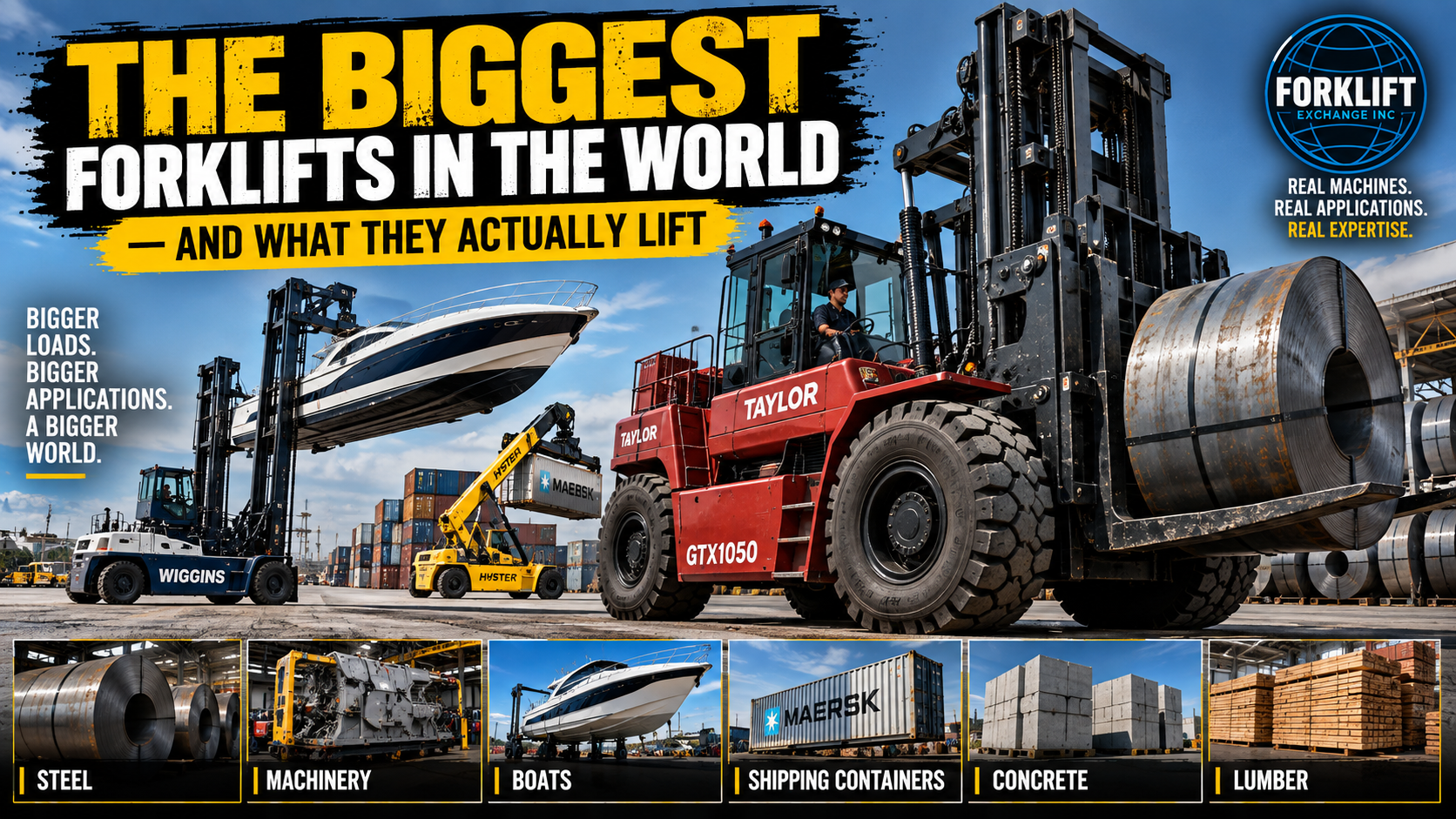
What are the biggest forklifts in the world and what do they lift? Most people hear the word forklift and picture the machine they see at a warehouse, lumber yard or home-improvement store. Maybe it lifts 5,000 pounds. Maybe 8,000. A 15,000-pound forklift already looks enormous compared with a typical warehouse truck, but that’s nowhere near the top of the forklift world.
There are forklifts capable of lifting 50,000, 75,000 and even more than 100,000 pounds. There are specialized machines weighing well over 100,000 pounds themselves. There are container handlers capable of picking up a loaded shipping container, marina forklifts designed to carry enormous boats, and machines built specifically to move steel coils, industrial machinery and other loads that would crush an ordinary forklift.
Hoist’s current pneumatic line, for example, includes a 125,000-pound-capacity forklift at a 48-inch load center. At that point, we’re not really talking about warehouse forklifts anymore. We’re talking about some of the largest mobile material-handling machines in the world and the interesting part isn’t just how much they can lift. It’s what people actually do with them.
There isn’t an official line where a forklift suddenly becomes a high-capacity forklift, but the scale changes quickly. A conventional warehouse forklift might be rated around 3,000–8,000 pounds. Once you get into the 15,000 – 30,000 pound range, you’re entering serious industrial territory.
At 30,000 to 60,000 pounds, you’re dealing with equipment designed around heavy manufacturing, steel, machinery moving, lumber, concrete and other specialized applications. But once you move beyond that? Everything changes. The tires, axles, mast, cooling system, counterweight, chassis; even the building or yard where the forklift operates may need to be designed around the machine.
Let’s put 100,000 pounds into perspective. That’s 50 tons.
Roughly the weight of:
And there are conventional-looking counterbalanced forklifts capable of handling loads in that neighborhood. Hoist currently lists its P1250 at 125,000 pounds of rated capacity at a 48-inch load center.
From a distance, it still looks like a forklift. There’s a mast, carriage, operator, forks but stand next to one and the scale becomes obvious. This isn’t simply a normal forklift made bigger. It’s an entirely different class of industrial equipment.
This is usually the next question. There aren’t many 100,000-pound pallets sitting around. These machines exist because certain industries routinely deal with extremely concentrated loads. One major example is steel.
Steel mills, processors and service centers may need to move massive coils, slabs, dies, fabricated structures and other products where tremendous weight is concentrated into a relatively small area.
Heavy manufacturing presents similar problems. A large stamping die, industrial press component or piece of production equipment may weigh tens of thousands of pounds. You can’t break the load into ten pallets. The load weighs what it weighs and the forklift has to be capable of handling it.
If you’ve never stood beside a large steel coil, it’s difficult to appreciate how much weight can be packed into such a compact object. A steel coil doesn’t necessarily look like something that could weigh tens of thousands of pounds, but it can.
That’s why steel-handling forklifts often look dramatically oversized compared with the physical dimensions of the load. The machine isn’t designed around how large the object looks. It’s designed around how much it weighs, where its center of gravity sits and how far that weight is positioned from the forklift. Which brings us to something important.
Suppose someone tells you, “This is a 50,000-pound forklift.” My next question is, At what load center? That matters enormously. A forklift rated for 50,000 pounds at a relatively short load center is dealing with a very different moment than a machine carrying the same weight much farther forward. That’s why comparing giant forklifts strictly by the capacity number can be misleading and specialized equipment can operate at load centers dramatically longer than that.
A marina forklift is a perfect example…
A boat is almost the opposite of a nice square pallet. It’s long, the weight isn’t distributed evenly, the center of gravity may be far away from the mast and the forklift may need to lift it several stories into the air.
That’s why marina forklifts are such interesting machines.
Wiggins, for example, rates its Marina Bull models using load centers appropriate to actual boats rather than the short load centers normally associated with warehouse forklifts. Current published models include capacities such as 44,200 pounds at a 240-inch load center.
Think about that.
Twenty feet.
That’s a completely different engineering problem from lifting a pallet whose center of gravity is two feet from the fork face.
This might be one of my favorite examples of extreme forklift engineering.
In 2016, Wiggins documented the construction of a custom Marina Bull for Haulover Marine Center in Florida. Its name was appropriately: Colossus. The requirements were remarkable.
The machine needed to handle boats up to 50 feet long and approximately 20 tons, while also being capable of raising 10,000-pound boats to 75 feet for placement into five-level dry-storage racks. The mast alone was approximately 50 feet tall.
And the completed forklift weighed approximately 220,000 pounds. That’s 110 tons of forklift! It had to be disassembled and transported to Florida on four multi-axle trucks. At that point, calling it a “forklift” almost seems inadequate but that’s exactly what it is.
The same fundamental concept as a warehouse forklift, taken to an extraordinary scale.
Then we get to shipping containers. A loaded ISO shipping container can weigh tens of thousands of pounds and ports don’t simply need to move them. They need to move a lot of them quickly. That’s where container handlers enter the picture.
A modern laden-container handler looks something like a forklift that spent its entire childhood lifting weights. Hyster currently offers its H40-52XD laden container handler with capacities ranging from 40,000 to 52,000 kilograms. At the upper end, that’s roughly 115,000 pounds.
And these machines aren’t simply picking containers up and putting them back down. Hyster says the machines can stack loaded containers three, four or five high in the first row. Imagine sitting in the operator’s seat with more than 80,000 pounds of container suspended in front of you.
That’s material handling on an entirely different scale.
Reach stackers take the container-handling concept even further. Instead of using a conventional forklift mast and forks, a reach stacker uses a telescopic boom with a container spreader. That distinction is important because technically, a reach stacker isn’t simply a giant conventional forklift. But it belongs in this conversation because it represents what happens when the material-handling problem becomes too specialized for traditional forklift architecture.
A reach stacker can pick up containers and reach into additional rows. That’s tremendously valuable at ports, rail terminals and intermodal facilities where space and container density matter. It’s also a good example of something that has happened throughout the forklift’s history. The load eventually determines the machine.
A steel mill might have room for a gigantic forklift. A machinery mover frequently doesn’t. Imagine moving a 40,000-pound machine out of an operating manufacturing plant. You’ve got doorways, columns, low ceilings, production equipment, narrow aisles & limited turning room.
Suddenly, simply building a longer forklift with a larger counterweight isn’t necessarily the answer. This is where specialized machines such as extendable-counterweight forklifts became important. Instead of permanently carrying all the machine’s counterweight at maximum extension, the forklift can change its geometry for the lift and then become more compact for maneuvering.
That’s an entirely different approach to the same fundamental problem, “How do I safely counterbalance an enormous load without building a forklift so large that I can’t get it into the building?”
This is one of the most interesting misconceptions about high-capacity forklifts. A huge forklift doesn’t necessarily lift something physically huge. Sometimes the load is surprisingly compact. Consider a heavy industrial die. It may only occupy a few feet of floor space.
But it could weigh between 20 & 40,000 lbs or even considerably more. That’s why looking at a photograph of a load can be deceiving. Density matters. Steel is heavy. Industrial tooling is heavy. Machinery is heavy. And when the load can’t be divided into smaller pieces, there’s only one solution, bring a machine capable of lifting the entire thing.
That favors large pneumatic tires, longer wheelbases and forklifts designed for demanding outdoor conditions. It’s one reason heavy pneumatic forklifts became so strongly associated with lumber and forest-products operations. The forklift has to handle not only the weight but also the environment.
Lumber doesn’t necessarily present the same extreme density as steel. Instead, it presents another problem. Size. Bundles can be long and awkward. Outdoor yards may have uneven surfaces. Operators may need to travel substantial distances.
Precast concrete operations are another natural home for large forklifts. Concrete pipe, barriers, structural components, blocks. & precast products. These loads combine substantial weight with awkward shapes and outdoor handling conditions.
Again, the problem isn’t simply, Can the forklift lift it? The question is, Can it safely pick it up, travel with it, maneuver with it and put it exactly where it needs to go? That’s a much higher standard.
This surprises people who aren’t around high-capacity equipment. Forklifts need counterweight. A conventional counterbalanced forklift must resist the forward overturning moment created by the load. As capacities increase, machines become extremely heavy. The result can be a forklift whose operating weight substantially exceeds the weight of what it’s carrying.
Wiggins’ Colossus is an extreme example: the machine itself was reported at approximately 220,000 pounds, while its mission included handling 20-ton boats and lifting lighter boats to extraordinary heights.
That weight has consequences and you have to consider everything from trailer capacity and permits to facility layout and floor strength.
That’s a fair question.
If the load weighs 80,000 pounds, why use a forklift at all? Because forklifts offer something cranes often don’t… mobility.
A high-capacity forklift can pick up a load, travel with it, reposition it, turn, enter a building and place the load. A crane may provide substantially greater lifting capability, but the equipment solves a different material-handling problem. In many industrial applications, the ability to pick, carry and place is exactly why a high-capacity forklift makes sense.
The two types of equipment frequently work together rather than replacing each other.
That’s what makes the forklift such an interesting machine. The same basic engineering concept can be used to move a pallet of bottled water in a warehouse… or a 100,000-pound industrial load.
One forklift spends its life moving pallets. Another moves steel coils. Another carries massive machinery. Another handles precast concrete. Another stacks loaded shipping containers. Another raises a boat several stories into the air. The scale changes. The engineering changes. The environment changes. But the fundamental problem remains remarkably similar.
There’s something extremely heavy over here. We need it over there.
The biggest forklifts in the world exist because somewhere, somebody has a load that an ordinary forklift simply can’t handle.
And when you get into that world, “How much does it lift?” is only the first question.
At Forklift Exchange, high-capacity equipment has been a major part of what we do for decades. Whether the application involves steel, machinery moving, heavy manufacturing or another specialized load, matching the machine to the actual application is where the conversation should start.
Jason Flaska
Forklift Exchange
📞 630-842-0779
📧 jasonf@forkliftexchange.com
#ForkliftExchange #Forklifts #MaterialHandling #HighCapacityForklifts #HeavyLifting #FleetManagement #Usedforklifts #IndustrialEquipment #SupplyChain #ForkliftAuthority #Rigging #MachineryMoving #SteelCoilHandling #Transloading #HoistForklifts
Visit some of my other articles
Comments are closed