
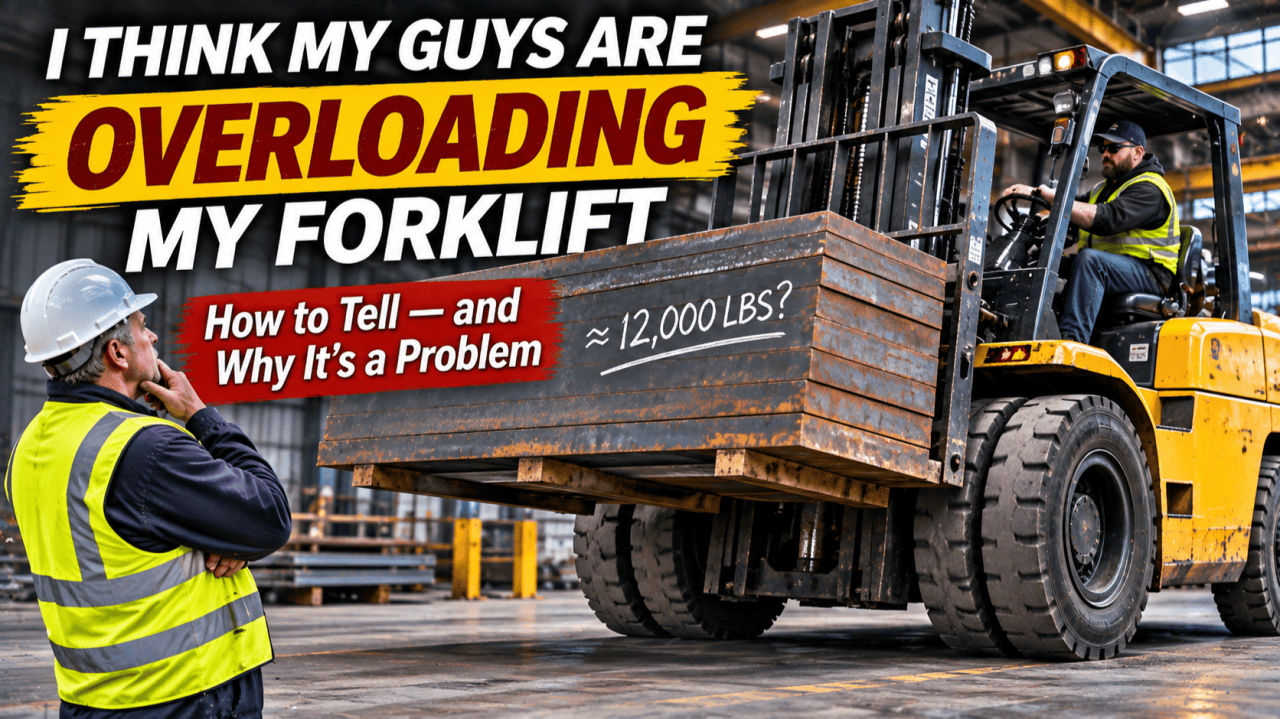
Every once in a while, I’ll have a customer tell me:
“I think my guys are overloading my forklift.”
Usually, they don’t have proof. Nobody has admitted to putting 8,000 pounds on a 6,000-pound forklift, and there isn’t necessarily a scale sitting next to the loading dock.
What they do have is a suspicion because something about the machine has changed.
Maybe the rear tires occasionally look like they’re getting light when a load is picked up. Maybe the mast is taking more abuse than it should. Maybe the forks are starting to look questionable. Or maybe the owner walked through the warehouse one afternoon and saw a load on the truck that looked a whole lot heavier than anything that forklift should have been carrying.
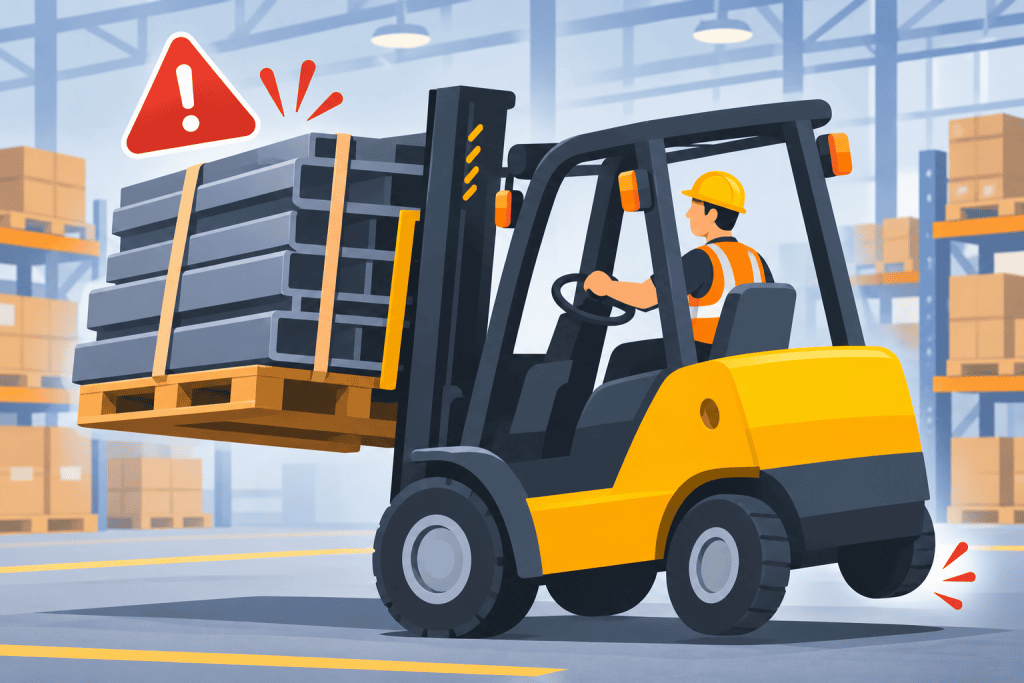
If you’ve had that thought, forklift overloading is worth investigating.
Routinely operating an overloaded forklift doesn’t just create a safety problem. It can accelerate wear on some of the most expensive components on the machine.
There’s another issue I see fairly often, though:
The operator may not even realize the forklift is overloaded.
Understanding why starts with understanding what forklift capacity actually means.
Let’s say you own a 5,000 lb forklift.
It’s easy to assume that means the truck can safely lift anything weighing 5,000 pounds or less.
That’s not necessarily true.
The forklift’s capacity rating only means something when you also understand the conditions under which that capacity applies. One of the most important of those conditions is the load center.
A typical forklift might be rated at:
5,000 lbs at a 24-inch load center.
Put a normal 48-inch-deep, evenly distributed pallet fully against the fork face and its center of gravity may be approximately 24 inches out.
Now put a 72-inch-deep load on the same forklift.
The load’s center of gravity may be considerably farther forward. That load could weigh less than 5,000 pounds and still exceed what the forklift is rated to safely handle.
Think about holding a heavy object against your chest compared with holding the same object straight out in front of you.
The weight hasn’t changed.
The leverage has.
A forklift deals with the same basic principle, with the front axle essentially acting as the fulcrum. Move the load farther forward and you increase the overturning moment working against the machine.
That’s why an awkward 4,000-pound load with a long load center can potentially create more of a problem than a properly positioned 5,000-pound pallet.
Forklift capacity isn’t just about how much the load weighs. It’s also about where that weight is located.
Absolutely, and this is one of the most commonly overlooked causes of forklift overloading.
A forklift may have originally been equipped with a standard fork carriage, but somewhere along the way somebody added a:
That attachment has weight of its own.
It can also move the load farther forward.
Both factors can reduce the forklift’s available lifting capacity.
That’s why you should look at the forklift capacity plate in its current approved configuration, not a generic brochure for that model or what someone remembers the forklift being rated for when it was purchased.
If the truck has been modified or an attachment has been added, the capacity information needs to accurately reflect that configuration.
A forklift that started life as a 5,000 lb truck may not necessarily have 5,000 pounds of available capacity with its current attachment, mast, lift height, and load center.
There’s no single mechanical clue that proves a forklift has been overloaded.
Forks, tires, masts, chains, and hydraulic components all wear during normal operation. Poor maintenance, rough floors, impacts, aggressive driving, and other operating conditions can create many of the same symptoms.
What I look for is a combination of warning signs, along with what the forklift is actually being asked to lift.
This is one of the most important forklift overload warning signs.
If the rear steer tires begin losing firm contact with the ground or the steering suddenly feels unusually light after picking up a load, stop using that load configuration until you understand what’s happening.
The combined center of gravity of the forklift and load may be moving too far forward.
Operators who spend every day on the same truck are often the first people to notice this because they know how the forklift normally steers, lifts, and reacts.
If an experienced operator tells you a particular load makes the truck feel unstable or significantly changes the steering, don’t dismiss it as the machine simply “working hard.”
The forklift may be telling you something is wrong.
The problem is that operators sometimes adapt to abnormal behavior instead of reporting it.
If they move the same questionable load every day and nothing dramatic happens, eventually the unusual steering or instability becomes normal.
That’s how an application that should have been investigated months ago turns into:
“That’s just how this forklift drives.”
If you suspect forklift overloading, inspect the forks carefully.
Look for:
Fork damage doesn’t automatically prove overloading.
Impacts, dragging forks across the floor, improper handling, and ordinary wear can all cause problems.
But bent or cracked forks should never be dismissed as cosmetic damage.
They’re safety-critical components that are actually supporting the load. Questionable forks should be inspected by someone qualified to evaluate them.
The mast and carriage deserve the same attention.
Repeated excessive loading can place additional stress on:
Again, unusual wear doesn’t automatically prove somebody is overloading the forklift.
But a relatively low-hour forklift experiencing unusually rapid fork, carriage, mast, or chain wear should make you curious about the application.
If you’re replacing components far sooner than expected, don’t just ask:
“What’s wrong with this forklift?”
Ask:
“What is this forklift doing all day?”
This is probably one of the most common misconceptions I hear around industrial equipment:
“It lifted it, so it must be okay.”
Unfortunately, forklift capacity doesn’t work that way.
A forklift may physically be capable of raising a load that it isn’t rated to safely handle.
Hydraulic lifting capability is not a substitute for the capacity shown on the forklift’s data plate.
I’ve seen this mentality around equipment for years. If a machine physically accomplishes something once, people assume it was designed to do it.
Then they do it again.
Nothing breaks, so that becomes proof that everything is fine.
The forklift may continue making that questionable lift for months without an obvious failure.
But getting away with something repeatedly doesn’t turn it into proper operation.
Forklift lift height matters too.
A load that seems manageable a few inches off the floor isn’t automatically acceptable when raised high enough to place into racking.
Mast configuration, lift height, attachments, tilt, and load position can all affect forklift capacity and stability.
That’s why some forklifts have different capacities at different heights and configurations.
It’s also why the actual forklift capacity plate matters more than the number people casually use when describing the truck.
If a forklift feels increasingly unstable as a particular load is elevated, don’t assume that’s normal simply because the truck was capable of getting the load off the ground.
Put safety aside for a moment and look purely at the money.
Forklift repairs aren’t cheap.
Depending on the truck, repairs involving forks, masts, chains, tires, hydraulic cylinders, axles, or transmissions can become expensive very quickly.
Those costs can increase dramatically once you get into specialized and high-capacity equipment.
If your forklift is going through components much faster than expected, it’s worth investigating whether the application is contributing to the problem rather than immediately assuming you bought an unreliable machine.
I’ve seen companies continue repairing a forklift when the better solution would have been moving up a capacity class.
If a 6,000 lb forklift spends its entire life being pushed near its limit—and occasionally beyond it—the company may ultimately spend more maintaining that truck than it would operating an 8,000 lb forklift properly sized for the work.
Bigger isn’t always better.
I’ve advised plenty of customers against buying more capacity than they need.
But the opposite is also true:
Trying to save money by consistently undersizing a forklift can become very expensive.
Sometimes the problem isn’t the forklift.
And it isn’t the operator.
The application changed.
Maybe your company bought a 5,000 lb forklift ten years ago when your heaviest pallet weighed 3,800 pounds.
Today, you’re routinely handling 5,500-pound loads.
Maybe production changed.
Maybe you’ve started receiving larger pallets.
Maybe a different attachment was installed.
Maybe your products gradually became heavier or their dimensions changed.
If the material has changed but the forklift hasn’t, you may simply have outgrown the machine.
That’s not necessarily a maintenance problem.
It’s an equipment-sizing problem.
It’s easy to hear “overloaded forklift” and immediately blame the person driving it.
That’s not always fair.
What if nobody ever told the operator what the load weighs?
What if production changed?
What if larger pallets were introduced?
What if a new attachment was installed?
What if the forklift capacity plate is damaged or unreadable?
Maybe everyone in the building genuinely believes the forklift has more lifting capacity than it actually does.
Operators can’t make good decisions without good information.
If you suspect forklift overloading, start by understanding the application rather than immediately assuming your employees are deliberately abusing the equipment.
Determine:
Those questions will usually tell you a lot more than simply telling everybody to “stop lifting too much.”
If I suspected forklift overloading in an operation, the first thing I’d do is identify the actual loads.
Don’t guess.
If the weight isn’t reliably known, determine it using an appropriate method.
For products you handle regularly, document the maximum expected weight and dimensions.
This becomes especially important when handling:
Something can look surprisingly small and still weigh tens of thousands of pounds.
Next, compare those loads with the forklift’s capacity plate and approved configuration.
Pay particular attention to:
If there’s reason to believe the forklift has been repeatedly overloaded, have a qualified technician inspect the forks, mast, chains, carriage, tires, steering, hydraulics, and other relevant components.
I’d also talk to the operators.
Ask:
Which loads make the forklift feel different?
Are there loads that make the steering unusually light?
Are there products you struggle to lift or position?
Are you routinely operating close to the forklift’s rated capacity?
Don’t make the conversation about catching somebody doing something wrong.
Make it about understanding what the forklift is actually being asked to do.
You may discover that the problem isn’t the operators or the machine at all.
Sometimes that’s where the conversation ends.
The forklift isn’t bad.
The operators aren’t bad.
The application changed.
Continuing to repair and push an undersized forklift isn’t necessarily saving money. It may simply be postponing a decision you’re eventually going to have to make anyway.
Moving into a properly sized higher-capacity forklift may be the smarter financial decision.
Your existing truck can potentially be reassigned to lighter work it was actually designed to perform.
The goal isn’t to buy the biggest forklift available.
It’s to have enough forklift for the actual application without constantly operating at or beyond the machine’s limits.
Forklift overloading can affect much more than whether the machine is physically capable of raising a load.
Operating beyond the truck’s rated capacity can contribute to:
And perhaps most importantly, an overloaded forklift can create conditions where the operator has much less margin for error than they realize.
A forklift may sometimes be physically capable of raising a load heavier than its rated capacity, but that does not mean the load is safe or within the manufacturer’s rated specifications. Always follow the capacity information shown on the forklift’s applicable data plate.
Check the forklift capacity plate or data plate for the truck’s rated capacity, load center, maximum lift height, and applicable configuration. Attachments, mast configurations, and other modifications may reduce the available capacity.
It can. Attachments such as side shifters, fork positioners, clamps, and other equipment add weight and can move the load center farther forward. The forklift’s capacity information should reflect its approved current configuration.
A 24-inch load center generally means the rated capacity applies when the load’s center of gravity is approximately 24 inches horizontally from the fork face. Longer or irregular loads may move that center farther forward and reduce available forklift capacity.
One of the most concerning warning signs is the rear of the forklift becoming light or the rear wheels beginning to lose firm contact with the ground when the load is lifted. Stop and investigate the load and forklift capacity before continuing.
Repeated excessive loading can contribute to additional stress and wear on components including forks, mast components, lift chains, carriage assemblies, tires, hydraulic components, and other parts of the forklift.
Not automatically, but it’s worth reviewing the application. If your current forklift routinely operates at or near its capacity—and especially if your loads, dimensions, lift heights, or attachments have changed—a properly sized higher-capacity forklift may be a better long-term solution.
Forklifts are tough machines.
That’s actually part of the problem.
They can tolerate enough abuse that poor operating practices sometimes continue for years before somebody realizes what’s happening.
An overloaded forklift doesn’t always tip over, break a fork, or blow a hydraulic line.
Sometimes it simply keeps working while wear accumulates.
Everyone assumes that because nothing catastrophic happened yesterday, everything must be fine today.
If you’re seeing unusual fork wear, mast problems, steering changes, instability with certain loads, or repair costs that don’t seem to match the machine’s hours, take a closer look at the application.
Find out what your people are actually lifting.
Don’t assume the load weighs what everyone thinks it weighs.
And don’t assume that because the forklift managed to lift it yesterday, it’s safe to lift it again today.
The important number isn’t simply the capacity people associate with the forklift. It’s what the capacity plate says the machine can safely handle in the configuration and conditions you’re actually using.
If your operation consistently needs more forklift than you currently own, the solution probably isn’t asking the existing machine to try harder.
It’s putting the right forklift under the load.
At Forklift Exchange, we work with everything from everyday warehouse forklifts to specialized high-capacity cushion and pneumatic-tire machines.
If you’re unsure whether your current forklift has enough capacity for the loads you’re handling, we can look at the application and help determine what makes sense.
Sometimes you need a bigger forklift.
Sometimes you don’t.
Figuring that out before something breaks is usually the least expensive option.
Jason Flaska
Forklift Exchange, Inc.
Phone: 630-842-0779
Email: jasonf@forkliftexchange.com
• Can a Forklift Be Used as a Snowplow?
See OSHA’s recommendations here.
Comments are closed