
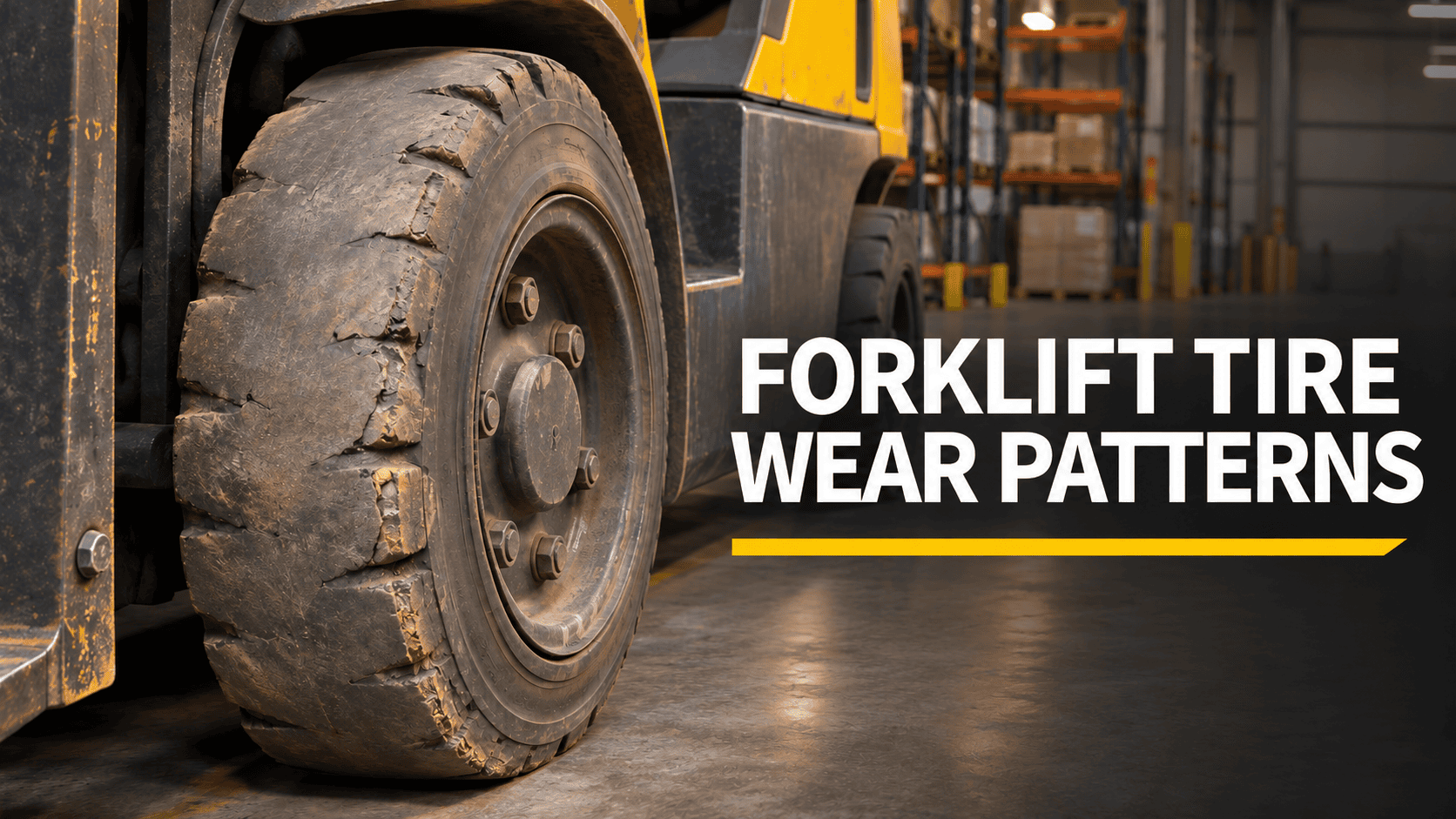
Forklift tire wear patterns can tell you a surprising amount about your operation. A cut, a missing chunk of rubber, or uneven wear may offer clues about the routes a truck travels, the surfaces it crosses, and the demands placed on it every day.
A forklift tire usually doesn’t fail all at once. It might start with a small cut. Then a piece of rubber breaks away. A few weeks later, the ride feels rougher, and the operator slows down over a dock plate.
Someone may look at the tire and say, “There’s still plenty of rubber left.”
Maybe there is. But the amount of rubber remaining is only part of the story.
The useful question isn’t just, “Do we need a new tire?” It’s also, “What happened to this one?”
A forklift may travel the same path hundreds of times a day. It crosses the same floor joints, turns in the same aisle, drives over the same dock plate, and stops at the same rack locations.
Each trip may seem uneventful, but the tires experience every bump, turn, impact, and piece of debris along the way.
Consider a small pothole near a loading dock. A delivery driver might see it once and avoid it. A forklift operator might cross it dozens of times per shift while carrying a load.
Repeated impacts can contribute to tire damage, a rougher ride, and added stress on the truck and its load. If a replacement tire goes onto a forklift that continues traveling over the same damaged surface, the new tire enters the same environment that may have damaged the old one.
That’s why a tire inspection should sometimes lead you away from the forklift and onto the route it travels.
Chunking occurs when pieces of rubber break away from a tire. It can appear as small missing sections around the tread or as more significant damage that makes the tire noticeably uneven.
A little missing rubber may not look like much from across the warehouse. Up close, it can tell a different story. Look at the size and location of the damage, whether it’s getting worse, and whether similar damage appears on other tires.
Then inspect the working area for possible contributors:
The material being handled matters too. A facility moving steel may face different debris concerns than a clean distribution warehouse.
Don’t assume every chunked tire has the same cause or that a particular amount of damage is safe to ignore. Have the tire evaluated against the forklift and tire manufacturers’ guidance. If its condition makes the truck unsafe, remove the forklift from service until the problem is corrected.
A cut in a solid tire and a cut in an air-filled tire are not necessarily the same problem. Tire construction, the location and depth of the damage, and the manufacturer’s recommendations all matter.
An air-filled tire adds another concern: pressure. A tire that appears low or is losing air needs attention from qualified personnel. Operators should inspect for obvious problems and report them; they should not adjust pneumatic tire pressure unless they’ve been trained to do so.
A solid tire won’t go flat in the same way, but it can still become unsuitable for service. Deep cuts, separation, missing material, or exposed structural components need attention.
The best time to notice a cut is when it can be inspected and documented—not after it has become part of a bigger problem.
Sometimes a tire wears faster on one side. That’s useful information, but it isn’t a diagnosis by itself.
Uneven wear may be related to the truck’s route, repeated turning in one direction, floor conditions, operating practices, tire selection, or a mechanical issue. The forklift’s design and normal load distribution matter too.
Ask a few practical questions:
The tire is providing evidence. The job is to gather enough information before deciding what that evidence means.
Not every tire on a forklift necessarily wears at the same rate. Still, a sudden change or an unusual difference deserves a closer look.
If several trucks show similar damage on the same side, a shared route or floor condition may deserve attention. If only one truck is affected, a qualified technician may need to look more closely at that machine.
Photos and notes can help. Record which tire is affected, when the damage was noticed, and whether it appears to be progressing. That information gives your maintenance team or service provider a better starting point.
Operators get to know their forklifts. They notice when a truck starts bouncing more than it used to or when a familiar stretch of floor suddenly feels rough.
That feedback is valuable.
A damaged or heavily worn tire can contribute to vibration and a rough ride. Repeated jolts may also affect the load. A pallet that looks secure when it’s picked up may behave differently as it moves across an uneven route.
Not every rough ride is caused by tires. Floor conditions, the forklift’s configuration, and mechanical problems can all play a role. But when an operator says the truck no longer rides the way it used to, inspect the tires and the travel path.
Tires are not a substitute for a sound operating surface. A different tire may be appropriate for an application, but it doesn’t make a damaged floor or unsafe route acceptable.
A forklift that handles comfortably on clean, dry concrete may behave differently on a wet dock, dusty floor, oily surface, or uneven yard.
Tire condition and type matter, but so do the surface, the truck, the load, and the operator’s actions. If a forklift moves between a warehouse, an outdoor yard, and a loading dock, don’t assume that one tire change will solve every traction concern.
Look at the whole application:
If a truck routinely struggles for traction or stability, review tire selection with a qualified supplier and address the conditions contributing to the problem. Any tire change must be compatible with the truck and follow the manufacturer’s requirements.
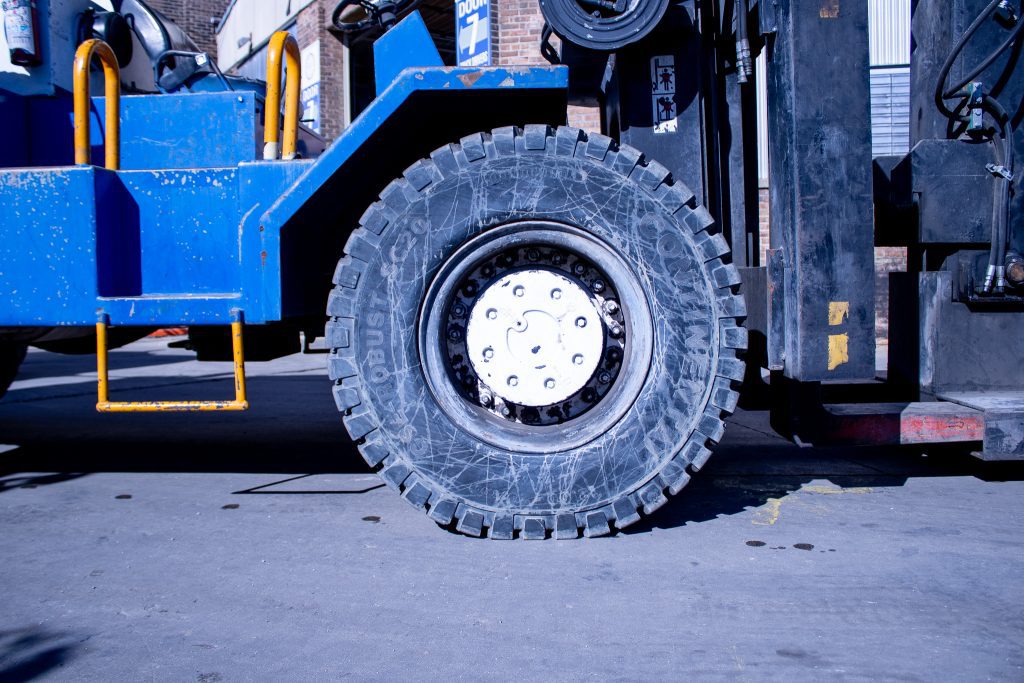
Premature wear can become especially costly on high-capacity forklifts. The equipment is larger, the tires can be expensive, and replacement may require specialized equipment and service personnel.
Planning helps avoid a scramble for parts and emergency service. But replacing a costly tire without investigating why it wore out early can leave the underlying problem in place.
If the forklift repeatedly crosses a damaged threshold, operates around debris, or works in an application the tire wasn’t suited for, the replacement may face the same shortened life.
Before arranging a replacement, gather photos, note the truck’s route, and speak with the operator. Share those observations with your service provider.
A tire inspection doesn’t need to become a complicated engineering project. It does need to be consistent and followed by action.
As part of your pre-use inspection:
OSHA’s powered industrial truck standard requires trucks to be examined before being placed in service, at least daily. When trucks are used around the clock, they must be examined after each shift. Defects must be reported and corrected, and a truck with a condition that makes it unsafe must be removed from service until restored to safe operating condition.
The follow-up matters. If an operator reports the same tire damage three days in a row and nobody responds, the inspection process has become a paperwork exercise.
Forklift tire wear patterns can offer clues about floor conditions, operator routes, and the demands being placed on your equipment. They can also give you an early reason to investigate a problem before it leads to unexpected downtime.
The next time you walk past a forklift, take a closer look at its tires. If something doesn’t look right, ask the operator what they’ve noticed and follow the truck’s route.
You may find that the most useful part of the inspection isn’t just the tire problem you uncover. It’s the operational problem you finally notice along the way.
Questions about your forklift operation? Contact Jason Flaska at Forklift Exchange, Inc., at jasonf@forkliftexchange.com or 630-842-0779.
See more Forklift Educational posts:
• Forklift Overloading: 7 Warning Signs Your Truck May Be Over Capacity
• Forklift Snowplow: 7 Dangerous Mistakes to Avoid
• Can a Forklift Drive Through Snow? 7 Essential Safety Tips
Comments are closed