
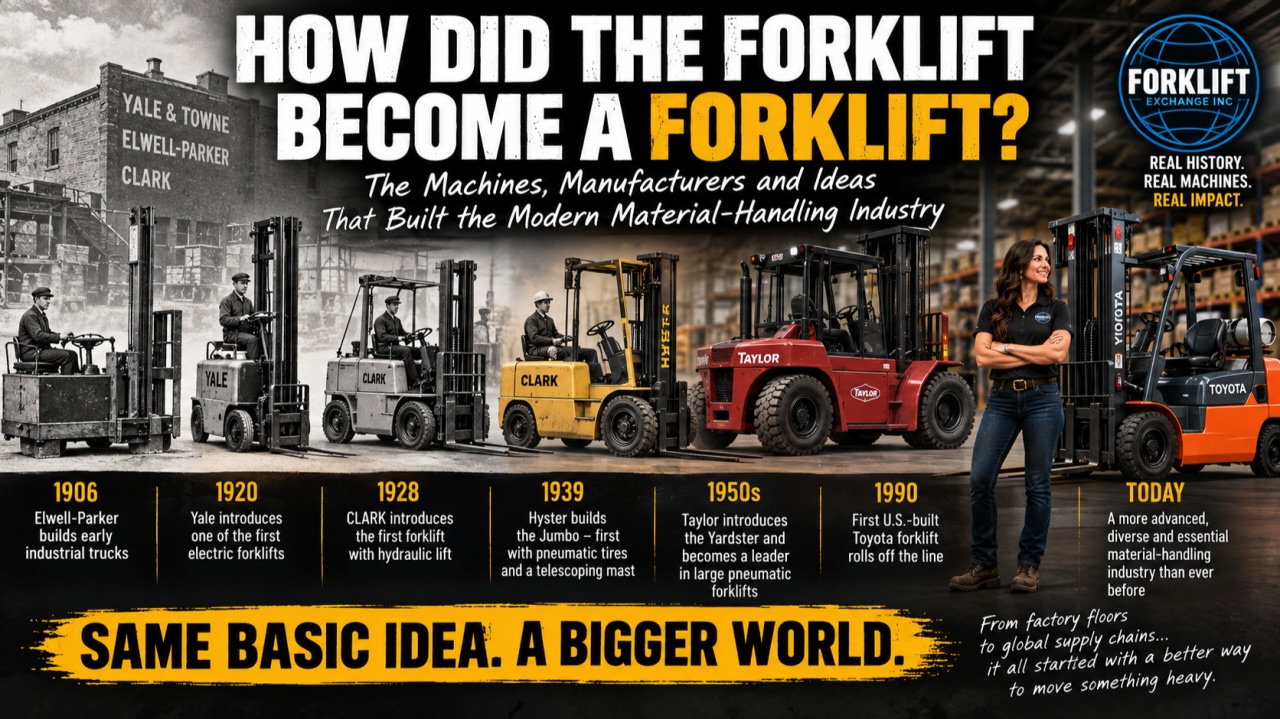
Walk into almost any warehouse, manufacturing plant, steel mill, lumber yard or distribution center today and you’ll find a machine that looks immediately familiar. Counterweight in the rear, operator in the middle, mast in the front, two forks extending ahead of the front axle.
Whether it’s a 3,000-pound electric warehouse truck or a 100,000-pound pneumatic-tire monster working in heavy industry, the basic architecture is recognizable. But who actually invented that layout? Who built the first electric forklift? Where did high-capacity forklifts come from? And how did companies such as Yale, CLARK, Hyster, Taylor, Silent Hoist, Elwell-Parker and eventually Toyota come to dominate different pieces of the forklift business?
The answer is more interesting than simply saying, “Somebody invented the forklift.”
The modern forklift was really invented in stages.
At the beginning of the 20th century, factories were becoming larger and industrial production was increasing rapidly. But moving material was still enormously labor intensive. Companies depended on hand carts, dollies, hoists, cranes, rail carts and manpower. The first breakthrough wasn’t actually lifting. It was powered transportation.
One of the earliest important names was Elwell-Parker Electric Company of Cleveland, founded in 1893. The company developed an industrial truck in 1906 and became an early pioneer in battery-powered material handling. Case Western Reserve University’s Encyclopedia of Cleveland History credits Elwell-Parker with developing the industrial truck in 1906.
These early machines were essentially powered platforms. They could move heavy material around a factory, but they weren’t yet the forklift we know today.
The next question was obvious: What if the truck could lift the material too?
This is where forklift history gets complicated.
There wasn’t one inventor who produced a machine one morning that looked exactly like today’s forklift. Several manufacturers were developing different pieces of the concept at roughly the same time.
Elwell-Parker was one of the earliest. In 1919, the company added a fork-lifting device to industrial trucks that allowed loads greater than one ton to be carried beyond the front axle. By 1920, Elwell-Parker was producing industrial trucks that used hydraulic power for load handling.
Meanwhile, another company was about to become one of the most important names in forklift history. Yale & Towne.
Electric forklifts aren’t a modern invention. Believe it or not, they’re more than a century old.
In 1920, Yale & Towne introduced what Yale describes as the first electric forklift truck brought to the material handling market. Yale was producing battery powered low lift platform trucks, high lift platform trucks, tow tractors and early lifting trucks with tilting forks.
That’s worth thinking about. We talk today about electrification as though the forklift industry recently discovered batteries. It didn’t. Electric material handling was present almost from the beginning of the forklift industry itself.
In fact, Elwell-Parker had already been developing battery-powered industrial equipment and says it produced one of the first electric lift trucks in 1914 and helped introduce an electric forklift in 1919.
So rather than arguing over a single “first,” the important historical point is that Elwell-Parker and Yale were both foundational companies in the development of electric industrial trucks and forklifts.
An even more important development occurred a few years later. According to Elwell-Parker’s historical account, Yale introduced an electric truck in 1923 with forks that could be raised and lowered on an elevated mast. Now we’re getting very close to the machine we recognize today.
You have a powered industrial vehicle, forks, a vertical mast & the ability to pick up a load / transport it / stack it. Elwell-Parker describes this period as the point when the first modern forklifts began appearing in factories.
CLARK was developing the concept simultaneously.
CLARK had begun building its powered Tructractor in 1917. The gasoline-powered Truclift followed in 1920, and in 1928 CLARK introduced the Tructier, which the company identifies as the first forklift with a hydraulic lifting system.
By the late 1920s, the essential pieces of the modern forklift had arrived.
A forklift without something standardized to pick up has limited usefulness. That’s where the pallet becomes almost as important as the forklift itself. As palletized material handling became increasingly standardized, manufacturers no longer needed workers to handle every box, bag or component individually.
Products could be assembled into one unit load. The forklift could drive up, slide its forks underneath, lift the entire load and leave. One operator could suddenly move thousands of pounds of product in minutes. The forklift and pallet evolved together, and that combination fundamentally changed industrial logistics.
Here’s something I think will surprise many readers. High-capacity forklifts aren’t a recent development either. By 1925, Elwell-Parker had produced what it called a “super-super” lift truck capable of handling more than 10 tons. That’s over 20,000 pounds approximately a century ago.
Elwell-Parker continued specializing in high-capacity equipment and eventually produced machines exceeding 100,000 pounds. This was the beginning of a branch of the forklift family that would become particularly important to steel mills, automotive plants, machinery movers and other heavy industries.
And another American manufacturer would become deeply associated with that market Silent Hoist & Crane.
The history of the American high-capacity cushion-tire forklift deserves more attention than it usually receives.
Silent Hoist & Crane traced its industrial-equipment roots to Brooklyn, New York, and was manufacturing heavy-duty forklifts, cranes and material-handling equipment very early in the industry’s development. Industry histories describe Silent Hoist as one of America’s early pioneers of heavy-duty, high-capacity equipment
Over time, Silent Hoist became particularly associated with the high-capacity cushion-tire forklift. That configuration became enormously important inside steel mills, automotive plants, metal processing facilities, machinery moving operations, paper operations & Heavy manufacturing plants.
Why cushion tires?
Because if you’re moving tremendous weight indoors on relatively smooth concrete, a compact cushion-tire chassis can provide huge capacity without requiring the dimensions of a giant outdoor pneumatic truck. That market eventually became a specialty all its own.
In 1994, Marty Flaska acquired the rights to build Silent Hoist cushion-tire forklifts and moved the operation to Illinois, where the product evolved under Hoist Liftruck. Hoist subsequently became a major supplier of high-capacity cushion-tire forklifts to the steel, aluminum and automotive industries. That lineage is one reason Chicago became such an important center for American high-capacity cushion-tire forklift manufacturing.
While cushion-tire forklifts developed around factories and heavy indoor applications, another problem existed outside. Lumber yards, docks and industrial yards didn’t have perfect concrete floors. They had dirt, gravel, mud, rail yards & uneven surfaces. You needed a different kind of forklift.
This is where Hyster becomes enormously important. Hyster’s origins were in the logging industry of the Pacific Northwest. The Willamette-Ersted Company was founded in 1929, building equipment for the brutal conditions encountered by logging operations. In 1936, the company built its BT lift truck, capable of lifting 6,000 pounds. Then came the machine that helped define the heavy pneumatic forklift.
In 1939, Hyster introduced the Jumbo. It had a 15,000-pound capacity and was designed for lumber operations loading ships and railcars. More importantly, Hyster-Yale’s own historical record identifies the Jumbo as “the first lift truck with pneumatic tires and a telescoping mast.”
That combination matters enormously. Pneumatic tires allowed a heavy forklift to work effectively on rough outdoor surfaces. The telescoping mast allowed it to lift and stack material while remaining a mobile counterbalanced machine. If you’re looking for an important ancestor of today’s large outdoor pneumatic forklift, the Hyster Jumbo is one of the machines I’d put near the top of the family tree. And Hyster never really abandoned that identity.
Today Hyster still manufactures pneumatic-tire forklifts with capacities reaching approximately 105,000 pounds, aimed at demanding industries including ports, steel, concrete, lumber and heavy manufacturing.
Another American company would become synonymous with giant pneumatic forklifts. Taylor Machine Works. Taylor was founded in Louisville, Mississippi, in 1927 by W.A. Taylor Sr. Interestingly, Taylor didn’t even begin as a forklift manufacturer. The company started as an automotive and repair business and developed equipment for the timber industry.
In 1937, Taylor produced a timber skidder that eventually became known as the “Logger’s Dream.” Then, in the early 1950s, Taylor developed its Yardster forklift trucks.
Those machines found a natural home handling exactly the kinds of loads ordinary warehouse forklifts weren’t built for lumber, prestressed concrete, steel, primary metals & containerized freight.
That became Taylor’s identity.
Today, Taylor’s familiar “Big Red” machines remain heavily associated with large pneumatic-tire forklifts, container handling and extreme-capacity industrial applications. Its current pneumatic forklift line reaches 125,000 pounds of capacity. So if you look at the historical development of the American heavy pneumatic market, Hyster and Taylor are two names that are impossible to separate from it.
While Hyster, Taylor, Silent Hoist and Elwell-Parker were establishing themselves in heavy industry, CLARK was becoming enormous in the mainstream forklift business. CLARK’s contribution goes far beyond one invention. By the 1940s and 1950s, CLARK had become so strongly associated with industrial trucks that in some environments the word “CLARK” practically became shorthand for “forklift.”
CLARK says it was the market leader in industrial trucks during the 1950s and 1960s. And the company continued introducing features that look completely ordinary today. In 1956, CLARK introduced its nested I-beam upright, significantly improving mast strength and load stability. The company also offered complete forklift lines in both cushion and pneumatic tire configurations.
That’s an important stage in forklift history. The forklift was no longer an exotic piece of specialized factory machinery. It was becoming standard industrial equipment.
The forklift’s development was accelerated dramatically by World War II. Factories were producing staggering quantities of equipment. Ships needed to be loaded & railcars unloaded. Military depots supplied & warehouses filled and emptied. Material had to move quickly.
Forklifts and palletized loads allowed fewer workers to move vastly more material. Companies including Elwell-Parker supplied equipment to arsenals, depots, shipyards, terminals, docks and military bases. When the war ended, industry didn’t suddenly decide to go back to moving material by hand.
The productivity advantage was too great.
Land and floor space cost money. Once forklifts could reliably lift palletized loads, warehouse designers realized something obvious… There’s a lot of unused space above us.
Warehouses began exploiting vertical storage. Racking got taller, masts got taller, aisles became narrower, forklifts became more maneuverable and eventually entirely new categories emerged. Reach trucks, order pickers, narrow-aisle trucks, turret trucks, & three-wheel electrics.
Warehouse design and forklift design began influencing each other. The question was no longer simply, “How much can it lift?” It became, “How much can it lift, how high can it put it, and how little space does it need to do it?”
The forklift industry’s center of gravity also changed over time. American companies dominated much of the industry’s early development, but Japanese manufacturers eventually became major global competitors. Toyota’s forklift business grew into one of the industry’s dominant forces, particularly in the mainstream warehouse and general-purpose counterbalanced market.
Toyota’s commitment to American forklift manufacturing became particularly visible in 1990, when the first U.S. built Toyota forklift rolled off the production line in Columbus, Indiana. Appropriately enough, it was a 5,000-pound cushion-tire forklift, the heart of the American warehouse and industrial forklift market.
That 3,000- to 8,000-pound general-purpose market ultimately became a very different business from the highly specialized high-capacity world. And that’s one of the fascinating things about forklift history. There isn’t really one forklift market anymore.
Over the decades, certain manufacturers became particularly associated with certain applications.
Yale and Elwell-Parker belong near the beginning of the electric and powered industrial-truck story.
CLARK played an enormous role in turning the conventional forklift into a mainstream industrial machine.
Hyster established an early reputation in rugged outdoor and pneumatic-tire applications.
Taylor became synonymous with large American-built pneumatic forklifts and heavy industrial handling.
Silent Hoist and later Hoist Liftruck became deeply associated with high-capacity cushion-tire forklifts.
Toyota grew into a dominant name in conventional warehouse and general-purpose forklifts.
And many other manufacturers, Caterpillar, Mitsubishi, Komatsu, Kalmar, Crown, Raymond, Jungheinrich, Linde and others, would develop strong positions in particular portions of the market.
That’s why asking “Who makes the best forklift?” has never been a particularly useful question.
The better question has always been: Best forklift for what?
Today’s forklift industry bears little resemblance to a single product category.
You can buy:
A 3,000-pound electric three-wheel forklift for a warehouse.
A 5,000-pound LP cushion truck for manufacturing.
A 10,000-pound pneumatic forklift for a lumber yard.
A 30,000-pound cushion truck for a steel processor.
A 60,000-pound pneumatic forklift for heavy manufacturing.
A marina forklift capable of placing boats several stories into dry storage.
An extendable-counterweight forklift capable of moving enormous machinery in confined spaces.
A reach stacker capable of handling loaded shipping containers.
And machines capable of lifting 100,000 pounds or more.
Yet look closely and you’ll still recognize the basic idea developed a century ago.
Forks work beautifully with pallets but industry doesn’t only move pallets. So manufacturers developed attachments for paper rolls, steel coils, drums, cartons, appliances, lumber, machinery, boats, long loads, bulk materials and more.
The forklift became more than a machine with two forks. It became a mobile material-handling platform that could be adapted to the load.
Perhaps the funniest part of the forklift’s history is where we’ve ended up. More than 100 years after Yale, Elwell-Parker and others were experimenting with battery-powered industrial trucks, electrification is once again one of the biggest conversations in material handling.
Except today’s technology would have been unimaginable to those early engineers, and electric forklifts are no longer confined to small warehouse machines. Manufacturers are now electrifying applications that historically belonged almost exclusively to diesel and LP equipment. So in some ways, the industry’s newest revolution is actually a return to one of its oldest ideas.
Take forklifts away from modern industry for one day. Warehouses slow down. Trucks stop getting unloaded efficiently. Factories struggle to move raw materials. Steel processors can’t move coils. Machinery movers can’t reposition equipment. Lumber yards can’t efficiently handle bundles. Marinas can’t stack boats. Distribution centers can’t feed the supply chain. Ports and terminals lose essential material-handling capability.
Do I need to keep going or do you get the picture?
The forklift isn’t glamorous. Most people will never stop in a warehouse and admire one. But there are very few machines that have quietly contributed more to modern manufacturing and logistics. And the forklift wasn’t invented by one person or one company. It was built by generations of engineers and manufacturers solving one industrial problem after another.
Elwell-Parker helped pioneer powered and high-capacity material handling.
Yale helped establish the electric forklift and elevated mast.
CLARK helped develop hydraulic lifting and made the forklift a mainstream industrial machine.
Hyster helped take the forklift outdoors and into severe-duty pneumatic applications.
Silent Hoist pushed high-capacity cushion-tire equipment into heavy industry.
Taylor built enormous machines for lumber, steel, concrete, ports and other heavy applications.
Toyota and other global manufacturers eventually transformed the mainstream forklift into the highly refined, reliable machine we know today.
Different companies. Different industries. Different generations. But they’ve all spent more than a century answering essentially the same question, “There’s something heavy over here and we need it over there. What’s the best machine to move it?”
And after more than 100 years, the forklift is still one of the industry’s best answers.
If you’re evaluating a used forklift and aren’t sure whether the age, hours, condition and price make sense together, that’s exactly the type of equipment question we help customers work through every day.
Jason Flaska Forklift Exchange 📞 630-842-0779 📧 jasonf@forkliftexchange.com
Want to check some of my sources? Here’s a list of links
(Case Western Reserve University) (Elwell-Parker) (Elwell-Parker)
(clarkmheu.com) (Elwell-Parker) (Forkliftaction) (Forkliftaction)
(Hyster-Yale) (Hyster-Yale) (Hyster)
(Taylor Forklifts) (Taylor Forklifts) (clarkmheu.com)
Comments are closed