
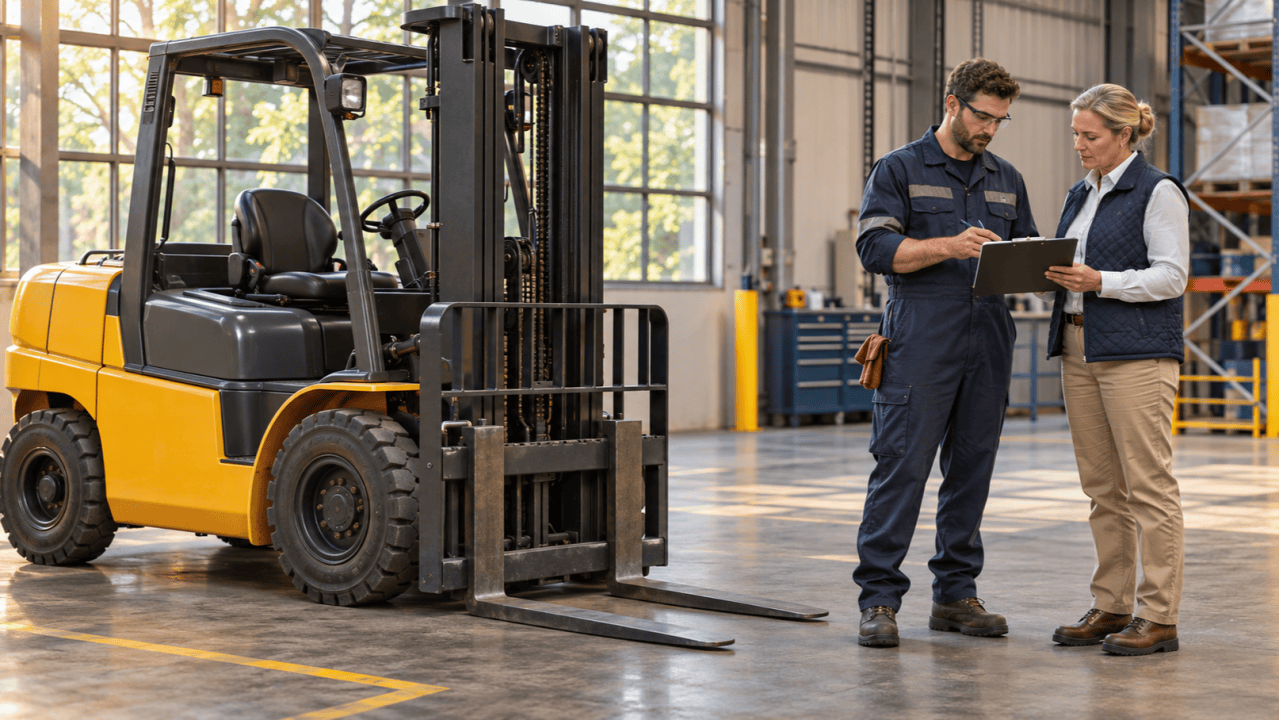
The forklift is down again.
A service technician arrives, finds the immediate problem, makes a repair, and gets the truck back to work. Everyone is relieved because production can keep moving.
A few weeks later, another work order appears. Then another.
The descriptions may not even be identical. One says “hydraulic leak.” Another says “hose damaged.” A third says “oil on floor near mast.” Because the invoices arrive at different times—and perhaps reach different people—nobody connects them.
That’s where your forklift repair history can help. Put those work orders side by side, and a different question emerges:
Are these separate repairs, or could something be causing the same problem to return?
The answer isn’t always obvious. But asking the question can change how you manage downtime, communicate with your service provider, and plan maintenance.
Every forklift needs maintenance. Parts wear out, hoses age, and equipment working in demanding environments eventually needs repairs.
A second repair in the same area doesn’t automatically mean the first technician missed something or installed a bad part. The new issue could be unrelated. The truck could have experienced an impact after the earlier repair. Another component could have developed a similar symptom for a different reason.
Still, repeated work in the same area deserves a closer look. Start by asking:
These details help distinguish a recurring problem from a collection of unrelated events. That distinction matters when you’re deciding what the next service visit should investigate.
A repair invoice usually tells you what was done. It may not capture everything that happened before the technician arrived—or what happened after the truck returned to service.
A useful equipment history connects those pieces. For each service event, record:
You don’t need an elaborate software system to start. A spreadsheet or organized file for each truck can reveal a pattern that’s easy to miss when invoices sit in separate folders.
Imagine a forklift that had a hose replaced in March, another hose repaired in June, and a third service call in September. The dates are useful, but the location and operating hours between events make the history more meaningful.
Was it the exact same hose? A neighboring hose? The same area of the mast? Did the truck work 200 hours between calls or 2,000?
Those answers won’t solve the problem on their own. They give the service team a better starting point.
A forklift can develop a hydraulic leak for more than one reason. The same is true of an electrical fault, a starting complaint, or a truck that doesn’t travel as expected.
Two work orders may use the same words while describing different failures. Likewise, different descriptions may refer to one recurring issue.
Consider an electrical complaint. An operator reports an intermittent warning light. A month later, another operator says a function sometimes stops responding. A third report mentions a fault code.
The reports could be connected, but nobody should assume they are without a proper evaluation. Compare the available evidence: the actual fault messages, the affected function, the conditions when the problem occurred, and the findings from earlier service visits.
A record that says only “fixed electrical problem” makes that comparison difficult. A record that identifies what was inspected, what was found, and what was repaired gives the next technician more to work with.
Good records don’t replace diagnostic skill. They help keep the diagnosis from starting over every time.
When the same area of a forklift keeps needing attention, the failed part is important—but so is the environment around it.
A technician may need to consider whether the component is properly specified and installed, whether nearby parts are damaged, or whether something in the application is contributing to the problem. A hose, for example, may be exposed to movement, contact, debris, and other conditions worth examining if damage repeatedly appears in the same location.
The forklift’s work matters, too. Consider whether it:
Report visible concerns from a safe position and leave detailed inspections and repairs to authorized personnel. Don’t reach into a mast or inspect a pressurized hydraulic system by hand.
The question for the service team is not only “What failed?” It’s also “What evidence might explain why it failed here and now?”
A single truck with repeated problems may point the investigation toward that machine, its configuration, or its assigned work.
A similar issue appearing across several trucks may suggest a different set of questions:
Suppose three trucks serving one loading area develop similar damage while the rest of the fleet does not. That’s a reason to look closely at the route and the work being done there. It isn’t proof that the route caused every failure.
A pattern is a starting point for an investigation. Comparing trucks can help make that investigation more focused and prevent each service call from being treated as an isolated surprise.
Service records are valuable, but they don’t tell you everything.
Operators know which machine is assigned to which job. They may know whether a route changed, whether a particular load is difficult to handle, or whether a problem appeared immediately after the last repair or gradually returned.
Ask what they’ve noticed, and listen without turning the conversation into a search for someone to blame.
An operator might explain that a truck now spends most of its day outdoors, regularly travels across a rough area, or uses a particular function much more often than it did last year. Those details can help the maintenance team understand the demands on the equipment.
Communication should work both ways. When a repair is completed, tell the operator what was addressed and what to report if the symptom returns. That makes the operator part of the follow-up.
When a forklift goes down, the immediate pressure is usually to get it moving again. A truck sitting idle isn’t loading trailers, supplying a production line, or moving material for customers.
But the cost of a repeat problem can extend beyond the repair invoice. It may include another service call, additional parts, lost operating time, a rental, delayed work, or employees rearranging schedules around the missing truck.
For a high-capacity forklift, the operation may not have another machine capable of taking over the same assignment.
Imagine a $1,000 repair that returns a truck to work, followed by two more shutdowns involving a similar concern. Compare that with an investigation that takes additional time and identifies a contributing condition. The second approach may cost more initially while reducing future disruption.
That’s an illustration, not a promise that every investigation will uncover one simple cause. Some problems take time to diagnose, and some repairs are unavoidable. The point is to consider the full cost of repeated downtime when deciding what information the next service visit needs.
A completed work order should explain what was repaired and how the repair was checked. For a recurring complaint, it also helps to agree on what follow-up will look like.
The service team can document its findings, corrective work, and the appropriate verification performed under the manufacturer’s procedures. The operation can then record whether the original concern returns during normal use.
If it does, report the recurrence promptly and connect the new report to the earlier work order. Include the truck identification, date, and operating hours since the repair.
Verification must be appropriate to the truck and performed by authorized personnel. Never deliberately operate an unsafe forklift or repeat a hazardous condition just to see whether a repair worked.
A maintenance history is only as useful as the information going into it.
Under OSHA’s powered industrial truck standard, forklifts must be examined before being placed in service, at least daily, and after each shift when they are used around the clock. Defects found must be immediately reported and corrected.
A truck that needs repair, is defective, or is otherwise unsafe must be taken out of service until it has been restored to safe operating condition. Repairs must be made by authorized personnel.
The daily examination is an opportunity to catch and report a developing concern. The report is most useful when someone reviews it and connects it to the truck’s service history.
A practical process gives the report a clear path: the operator reports the concern, a responsible person reviews it, the truck is removed from service when required, and the service team receives the information. Afterward, the completed work and any follow-up are recorded where the next person can find them.
The next time a familiar truck appears on the service schedule, pull its recent work orders together.
Look at the repair locations, operating hours between visits, conditions reported by operators, and work actually completed. Then ask whether the new concern appears related—or whether the similarity is only in the wording.
You may discover several unrelated issues. You may find an application change worth reviewing. Or you may uncover a recurring condition that has been hiding inside a stack of invoices.
Either way, the next service call can begin with a clearer picture of the truck and a better question than “Can you replace that part again?”
Have questions about a recurring forklift repair? Contact Jason Flaska at Forklift Exchange, Inc., at 630-842-0779 or jasonf@forkliftexchange.com.
• It Starts Fine in the Morning: Why Is My Forklift Losing Power Later in the Day?
• Forklift Forks: What Wear, Cracks, and Uneven Tips Could Be Telling You
Comments are closed