
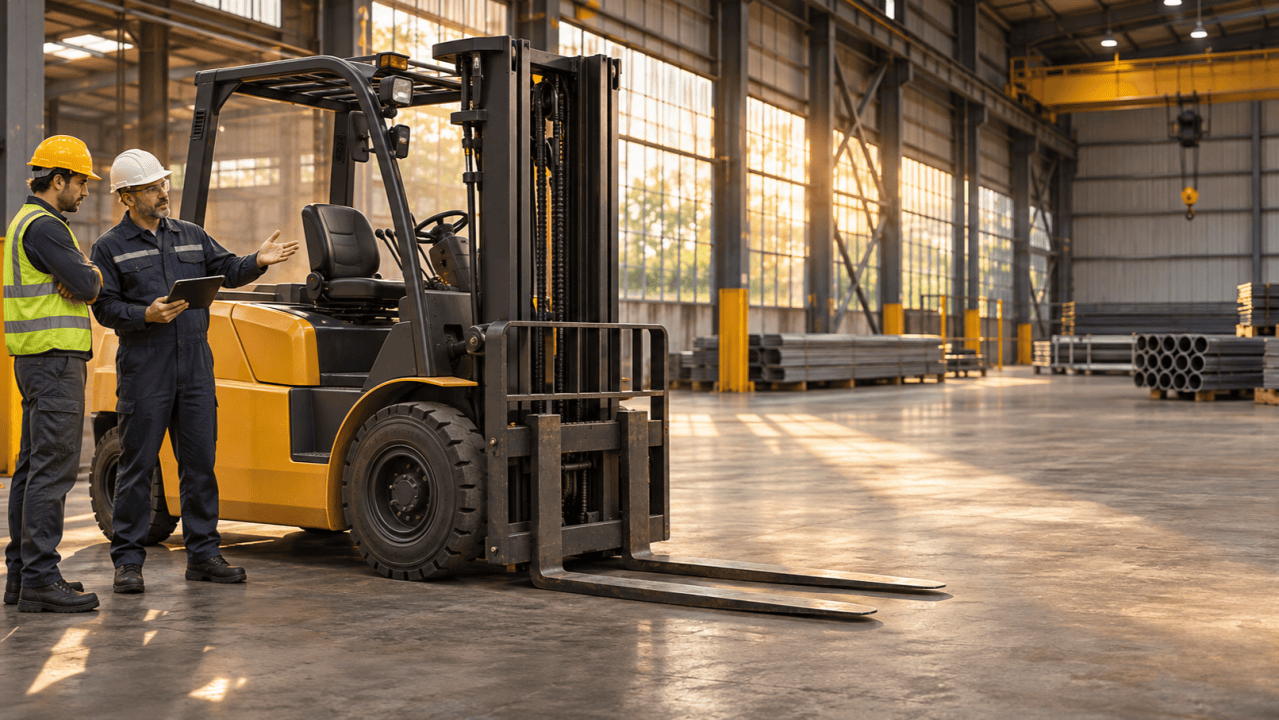
The forklift starts right up at the beginning of the shift.
It drives across the yard, picks up a few loads, and seems ready for another day of work.
A couple of hours later, the operator notices something different. The truck is slower to respond. Maybe it hesitates when moving a load, or the engine doesn’t sound quite the same. By lunch, somebody has said the words every maintenance department has heard before:
“It was working fine this morning.”
That statement can be frustrating, but it’s also useful information. A problem that appears after a forklift has been working for a while can provide clues about what was happening when the trouble began.
The important thing is not to jump straight from “it changed when it warmed up” to “I know exactly what failed.” A forklift has several systems working together, and the description “it loses power” can mean very different things depending on what the operator actually experienced.
Imagine two operators report the same problem: “The forklift lost power.”
The first operator means the engine began running rough and nearly stalled while the truck was traveling. The second means the engine sounded normal, but the truck was slow to move when the accelerator was pressed.
Those may be two very different service calls.
Now add a third operator who says the truck drives normally, but the forks lift more slowly than usual. That changes the conversation again.
Before anyone starts ordering parts, it helps to identify which function changed. Did the engine slow down or run unevenly? Did travel speed change while the engine sounded normal? Did the mast become sluggish? Did the steering feel different? Was there a warning light or an unusual sound?
You don’t need the operator to diagnose the problem. You need them to describe what the forklift did.
That distinction can save a technician time and help keep a small problem from becoming a guessing game involving several expensive components.
Every working forklift produces heat. An internal combustion engine warms up, and depending on the truck, the transmission, hydraulic system, and other components also operate at elevated temperatures.
That alone is normal. A machine that has been working for two hours should not feel exactly like one that has been sitting overnight.
But a noticeable change in performance, a warning indicator, an unusual smell, or a temperature reading outside the manufacturer’s normal range deserves attention. The fact that a problem appears after the machine warms up does not prove the machine is overheating. It tells you when the symptom appeared.
That timing matters. It can help a technician decide what information to gather and which systems to inspect. It does not replace a proper diagnosis.
And if a truck is overheating in a way that creates a hazardous condition, continuing to operate it until the end of the shift is not a maintenance strategy. Safely stop, report the condition, and follow the company’s removal-from-service procedure.
Most operators become familiar with the sound and feel of the truck they use every day. They can often tell when an engine is running differently before anyone else notices.
Maybe it begins to hesitate under load. Maybe it idles unevenly after working for a while. Perhaps it runs normally until it is asked to accelerate, then struggles or stalls.
Those observations can point a technician toward the engine and its supporting systems, but several possible causes may need to be considered. Fuel delivery, air supply, electrical components, sensors, and other parts of the engine system can all be part of an investigation. The right checks depend on the truck, its fuel type, and the actual symptom.
That does not mean the operator should open the engine compartment and start adjusting things. It means the operator should report what changed, when it changed, and whether the truck displayed a warning.
For example, “It starts fine but begins to hesitate after about an hour, especially when accelerating with a load” gives the service team a better starting point than “It needs a fuel filter.”
The first is an observation. The second is a diagnosis that may or may not be correct.
Here’s a different situation. The engine responds when the accelerator is pressed, but the forklift seems slow to move or doesn’t travel the way it normally does.
Depending on the truck’s design, the investigation may include the transmission or another part of the drive system. A technician will need to consider the machine’s configuration and follow the manufacturer’s diagnostic procedures.
This is where an operator’s description becomes particularly valuable. Did the change happen in forward, reverse, or both? Was it noticeable only with a load? Did the truck move differently on an incline? Was there a warning light, a new noise, or a smell?
None of those answers proves that a particular part has failed. Together, though, they help define the problem.
It’s also important not to conduct improvised tests. Trying to force a truck against an object, repeatedly accelerating a machine that is not responding correctly, or attempting a transmission test without authorization can create hazards and may cause damage. Leave diagnostic procedures to trained, authorized service personnel.
Sometimes the complaint has nothing to do with travel speed. The forklift drives across the floor, but lifting or another hydraulic function does not feel right.
The operator might notice the forks lifting more slowly than usual, a function hesitating, or the response changing as the shift goes on. Those are reasons to stop and report the condition, particularly if the truck cannot handle the work safely.
A hydraulic system is more than a pump and a tank of oil. It includes valves, hoses, cylinders, controls, and other components that must work together. Different forklift designs also behave differently, so a symptom that seems familiar on one machine may have a different cause on another.
One temptation is to assume the truck simply needs fluid. Fluid level can be relevant, but guessing at the cause—or adding an unspecified fluid—is not a substitute for inspection. The manufacturer’s instructions determine the correct fluid and checking procedure for the particular machine.
If there is a leak, note where it appears, if that can be done safely, and report it. Don’t use your hands to search for a suspected pressurized hydraulic leak.
A forklift can appear to change as the day goes on because the job changes as the day goes on.
The morning may begin with light loads and short trips. Later, the truck may move heavier material, travel farther, or work continuously in a busier area. A machine that handles one part of the assignment without an obvious complaint may reveal a problem when the demands change.
That’s why “What was the truck doing?” is just as important as “What time did it happen?”
Consider a high-capacity forklift in a steel operation. It might spend the first part of the day repositioning smaller bundles, then move larger material when a delivery arrives. If a problem appears during that second task, the technician needs to know the work has changed.
That does not mean the heavier load caused the problem. It may have made an existing problem easier to notice. It could also mean the application itself needs a closer look.
Either way, the load must remain within the truck’s rated capacity for its configuration and load center. A forklift that struggles with a load should not be pushed harder to “see if it can do it.”
If a forklift develops a condition that makes it unsafe, stop operating it, park it safely according to company procedures, and report the issue. A truck that needs repair, is defective, or is otherwise unsafe must be taken out of service until it is restored to safe operating condition.
Some conditions require particular attention. A fuel-system leak must be corrected before the truck is operated. Report a warning, abnormal noise, unusual vibration, or change in response promptly so the appropriate person can assess it.
The operator’s job is not to determine whether a questionable machine can probably make it through one more load. The operator’s job is to recognize and report a change and follow the site’s safety procedures.
Repairs belong with authorized personnel. They have the information, tools, and procedures needed to investigate without turning the forklift into an experiment.
A useful service report doesn’t have to be long. It does need to be specific.
Start with the truck’s identification and the time or approximate operating hours when the problem appeared. Describe what the machine was doing immediately beforehand: traveling, lifting, turning, idling, or handling a particular load.
Then describe what changed. Did the engine slow down? Did the truck stop moving while the engine continued to respond? Did a hydraulic function become slow? Was there a warning light, noise, vibration, leak, or smell?
It also helps to record whether the symptom has appeared before and whether the truck was recently serviced. If a warning code is displayed, record it as shown rather than clearing it.
A short conversation with the operator can be more valuable than a work order that simply says “forklift weak.” The technician may still need to perform a full diagnosis, but at least they know where the story began.
One of the most frustrating equipment problems is the one that disappears before the technician arrives.
The forklift is parked. It sits for a while. Someone starts it later, and everything seems normal.
That can make the original report easy to dismiss. It can also lead to the truck being put back to work without anyone understanding what happened.
A symptom that temporarily disappears is still worth documenting and evaluating. The service team may need the operator’s description, the machine’s history, and the manufacturer’s diagnostic guidance to determine the next step. If the truck was removed from service because it was unsafe, it should stay out until it has been restored to safe operating condition.
The operator who reported the problem should also hear what was found. Closing that loop builds trust in the inspection process and encourages people to report the next change before it becomes a breakdown.
A forklift that starts the day normally and struggles later isn’t necessarily telling you which part to replace.
It is telling you that something changed.
The most useful response is to pay attention to the timeline: what the machine was doing, which function changed, what the operator noticed, and whether the condition affected safe operation.
That information gives the service team a better chance of finding the cause. It also gives the operation a better chance of addressing the problem before a truck stops in the middle of a busy yard with a load everyone was waiting for.
Because “it was working fine this morning” may be the beginning of the story—not the end of the explanation.
Jason Flaska, Forklift Exchange, Inc. 630-842-0779 jasonf@forkliftexchange.com
• Forklift Forks: What Wear, Cracks, and Uneven Tips Could Be Telling You
• Forklift Tire Wear Patterns: 7 Warning Signs to Know
• Forklift Overloading: 7 Warning Signs Your Truck May Be Over Capacity
Comments are closed