
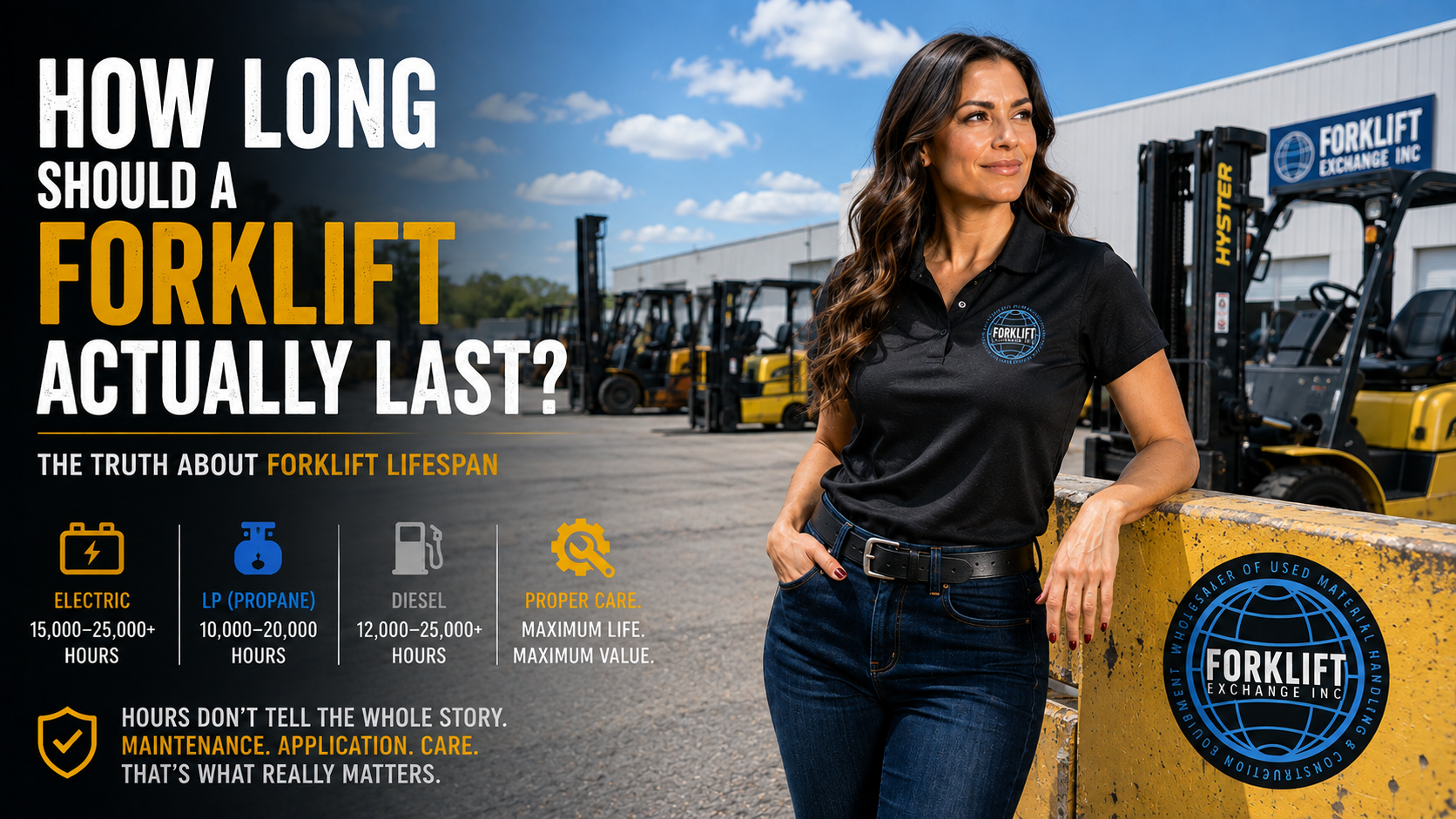
One of the most common questions I hear is “is that a lot of hours?” It’s a fair question, but it’s also one of the hardest to answer with a binary answer. I’ve seen forklifts with more than 30,000 hours still working every day, and I’ve seen machines with fewer than 3,000 hours that were ready for the scrapyard. The truth is that a forklift’s lifespan depends far more on how it was used, maintained, and matched to the application than the number on the hour meter.
After more than 20 years in the forklift industry, here’s how I explain it to customers.
Most people compare forklift hours to miles on a car. That’s a good starting point, but it isn’t the whole story.
Imagine two pickup trucks:
Both may have 100,000 miles, but they’re in completely different condition. Forklifts are no different.
While every application is different, these are reasonable expectations for well-maintained equipment.
| Forklift Type | Typical Life Expectancy |
| Electric | 15,000–25,000+ hours |
| LP (Propane) | 10,000–20,000 hours |
| Diesel | 12,000–25,000+ hours |
| High-Capacity Forklifts | Often rebuilt multiple times and can exceed 30,000 hours |
Notice the overlap. Maintenance often matters more than fuel type.
Modern AC electric forklifts are incredibly durable and can be easier to maintain due to the fact that they have fewer moving parts, no engine oil, no transmission clutches, and less vibration. Many electric forklifts actually outlast comparable internal combustion trucks.
The biggest wear item is often the battery.
A quality industrial battery may last approximately 1,500–2,000 charge cycles or 6 – 10 years, but can sometimes last even longer with proper watering and maintenance. When the battery reaches the end of its life, the forklift itself often has many productive years remaining.
LP forklifts remain one of the most versatile machines in the industry.
They’re ideal for indoor/outdoor use, multiple shifts, quick refueling, and overall general manufacturing. Like any engine-powered equipment, longevity depends heavily on routine maintenance.
Regular servicing of engine oil, cooling system, ignition components, transmission & hydraulic system can dramatically extend service life.
Diesel forklifts are built for demanding applications.
You’ll commonly find them in:
Properly maintained diesel engines can operate for decades. Many high-capacity diesel forklifts undergo multiple engine rebuilds throughout their working lives, extending this type of forklift’s lifespan.
They’re designed for:
This is where my experience has been especially valuable. High-capacity forklifts are often treated more like construction equipment than warehouse equipment.
These machines frequently receive engine, transmission & full mast rebuilds, as well as hydraulic overhauls and axle repairs. Instead of replacing the entire machine, owners often rebuild major components and continue operating the truck for many more years. I’ve seen properly maintained heavy-capacity forklifts exceed 30,000 hours and remain productive.
Many buyers assume a forklift lifespan has reached the end simply because it has high hours. That’s rarely true.
A forklift reaches the end of its economic life when:
Notice that hours aren’t on that list.
This is one of the most important conversations I have with customers.
Generally speaking, rebuilding makes sense when:
Replacement becomes the better option when:
Sometimes rebuilding saves tens of thousands of dollars. Sometimes replacement is the smarter investment. Every situation is different.
Consider these examples.
A forklift running one shift on smooth concrete floors in a clean environment may accumulate 15,000 hours with relatively little wear.
Now compare that to a forklift working outside in the heat and dust, moving heavy loads with multiple shifts per day. Those same 15,000 hours represent a much harder life.
The application tells the real story.
When evaluating a used forklift, I care more about:
The hour meter is just one piece of the puzzle.
People often ask me, “How long should a forklift lifespan last?”
My answer is always the same: If well-maintained, a forklift lifespan should last as long as it continues to safely and economically perform the job you need it to do.
I’ve seen older forklifts outperform newer ones simply because they were maintained correctly and matched to the right application. Buying (or keeping) the right forklift isn’t about chasing the lowest hours. It’s about understanding the machine’s condition, maintenance history, and the work you expect it to perform.
Special Note: If you’re still reading, like and share. It’s appreciated. At Forklift Exchange, we help customers determine whether new, used, refurbished, or rebuilt equipment makes the most sense for their application. If you’re evaluating whether to repair, rebuild, or replace your forklift, I’d be happy to help you weigh the options.
Jason Flaska
Forklift Exchange, Inc.
📞 630-842-0779
📧 jasonf@forkliftexchange.com
#HighCapacityForklifts #HeavyLifting #Rigging #MachineryMoving #SteelCoilHandling #BulkMaterialHandling #SteelCoilHandling #Transloading #MachineryMovingAndRigging #HighCapacityForklifts #HoistMaterialHandling #HoistForklifts
Check out some of my other Articles…
Comments are closed