
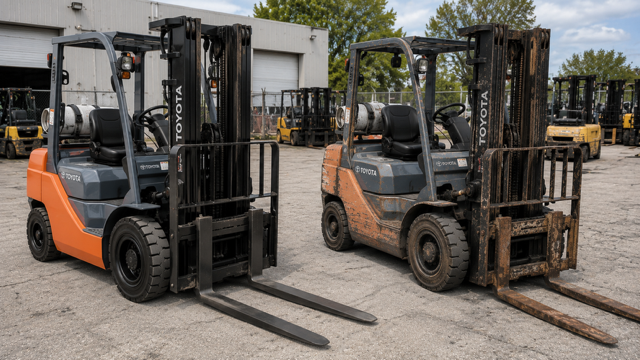
What Makes One Used Forklift Worth $12,000 and Another Worth $22,000?
Two forklifts can have the same capacity, the same fuel type, and even similar hours, yet sell for dramatically different prices. To someone looking at a few online listings, that difference can seem arbitrary. It usually is not.
Used forklift value is built from a combination of condition, specification, history, and market demand. The hour meter matters, but it is only one part of the story. A well-maintained 8,000-hour forklift can be a far better purchase than a neglected 3,000-hour machine.
Here are the factors that most often explain why one forklift is worth $12,000 while another is worth $22,000.
1. Previous Application Matters More Than Many Buyers Realize
A forklift that spent its life in a clean, dry warehouse usually ages very differently from one that worked outdoors, in a scrapyard, around salt, or in a heavy manufacturing plant.
Indoor use generally means less corrosion, cleaner electrical systems, and reduced exposure to weather. Outdoor work can be perfectly acceptable, but the machine should be evaluated for rust, water intrusion, tire wear, and damage from rough surfaces.
The type of load matters too. A forklift handling light palletized product may have had an easier life than one carrying steel, paper rolls, concrete products, or heavy attachments every shift.
2. Maintenance History Can Add Thousands of Dollars in Value
A documented maintenance history gives a buyer confidence. Service records can show regular oil changes, cooling-system work, brake repairs, transmission service, and replacement of wear items before they caused larger failures.
A machine with no records is not automatically a bad forklift, but it creates uncertainty. Buyers and dealers usually account for that uncertainty in the price.
Clean fluids, properly operating hydraulics, a cool-running engine, and evidence of consistent preventive maintenance can be more important than a low hour reading by itself.
3. Hours Matter, but They Do Not Tell the Whole Story
Hour meters are useful, but they should never be treated as the only measure of value. Some forklifts idle for long periods, while others accumulate hours through constant productive work. Meter replacements and broken hour meters can also make the displayed number less reliable.
How the forklift starts, shifts, steers, lifts, tilts, brakes, and performs under load tells a more complete story. Condition should support the hours shown on the meter.
4. Mast, Lift Height, and Attachments Change the Market
Two forklifts with the same basic capacity can serve very different customers. A standard mast may be ideal for one warehouse but unusable for a facility that needs a higher lift or a lower collapsed height.
Side shifters, fork positioners, paper-roll clamps, push-pulls, rotators, and specialized carriages can add value when they match the buyer’s application. They can also narrow the buyer pool when they are highly specialized.
A common, desirable specification usually sells faster and for more money than a configuration that only works in a limited number of applications.
5. Tires, Forks, and Wear Items Affect the Real Purchase Price
A forklift may look inexpensive until the buyer realizes it needs tires, forks, brakes, chains, and hydraulic repairs immediately.
Large solid pneumatic tires, high-capacity forks, and specialty components can be expensive. Buyers naturally pay more for a machine that can go directly to work without a large first round of repairs.
Fork thickness, heel wear, chain condition, mast rollers, carriage play, and tire condition should all be considered when comparing prices.
6. Brand, Parts Support, and Resale Demand Matter
Brand recognition affects used forklift value because buyers think beyond the initial purchase. They want to know whether local technicians can service the machine, whether parts are available, and whether the forklift will still have resale value several years later.
Popular brands with strong parts and service support often command higher prices. A lesser-known machine can still be a good value, but the price should reflect the support network and future resale market.
7. Appearance Does Not Replace Mechanical Condition, but It Still Matters
Paint does not make a forklift mechanically sound. At the same time, a clean machine often suggests that the previous owner cared about the equipment.
Buyers should distinguish between honest cosmetic wear and signs of deeper neglect. Scratches, faded paint, and worn decals are normal on used equipment. Bent panels, heavy corrosion, leaking cylinders, cracked welds, and poorly completed repairs deserve closer attention.
A professionally refurbished forklift can justify a higher price when the work goes beyond paint and includes mechanical repairs, safety items, tires, hoses, seals, and a documented inspection.
How to Compare Two Used Forklifts Fairly
When comparing machines, do not compare asking prices alone. Compare what it will cost to put each forklift into dependable service.
Purchase price and freight
Immediate repairs and deferred maintenance
Tires, forks, battery, or attachments
Expected downtime and parts availability
Remaining useful life and future resale value
A $12,000 forklift that immediately needs $8,000 in work may be more expensive than a $22,000 machine that is ready to operate. The better value is the machine with the lowest realistic cost over the time you plan to own it.
The Bottom Line
Used forklift pricing is not an exact science, but it is not random either. Application, maintenance, hours, specifications, wear items, brand support, and overall condition all influence value.
The best purchase is not always the cheapest forklift, and the most expensive machine is not automatically the best one. The goal is to understand what you are paying for and whether the forklift fits your operation.
At Forklift Exchange, we help customers determine whether new, used, refurbished, or rebuilt equipment makes the most sense for their application. If you are planning a purchase and would like a second opinion, I would be happy to discuss your options.
About the Author
Gene Bayer
National Account Manager
Forklift Exchange, Inc.
Phone: 847-707-1316
Email: gbayer@forkliftexchange.com
Comments are closed