
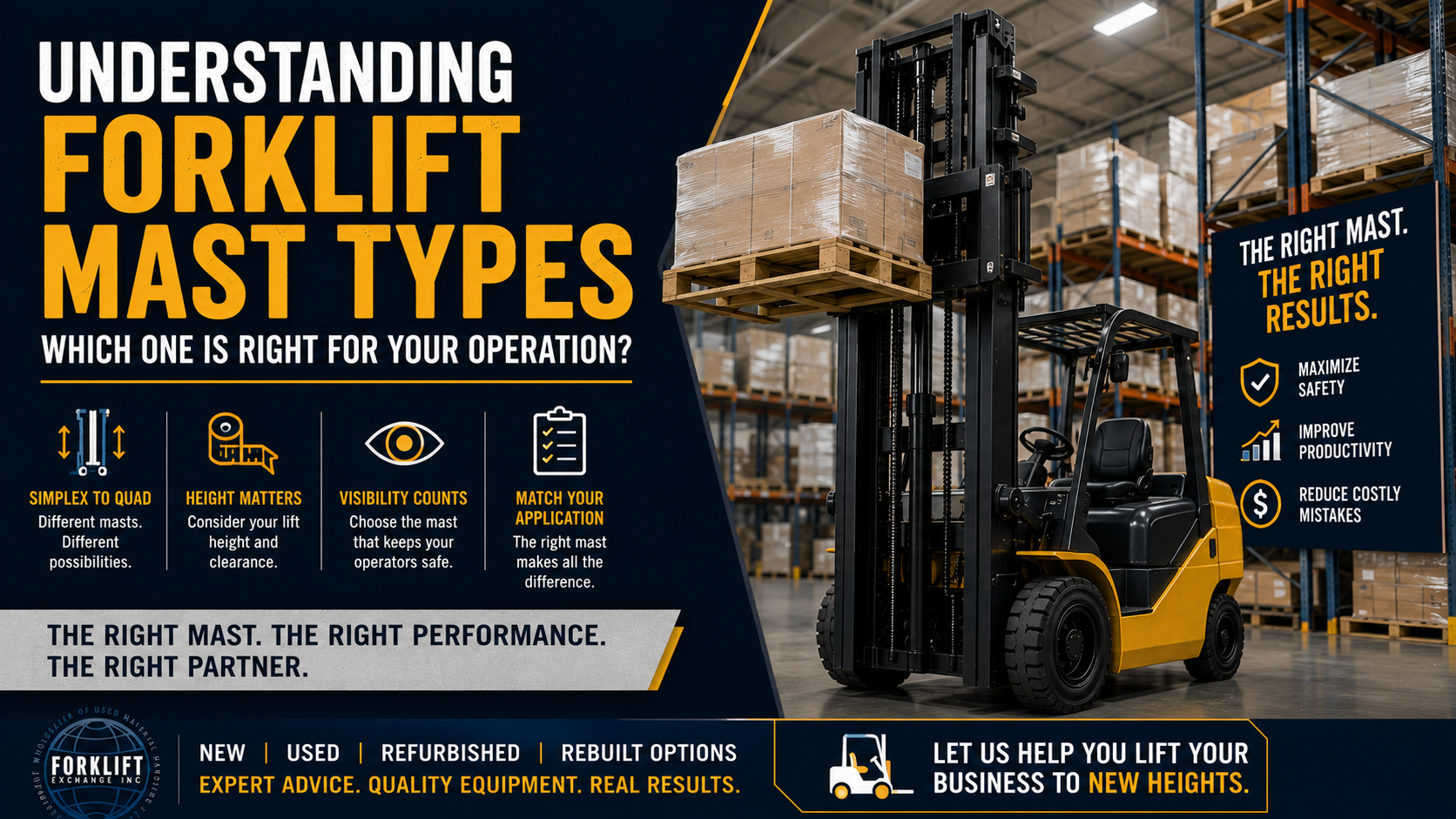
Forklift mast types can affect nearly every part of your material-handling operation, from the height you can reach to the doorways your equipment can clear. Choosing the wrong mast may prevent a forklift from reaching your highest racks, entering trailers, or moving safely through your facility.
Capacity, fuel type, tire type, and price are all important when selecting a forklift. However, the mast deserves just as much attention. Its design influences lift height, lowered height, visibility, maintenance needs, and the types of loads the truck can handle efficiently.
This guide compares the four primary forklift mast types and explains free lift, mast measurements, attachment considerations, and the questions you should answer before selecting a configuration.
The mast is the vertical assembly at the front of a forklift that raises, lowers, and positions the carriage and forks. It typically includes steel channels, hydraulic cylinders, lift chains, and rollers.
A mast may contain one, two, three, or four telescoping sections. These sections are commonly called stages. Adding stages can provide more lift height while allowing the mast to collapse into a relatively compact lowered profile.
The four most common configurations are:
The best configuration depends on where the forklift will operate, how high it must lift, and the clearances it must pass beneath.
A simplex mast has one fixed outer section and provides the lowest lift height of the four principal forklift mast types. Its straightforward construction generally offers excellent forward visibility and fewer moving components.
A simplex mast can be a practical choice for:
If your team rarely raises materials above approximately 8 to 10 feet, a simplex mast may provide all the reach you need without unnecessary complexity.
A duplex mast has two stages and provides more lift height than a simplex mast while retaining a comparatively compact design. Some duplex masts also include full free lift, allowing the forks to rise before the mast extends above its lowered height.
Duplex forklift mast types are frequently suited to:
A duplex mast may be the right middle ground when a simplex does not reach high enough but a three- or four-stage mast is unnecessary.
A triplex mast uses three stages. It provides substantial lift height while collapsing to a height that can fit through many conventional warehouse doors.
This combination makes the triplex one of the most versatile forklift mast types for warehouse and distribution environments.
Triplex masts are often used in:
A triplex mast is often a strong choice when the forklift must travel through standard openings and then place loads on higher racks. However, the additional channels, chains, and hydraulic components can affect forward visibility compared with a simpler mast.
A quad mast has four stages and is designed to reach exceptionally high storage positions while retaining a manageable lowered height.
Among the primary forklift mast types, the quad offers the greatest potential lift height. That capability comes with additional moving parts and a more restricted view through the mast.
Before choosing a quad mast, account for:
Quad masts are generally best suited to:
Only choose a quad mast when the application genuinely requires it. More lift height is not automatically better if it adds cost and complexity without improving the operation.
Free lift is the distance the forks can rise before the mast’s overall height begins to increase. This capability is especially important when a forklift must raise a load beneath a low ceiling.
Full free lift can help when operating inside:
Without enough free lift, the upper mast section may contact the ceiling before the operator can raise the forks sufficiently to stack or remove a load.
Free lift is not determined solely by the number of mast stages. Confirm the actual free-lift specification for the forklift you are considering.
Two mast measurements are especially important when comparing forklifts.
Collapsed height—also called lowered mast height—is the height of the mast when it is fully lowered. This measurement determines whether the forklift can pass through doorways, dock openings, trailers, and other overhead restrictions.
Measure the lowest opening along the forklift’s entire operating route. A mast that clears the storage area but cannot pass through a doorway will not work for the application.
Maximum fork height is the highest position the forks can reach. Your required height should be based on the highest load position, not simply the height of the rack.
Allow sufficient clearance to lift the pallet above its supporting beam before placing or removing it. OSHA also advises operators to consider the forklift’s overall raised height and rated capacity at the highest stacking positions.
As mast stages are added, more steel channels, hoses, cylinders, and chains may enter the operator’s line of sight. Modern designs can improve visibility, but mast configuration still makes a meaningful difference.
Visibility is especially important when:
Choose enough mast to satisfy the application without adding stages the operation does not need. Operators should use a spotter or travel with the load trailing whenever the load or mast prevents a clear view.
Attachments can change the forklift’s load center, weight distribution, visibility, and usable capacity. Common examples include:
The forklift, mast, carriage, attachment, and load must be evaluated as a complete system. Do not rely only on the truck’s original base capacity.
The forklift data plate should reflect the installed attachment and approved capacity. OSHA explains that attachments generally reduce capacity and that operators must follow the ratings shown on the truck’s data plate. Review OSHA’s forklift nameplate guidance when evaluating a forklift-and-attachment combination.
Before selecting among the available forklift mast types, answer these questions:
Record actual measurements instead of relying on estimates. Include door frames, lights, pipes, sprinklers, rack beams, trailer roofs, and other potential obstructions.
The best mast is the configuration that reaches the required height, clears every overhead restriction, maintains the necessary capacity, and supports safe visibility.
In general:
Mast selection should always be based on the complete application—not lift height alone.
Forklift Exchange helps businesses match new, used, refurbished, and rebuilt equipment to their loads, facilities, and operating requirements. Browse our available forklifts or contact our team for help comparing mast configurations.
The right mast can prevent expensive clearance problems, improve productivity, and help your forklift perform reliably for years.
Jason Flaska Forklift Exchange 📞 630-842-0779 📧 jasonf@forkliftexchange.com
#UsedForklifts #ForkliftInspection #MaterialHandling #WarehouseOperations #IndustrialEquipment #ForkliftMaintenance #ForkliftExchange
Comments are closed