
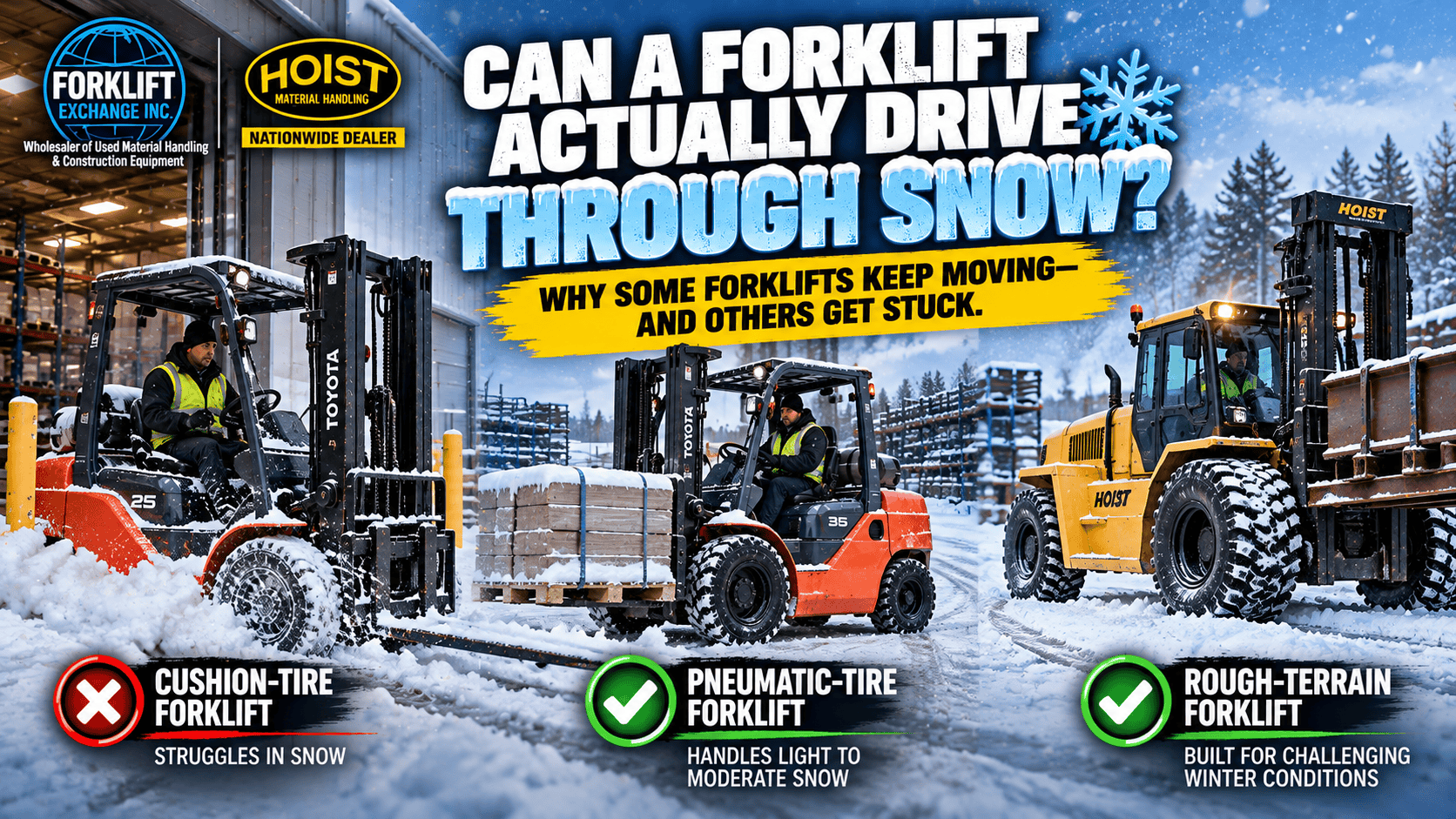
Can a forklift drive through snow? Some forklifts can operate in snowy conditions, but suitability depends on the machine, tires, ground clearance, load, and operating surface. A forklift designed for outdoor work may handle certain winter conditions, while a cushion-tire warehouse forklift can quickly lose traction or become stuck.
Even an outdoor forklift needs a properly maintained route. Snow can hide potholes, debris, and ice, and having enough traction to move does not guarantee enough traction to steer or stop.
Before sending equipment outside, assess the conditions and follow the forklift manufacturer’s operating instructions. These seven considerations can help you evaluate winter forklift operation.
Tire selection is one of the biggest differences between a forklift suited to warehouse floors and one configured for outdoor work.
Cushion tires are generally designed for smooth, improved surfaces. Their compact profile helps forklifts maneuver in warehouses and manufacturing facilities.
However, many cushion-tire forklifts have limited ground clearance and tire designs poorly suited to snow-covered yards. A machine that performs well indoors may struggle just beyond the overhead door.
Pneumatic-tire forklifts are generally better suited to outdoor applications. Depending on the model, they may offer larger tires, more substantial tread, and greater ground clearance.
Some use air-filled tires; others use solid pneumatic-style tires. Neither construction automatically provides suitable winter traction. Tread pattern, rubber compound, tire condition, and the underlying surface all matter.
Have your forklift dealer and tire supplier evaluate the specific application before changing tire configurations.
The practical question is more than “Can a forklift drive through snow?” It is whether the route allows the operator to maintain control throughout the job.
Fresh snow, packed snow, and ice create different challenges:
Clear designated travel routes and loading areas before work begins. Treat slippery surfaces using methods appropriate for the site, and reassess conditions as temperatures change.
OSHA’s guidance on forklift operating surfaces identifies snow and ice as tipover hazards and recommends avoiding hazardous surfaces where feasible.
If the route cannot be made suitable for the equipment and task, suspend the operation.
Good tires cannot compensate for inadequate clearance.
A low-clearance forklift may begin pushing snow with its undercarriage. Deep snow also increases resistance and can prevent the operator from seeing hazards beneath the machine.
There is no universal snow-depth limit that applies to every forklift. Suitability depends on the model, configuration, snow conditions, and surface underneath.
Before operating, evaluate:
Inspect the route before moving materials. Do not assume yesterday’s travel path remains suitable after an overnight freeze or snowfall.
A heavy forklift can still lose traction.
Weight alone does not establish that a forklift can drive through snow safely. Once traction is lost, a heavy machine can become difficult to stop or control.
Many conventional counterbalanced forklifts use front-wheel drive and rear-wheel steering. The rear of the truck swings outward during turns, which makes adequate clearance and controlled movement especially important.
Some rough-terrain forklifts offer four-wheel drive. That may help appropriately configured equipment move in certain conditions, but it does not eliminate sliding, braking, or stability hazards.
Choose equipment for the complete task: traveling, turning, stopping, lifting, and placing the load.
Winter readiness involves more than tires.
Complete the required pre-operation inspection and follow the manufacturer’s cold-weather procedures. Pay attention to brakes, steering, tires, lights, visibility, leaks, and hydraulic response. Where fitted, check wipers, defrosters, and cab heating.
For air-filled tires, check pressure against the manufacturer’s specifications. For electric equipment, follow the battery manufacturer’s temperature limits and charging instructions.
Our forklift winterization checklist covers preparation in more detail. You can also learn how cold weather affects forklift performance.
Operators also need training appropriate to the equipment and workplace conditions. Winter clothing should provide protection while allowing clear visibility and effective use of the controls.
Can a forklift drive through snow while carrying a load? Potentially, but load handling introduces additional stability and control considerations.
The load must remain within the truck’s rated capacity for its configuration and load center. Keep it stable, secure, and at the manufacturer’s recommended travel position.
During winter operation:
Do not add an improvised load or ballast to improve grip. Use tire chains or other traction aids only when approved for the specific forklift and application.
Spinning the tires or repeatedly rocking the truck can worsen a traction problem. Improvised towing can create additional hazards.
If a forklift becomes stuck, stop the operation, secure the area, and follow the manufacturer’s recovery instructions. Qualified personnel should assess the machine, surface, load, and recovery equipment before attempting to move it.
Never assume another forklift can safely pull it free.
This becomes especially important with high-capacity equipment. A forklift’s lifting capacity does not establish its suitability for towing or recovering another machine.
Use this comparison as a starting point when discussing your application with an equipment specialist.
| Forklift type | Winter considerations |
|---|---|
| Cushion-tire warehouse forklift | Generally poorly suited to snow-covered yards; evaluate its intended surface and clearance limits. |
| Air-filled pneumatic-tire forklift | Often suited to outdoor work, but winter performance depends on tires, conditions, and configuration. |
| Solid pneumatic-tire forklift | Can serve outdoor industrial applications; snow and ice traction varies by tire design. |
| Rough-terrain forklift | Designed for challenging outdoor surfaces; features vary, and winter hazards still apply. |
| High-capacity pneumatic forklift | May suit heavy outdoor handling when properly configured and used on suitable surfaces. |
| High-capacity cushion forklift | Evaluate its intended improved-surface application carefully before considering winter yard work. |
No category guarantees safe operation on snow or ice.
Some forklifts with solid pneumatic-style tires may be suitable for certain snowy outdoor conditions. Conventional cushion tires are a different design and are generally poorly suited to snow-covered yards. Confirm the specific tire and forklift configuration with your dealer.
There is no single safe depth for every forklift. Ground clearance, tire design, snow density, hidden obstacles, and manufacturer limits determine whether the route is suitable. Clear the route before operating.
Traction chains may be available for certain machines. Confirm manufacturer approval, tire compatibility, clearance, and application requirements before installation.
Some electric forklifts are configured for outdoor or cold-environment use. Verify the truck’s environmental suitability, battery temperature limits, tire configuration, and manufacturer instructions.
So, can a forklift drive through snow? Some can, when the equipment, route, and conditions are suitable. The right decision starts with evaluating the entire application.
At Forklift Exchange, we work with conventional warehouse forklifts and specialized high-capacity cushion- and pneumatic-tire equipment.
Whether you handle pallets, steel, or heavy machinery, we can help evaluate equipment options for your operating environment.
Browse our forklift inventory or contact Forklift Exchange to discuss your application.
Jason Flaska
Forklift Exchange
Phone: 630-842-0779
Email: jasonf@forkliftexchange.com
Comments are closed