
(NOTE: Don’t want to read the whole article? There’s a condensed checklist at the end you can skip too!)
Every year, the first real cold snap seems to expose the same problems. Knowing how to winterize a forklift before temperatures drop can help prevent cold-weather starting problems, battery failures, sluggish hydraulics, tire issues, and unnecessary downtime. A forklift that started perfectly in September suddenly won’t start. Hydraulics feel sluggish. An older battery that seemed fine all summer struggles to crank the engine. A small coolant leak becomes a bigger problem. Tires that worked fine on dry pavement suddenly have very little traction. And the forklift that everyone assumed was “ready for winter” turns out not to be ready at all.
Cold weather doesn’t necessarily create every one of these problems. Often, it exposes weaknesses that were already there. That’s why fall is a good time to inspect your forklift fleet before temperatures really drop. Whether you’re operating electric, LPG, or diesel forklifts, here’s a practical checklist for getting your equipment ready for winter.
If I were preparing an internal-combustion forklift for winter, the battery would be one of the first things I’d check. Cold temperatures are hard on batteries. At the same time, a cold engine can be more difficult to crank. That’s a bad combination for a battery that’s already nearing the end of its life.
Before winter, inspect:
If the forklift has been getting progressively slower to crank, don’t ignore it because it still starts. That may change on the first truly cold morning.
Electric forklifts deserve special attention as well.
Battery performance and charging behavior can be affected by temperature, and applications involving freezers, cold-storage facilities, or trucks repeatedly moving between warm and cold environments require additional consideration.
Lead-acid and lithium-ion batteries also have different operating and charging requirements. Follow the battery and forklift manufacturer’s temperature and charging recommendations rather than assuming every electric forklift should be treated the same way.
The cooling system is easy to associate with summer overheating. It’s just as important during winter. An internal-combustion forklift operating in freezing temperatures needs the proper coolant mixture and freeze protection.
Before winter, inspect:
A hose that’s already cracked or deteriorated isn’t going to improve because it’s December. Neither is a leaking radiator. And don’t assume that because there’s liquid in the cooling system, it has adequate freeze protection.
Test it.
Oil becomes more viscous as temperatures fall. The correct engine oil specification is important for lubrication and cold-weather starting. This doesn’t mean you should simply switch every forklift to thinner oil for winter. Engine requirements vary. Use the viscosity and specification recommended by the engine or forklift manufacturer for the temperatures in which the machine will operate.
This is also a good opportunity to check:
If the truck is overdue for an oil change heading into winter, now is a good time to address it.
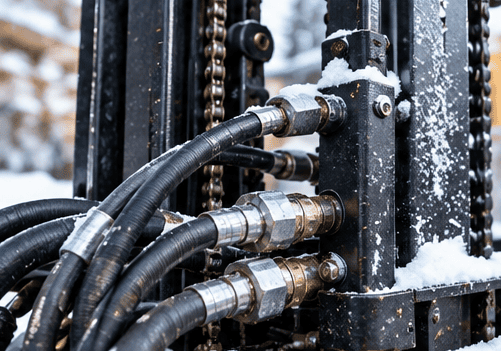
Have you ever started a forklift on a very cold morning and noticed that the hydraulics seem slower than usual? There’s a reason. Hydraulic oil becomes more viscous as temperature drops. That can make hydraulic functions feel sluggish until the system reaches operating temperature.
Before winter, inspect:
And make sure the hydraulic fluid being used is appropriate for the forklift and its operating environment. Don’t automatically change hydraulic oil viscosity because winter is coming. Use the manufacturer’s specifications. The wrong fluid can create a different set of problems.
One of the worst things you can do with certain equipment is start it on an extremely cold morning and immediately demand maximum performance. Allow the machine to stabilize according to the manufacturer’s recommended cold-start procedure. For an internal-combustion forklift, that may include allowing the engine and fluids appropriate time to circulate before placing the machine under heavy load. Hydraulic functions should also be operated appropriately rather than immediately demanding maximum speed and pressure from a system full of very cold oil.
That doesn’t mean every forklift needs to sit idling for half an hour. It means don’t treat a machine that’s been sitting outside overnight at 10°F exactly like one that’s been operating inside a 70°F warehouse all morning.
Propane forklifts are extremely common, particularly in applications where trucks move between indoor and outdoor environments. Winter is a good time to inspect the LPG system carefully.
Look at:
An LPG system depends on proper fuel delivery and vaporization. Cold-weather problems can make an existing fuel-system issue much more noticeable. If a forklift begins starting poorly, losing power or developing fuel-system symptoms as temperatures drop, don’t automatically assume “that’s just what propane forklifts do in winter.” There may be an underlying problem that needs attention.
Diesel equipment has several additional cold-weather considerations. Before winter, inspect the fuel system and make sure maintenance is current.
Pay attention to:
Water contamination is especially worth watching. Condensation and water in the fuel system can create problems that become much more obvious once temperatures fall below freezing. In very cold climates, fuel selection and cold-flow characteristics also matter. Follow the engine manufacturer’s fuel recommendations for your operating temperature.
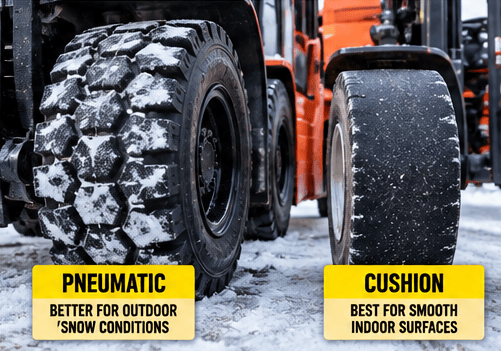
This one gets overlooked. A forklift tire that works perfectly on a smooth warehouse floor may be completely inappropriate for snow, ice, or an outdoor yard.
Before winter, inspect:
Pneumatic tire pressure changes with temperature, so trucks equipped with air-filled tires deserve additional attention when temperatures fall.
Cushion tires are excellent for the applications they’re designed for: generally smooth, improved indoor surfaces and tight operating environments. Snow-covered outdoor yards are a different story.
Pneumatic-style tires generally provide better suitability for rough outdoor environments, but having tread doesn’t make a forklift immune to ice. A heavy forklift can still slide, and a sliding forklift carrying a load is something you want to avoid.
Winter operation isn’t just a traction issue. It’s a stability issue. A forklift’s ability to stop, steer, and remain stable can change dramatically on:
Operators need to adjust speed and driving behavior accordingly. Particular attention should be paid to dock areas and transitions between indoor and outdoor surfaces. Snow can also hide things. A pothole that’s obvious in July can disappear under two inches of snow in January. The forklift still finds it.
You want the braking system working properly year-round. Winter simply gives you fewer margins for error. Inspect the service brakes and parking brake before winter operation becomes routine. If the truck pulls, doesn’t stop properly, has an ineffective parking brake or exhibits other braking problems, address them.
And remember, good brakes don’t create good traction. Even a properly functioning braking system cannot overcome a slippery operating surface.
The lifting system deserves its normal inspection regardless of season. Before winter, inspect appropriate components such as:
Use lubricants specified for the machine and expected operating temperatures. Also keep the mast and carriage reasonably free from accumulated snow, ice, and debris. Never assume a frozen or obstructed component will simply “break itself loose” once the operator starts working.
Winter doesn’t eliminate the normal rules of forklift inspection.
Check the forks for:
If you’re operating outdoors, ice and snow can also affect how a load sits on the forks. Operators should make sure loads are stable and properly positioned before traveling.
Winter creates some of the worst visibility conditions forklift operators encounter. Dark mornings, early sunsets, snow, fog, dirty windshields, condensation, & road salt that dries on the windshield.
Make sure the truck’s visibility equipment is working properly.
Check:
A heated cab isn’t just about operator comfort. Being able to keep the windshield clear can directly affect safe operation.
This is especially relevant when forklifts repeatedly move between very different temperatures. Imagine a truck operating outside in freezing conditions and then entering a warm, humid building. Or an electric forklift moving in and out of a freezer application.
Temperature changes can contribute to condensation. Moisture and electrical components are generally not a combination you want to ignore. Applications involving repeated temperature transitions should follow the manufacturer’s recommendations regarding electrical equipment, batteries, connectors, and charging.
Where does the forklift spend the night?
Inside a heated building? Inside an unheated building? Under a canopy? Or completely outside? A forklift that’s stored indoors faces a very different winter environment from one sitting outside through snow, wind and sub-zero temperatures. Whenever practical, protecting equipment from the elements can reduce winter-related headaches.
If outdoor storage is unavoidable, consider the machine manufacturer’s recommendations regarding:
And before starting a snow-covered machine, inspect it. Don’t simply brush enough snow off the seat to sit down and go.
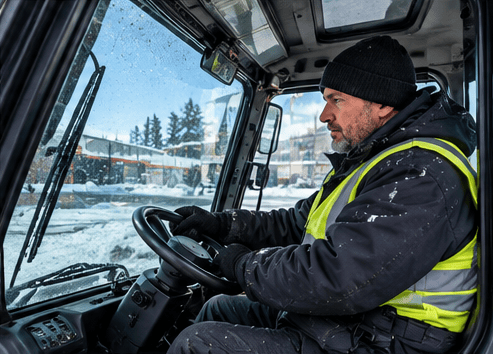
We spend a lot of time talking about the forklift. The operator is working in the same environment. Cold temperatures, bulky clothing, gloves, snow, and reduced visibility can affect how someone interacts with the machine.
Winter PPE should keep the operator warm without interfering with:
Footwear matters too. Snow and ice carried onto steps, pedals and operator compartments can create slip hazards. Keep access steps and grab points clean.
This sounds backward, but winter can be extremely hard on equipment surfaces. If a forklift operates around road salt, deicing chemicals, slush, or corrosive material, regular cleaning becomes important.
Pay attention to areas where material accumulates. The objective isn’t to create a showroom-ready forklift every Friday. It’s to prevent corrosive material from sitting on the truck for months. Just be careful about washing equipment in freezing temperatures and follow proper procedures for the machine and facility.
Turning yesterday’s road salt into tomorrow morning’s sheet of ice isn’t much of an improvement.
This may be the most important item on the entire list.
If your forklift already has:
Winter probably isn’t going to make any of those things better.
Cold weather has a way of turning “We should probably look at that.” Into, “Why isn’t the forklift starting?” That’s why the best time to winterize a forklift isn’t during the first snowstorm. It’s before it.
If you want the condensed version, here it is:
At Forklift Exchange, we work with forklifts ranging from everyday warehouse equipment to high-capacity industrial machines. Whether you’re preparing an existing fleet for winter, replacing an aging forklift or trying to determine the right machine for an indoor/outdoor application, we’re always happy to help.
Jason Flaska
Forklift Exchange
📞 630-842-0779
📧 jasonf@forkliftexchange.com
Visit some of my other articles
Comments are closed