
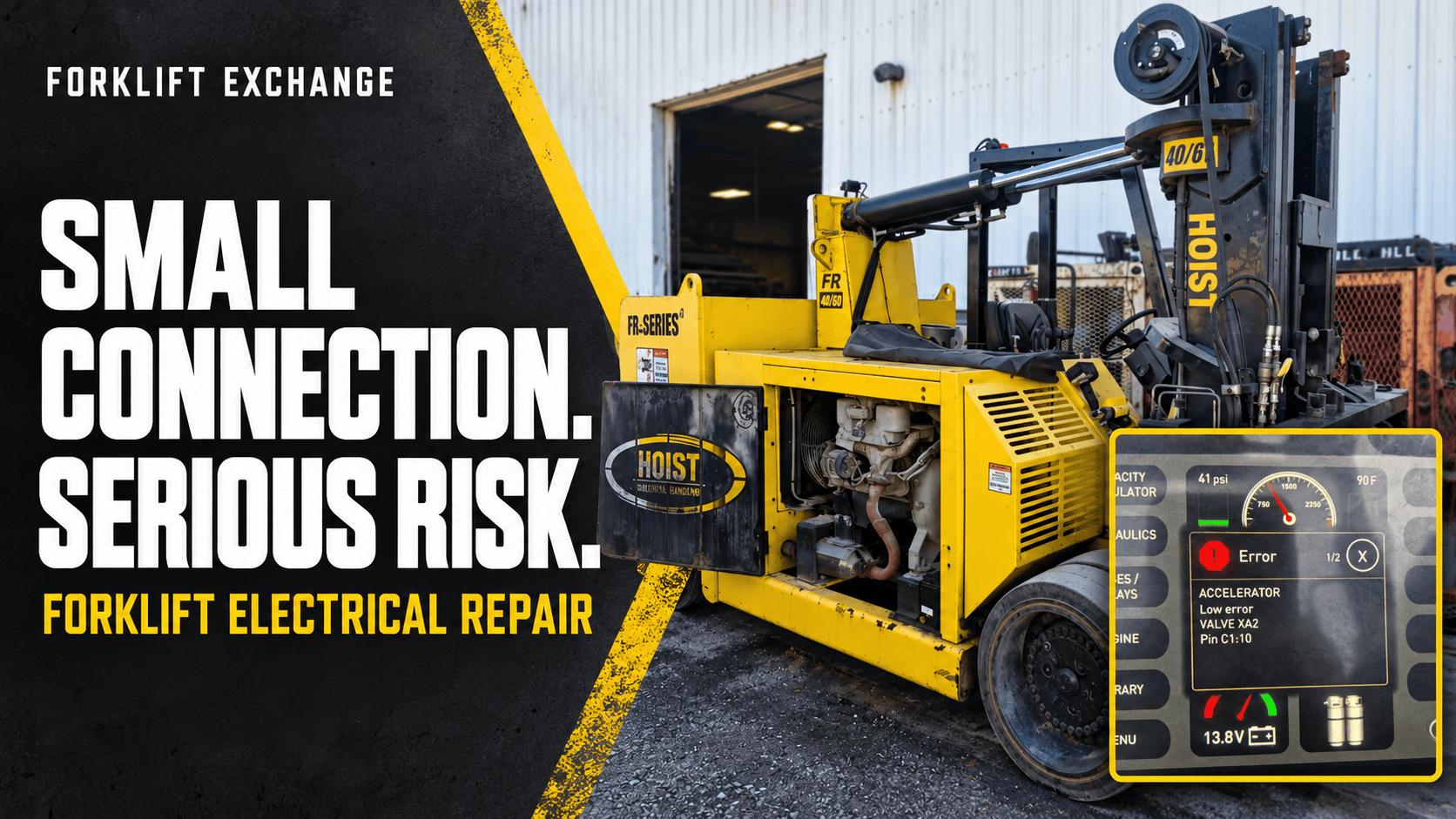
Forklift electrical repair can uncover a small connection problem behind a serious operating issue. During a service call in Indianapolis, Indiana, Forklift Exchange technician Jeremy investigated a 40/60 forklift that was moving forward without operator input.
The cause he identified was a loose connector pin.
That small fault had significant consequences. Unexpected movement puts operators, nearby personnel, and surrounding equipment at risk. Jeremy’s diagnosis highlights why careful electrical troubleshooting matters—and why replacing a major component is not always the right starting point.
Jeremy traveled to the customer’s facility to investigate the forklift’s unintended forward movement.
A forklift should respond predictably to its operator’s controls. When it moves without an operator command, the problem goes beyond productivity or convenience. Before normal work can resume, the cause needs to be identified and corrected.
For the customer, the immediate concern was clear: understand why the truck was moving on its own and address the fault responsible.
This is where a methodical diagnostic approach becomes essential. A symptom can point toward a control-system problem without identifying which connection, circuit, or component has failed.
During his electrical troubleshooting, Jeremy traced the problem to the XA2 connector. There, he discovered a loose connector pin.
On electronically controlled equipment, reliable electrical connections help control systems receive and transmit the signals they need. An unreliable connection can interfere with those signals and contribute to unpredictable operation.
In this case, the connector issue was the fault Jeremy identified during his investigation.
The diagnostic display photographed during the service call showed an accelerator-related low error referencing “VALVE XA2” and “Pin C1:10.” That information provides context for the job, but it should not be treated as a universal diagnosis for other forklifts.
Fault messages must be evaluated alongside the specific machine’s documentation, circuit information, and inspection findings.
After identifying the loose pin, Jeremy installed a new, properly wired connector.
Following the forklift electrical repair, the truck was no longer moving forward on its own.
The outcome demonstrates the value of finding the source of a fault before replacing expensive components. A connection problem can produce symptoms that appear much larger than the physical defect itself.
Effective forklift electrical repair depends on understanding that relationship: what the truck is doing, what the electrical system is reporting, and what inspection and testing reveal.
Jeremy’s service call illustrates why connectors deserve close attention. Depending on the equipment and symptoms, a qualified technician may need to evaluate the following five areas.
A connector housing can appear connected while an individual terminal is loose or poorly retained.
Checking terminal condition and retention helps technicians determine whether the connection can reliably perform its intended function. On this service call, the loose connector pin was the key finding.
Damaged conductors, worn insulation, and stressed wiring can contribute to electrical faults.
A technician may need to inspect the relevant harness and test the affected circuits using the manufacturer’s procedures. The objective is to establish the condition of the wiring rather than assume that a visible component is responsible.
When a forklift moves unexpectedly, the inputs associated with travel direction may require evaluation.
Technicians need to determine whether the system is receiving the expected commands and whether related circuits are functioning correctly. The necessary checks vary by machine and control-system design.
Control-system signals and applicable interlocks may also need inspection.
This stage of forklift electrical repair helps establish how the affected systems are interacting. It requires equipment-specific information and qualified troubleshooting; bypassing a safety device is not a corrective repair.
Corrective work needs to be followed by appropriate operational verification before the equipment returns to service.
For Jeremy’s Indianapolis call, the reported result was that the unintended forward movement stopped after the connector replacement. That confirmed improvement addressed the symptom that prompted the visit.
Unexpected movement requires prompt attention. Report the issue and remove the forklift from service so qualified personnel can investigate it.
OSHA’s powered industrial truck standard, including sections 1910.178(p)(1) and 1910.178(q)(1), requires unsafe trucks to be taken out of service until restored to a safe operating condition.
When requesting service, share the equipment identification, a clear description of the behavior, and any available fault messages. Existing photos of the display can also help communicate what was observed.
Avoid assuming that another truck with a similar symptom needs the same repair. A loose connector pin was the finding on this job; other equipment may have a different underlying fault.
A small connection issue can create a major operational concern. Jeremy’s work shows the value of technical knowledge, careful diagnosis, and a repair directed at the identified fault.
Our team supports customers with forklift repair and field service, along with replacement parts support.
If your forklift is showing electrical faults or unexpected behavior, contact Forklift Exchange to discuss the symptoms and arrange service.
Contact our service team to get started.
Comments are closed