
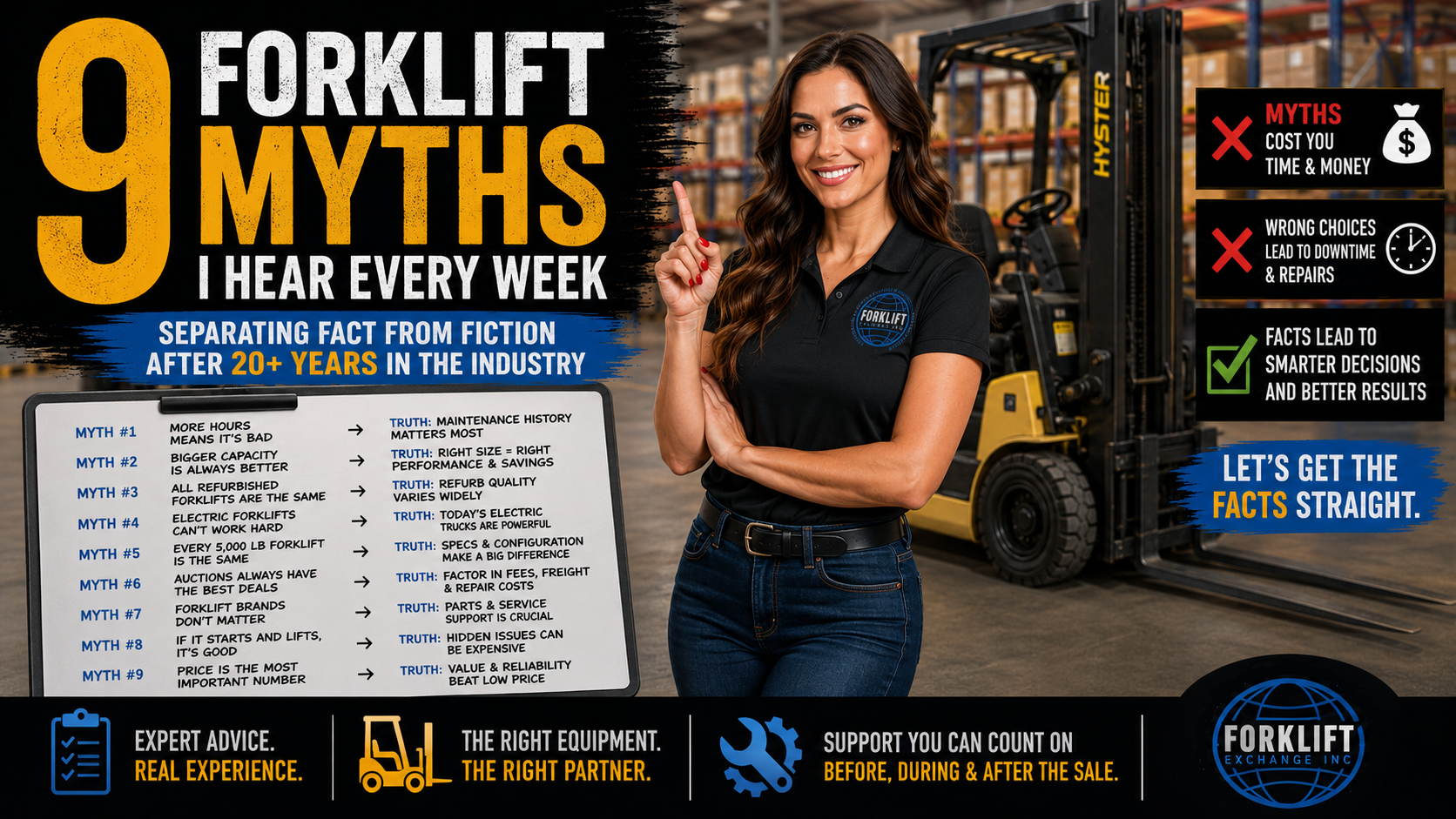
After more than 15 years in the material handling industry, I have spoken with forklift dealers, plant managers, warehouse supervisors, rigging companies, steel processors, and business owners across the country. Regardless of their experience, I continue to hear many of the same misconceptions.
Let’s separate fact from fiction by examining nine common forklift myths—and what buyers should consider instead.
This may be the most common misconception in the used forklift market.
I have seen forklifts with 15,000 operating hours that were meticulously maintained and capable of outperforming machines with only 3,000 hours. I have also inspected low-hour forklifts that sat outside for years with neglected maintenance, dead batteries, hydraulic leaks, and serious corrosion.
Operating hours matter, but they never tell the entire story. Maintenance records, application history, storage conditions, and inspection results are often more important.
I would rather purchase a well-maintained 10,000-hour forklift than a neglected 3,000-hour machine.
Some buyers assume that purchasing a larger forklift is a smart way to “future-proof” their operation. In practice, an oversized machine can create new problems.
A forklift with more capacity than the application requires may have:
The best forklift is not necessarily the biggest one available. It is the machine properly sized for your loads, aisles, lift heights, surface conditions, and daily workload.
The word “refurbished” does not have one universal meaning.
For one seller, refurbishment may consist of pressure washing, fresh paint, and new decals. Another dealer may perform engine work, rebuild the transmission, repair the hydraulic system, restore the mast, install new tires, and correct electrical problems.
Before purchasing a refurbished forklift, ask for an itemized explanation of the work completed. Request service records, inspection results, replaced-component lists, and warranty details when available.
Never rely on appearance alone. A clean coat of paint does not reveal the condition of the components underneath it.
This belief may have been more understandable years ago, but modern electric forklifts are remarkably capable.
Today’s AC electric trucks can handle demanding warehouse applications, operate across multiple shifts with the right charging strategy, and reduce routine operating expenses. They also produce no tailpipe emissions at the point of use, making them attractive for many indoor environments.
However, electric equipment is not automatically the right answer for every operation. Battery condition, charging infrastructure, duty cycle, temperature, load weight, and available downtime must all be considered.
The lesson behind this and many other forklift myths is simple: equipment should be selected around the application—not an outdated assumption.
Two forklifts may both carry a 5,000-pound capacity rating and still be completely different machines.
Important differences can include:
Attachments and load dimensions can also affect usable capacity. A data plate provides essential information, but the forklift still needs to be evaluated against the work it will actually perform.
Before buying, document the heaviest load, load dimensions, maximum lift height, aisle width, doorway clearance, operating surface, and required attachments.
You can also compare available used forklifts for sale by capacity, fuel type, condition, and manufacturer.
Auctions sometimes produce excellent purchases. They can also expose buyers to costs that were not obvious in the winning bid.
Those expenses may include:
Auction equipment is commonly sold as-is, with limited warranties and incomplete maintenance histories. Buyers may also be responsible for confirming the machine’s condition before bidding.
I have seen companies spend more repairing an auction purchase than they would have spent buying an inspected machine from a reputable dealer.
The lowest bid is not always the lowest total cost.
Every major manufacturer builds equipment capable of delivering dependable service. The more important question is whether parts and qualified technical support are readily available in your area.
A good forklift can become a frustrating ownership experience if replacement parts take weeks to arrive or no nearby technician understands the machine.
Before choosing a brand, consider:
Support should be part of every forklift purchasing decision. Forklift Exchange provides nationwide forklift repair and service for major brands and models.
A forklift can start, drive, and lift a load while still requiring thousands of dollars in repairs.
Potential problems may include:
Many of these conditions are difficult to recognize during a short test drive. A detailed inspection performed by an experienced professional can identify wear, damage, and potential repair costs before the purchase is complete.
The Occupational Safety and Health Administration also provides guidance covering the safe operation and maintenance of powered industrial trucks.
Everyone wants a good deal, but purchase price represents only one part of forklift ownership.
The cheapest machine can quickly become the most expensive after unexpected repairs, excessive fuel consumption, downtime, unavailable parts, and lost productivity are considered.
Evaluate the total cost of ownership, including:
The best value comes from purchasing the right machine from a company that understands the application and stands behind its equipment.
Most forklift myths begin with an oversimplification. Hours, capacity, brand, condition, and price all matter, but none of them should be evaluated in isolation.
The right decision usually comes from asking better questions:
A forklift is an investment—not simply another purchase order.
If you are unsure whether a machine is right for your operation, contact Forklift Exchange for help evaluating it. A short conversation and a professional inspection can prevent costly mistakes and unnecessary downtime.
Jason Flaska
Forklift Exchange
630-842-0779
jasonf@forkliftexchange.com
#UsedForklifts #ForkliftInspection #MaterialHandling #WarehouseOperations #IndustrialEquipment #ForkliftMaintenance #ForkliftExchange
Comments are closed