
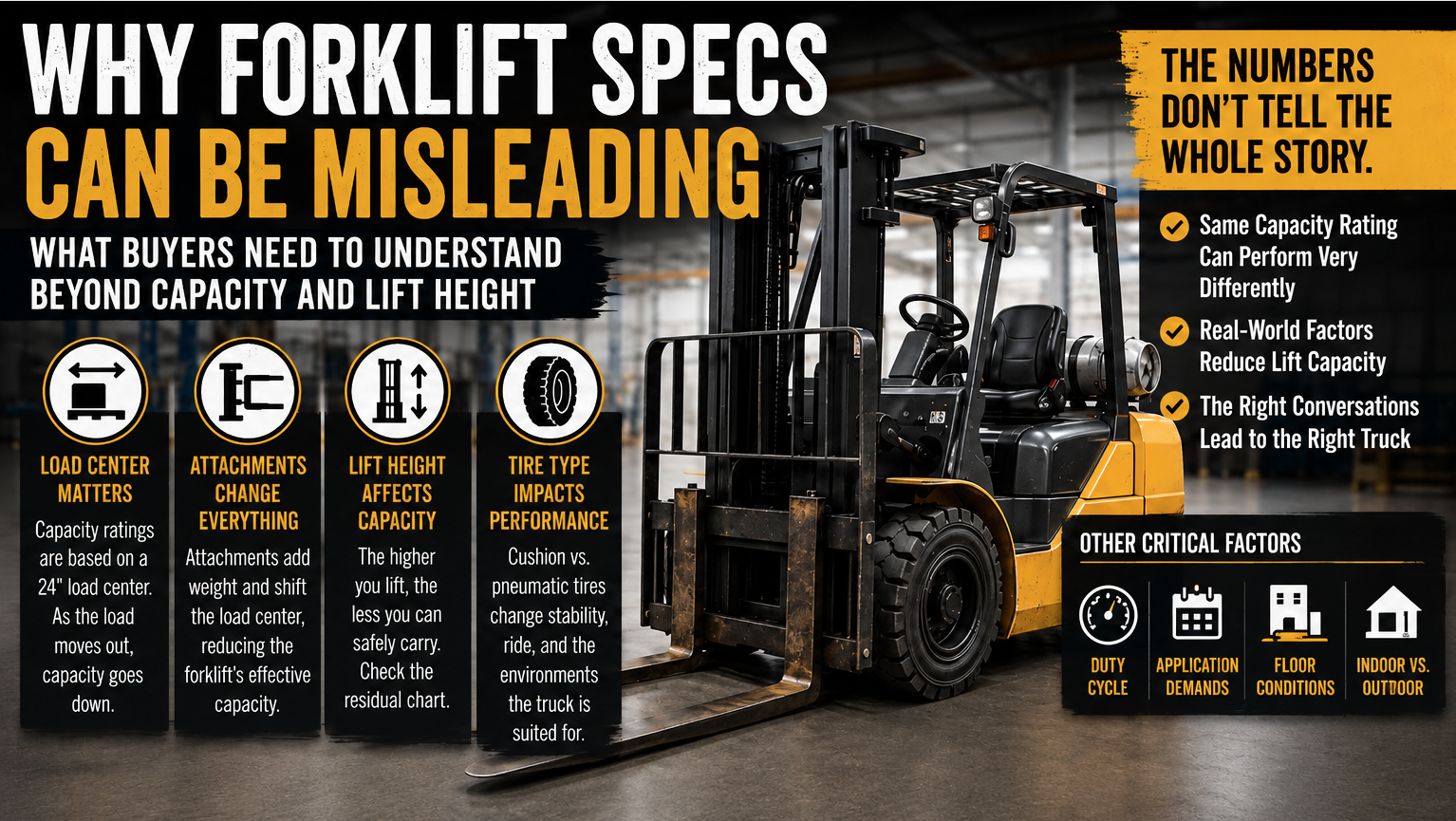
One of the most common mistakes I see when people shop for a forklift is focusing only on the numbers.
They look at:
And assume they’re comparing apples to apples. The problem is forklift specifications don’t always tell the whole story. In fact, some of the most important factors affecting performance aren’t obvious unless you know what you’re looking for. I’ve seen companies buy forklifts that looked perfect on paper, only to discover later that the truck couldn’t safely perform the job they needed it to do.
Here’s why.
This surprises many buyers. A forklift rated for 5,000 lbs. May not actually lift 5,000 lbs in your application.
Why? Because capacity ratings are based on specific conditions. Most commonly a 24-inch load center with standard forks and a standard mast configuration
Once those conditions change, capacity often changes too.
This is probably the most misunderstood specification in the forklift world.
Manufacturers typically rate forklifts at 24-inch load center. That means the load’s center of gravity is assumed to be 24 inches from the face of the forks.
The problem is many loads aren’t 48-inch pallets. Many applications move loads that consist of machinery, long crates, steel products, lumber or even large containers. As the load center moves further away effective lifting capacity decreases.
A forklift rated at: 5,000 lbs @ 24″
May only safely lift: 3,500–4,000 lbs @ 48″
Depending on the truck. That’s a huge difference.
Many buyers forget that attachments have weight. And that added weight matters.
Every attachment adds weight, distance to the load center and added complexity. The result is that the forklift’s available capacity often decreases. A truck that safely lifts a load with standard forks may become undersized once an attachment is installed.
Another commonly overlooked factor is that the higher you lift, the less capacity you often have.
As mast heights increase stability changes, mast deflection increases and the load dynamics change This is why forklifts often have residual capacity ratings.
Residual capacity tells you what the truck can safely lift at maximum height. And that number is frequently lower than the advertised capacity.
This is where experience becomes important. Two companies may need a 5,000 lb forklift but their applications could be completely different.
Warehouse operation
Manufacturing facility
While both examples have the same capacity requirement; they require completely different forklift solutions. While Example 1 might get by with a standard heart of the line forklift; Example two needs a stand up electric forklift. Possibly a reach truck or order picker depending on the exact aisle restrictions.
Most specification sheets don’t tell the whole story here either.
A forklift equipped with cushion tires will behave very differently than one equipped with pneumatic tires. Most commonly these differences include ground clearance, ride quality, stability characteristics and even outdoor performance.
It’s entirely possible for a truck to technically meet the specifications while being poorly suited for the environment.
A forklift that runs one hour per day is very different from one running three shifts per day.
Heavy-duty applications may require larger batteries and/or enhanced cooling. They might need different drivetrain configurations or more robust components. The spec sheet won’t always reveal how well a truck will perform under sustained demand.
When evaluating forklifts, do not just ask: “What’s the capacity?”
Work with your salesman to review these topics and choose the right specifications for your application:
Those questions lead to better decisions.
The forklift that looks best on paper isn’t always the forklift that’s best for the application. And the more specialized the operation becomes, the more important those details become. Because at the end of the day specifications tell part of the story; the applications tell the rest.
Some of the most expensive forklift mistakes I’ve seen weren’t caused by bad equipment. They were caused by good equipment being matched to the wrong application.
That’s why the most important question isn’t “What forklift should I buy?”
It’s “What exactly am I asking that forklift to do?”
The answer to that question usually determines everything else.
Call – Text – WhatsApp
630-842-0779
Jasonf@forkliftexchange.com
www.Forkliftexchange.com
Special Note: If you’re still reading, like and share. It’s appreciated. If you’re evaluating forklifts and want a second opinion on specifications, capacities, or application requirements, I’d be happy to help. Matching the right truck to the right application is one of the most important decisions in material handling. Send me a message.
#Forklifts #MaterialHandling #WarehouseOperations #Leadership #SupplyChain #UsedEquipment #Logistics #OperationsManager #Safety #UsedEquipment #IndustrialEquipment #highcapacity #heavyequipment
Comments are closed