
Most people look at a forklift and think, “It’s just a bigger version of the one in my warehouse.” Then they stand next to a 30,000 lb, 50,000 lb, or 80,000 lb forklift for the first time. And suddenly, everything changes.
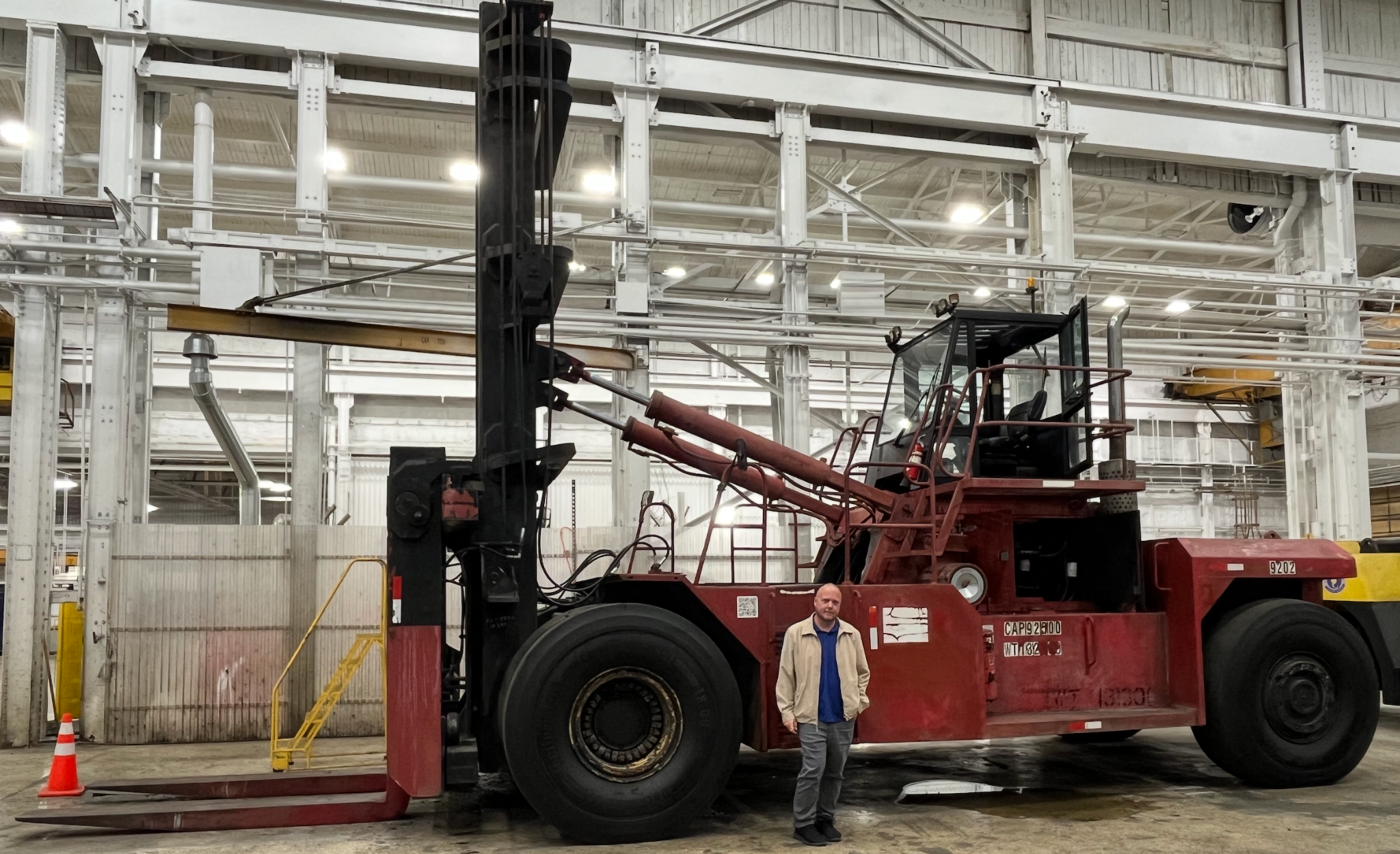
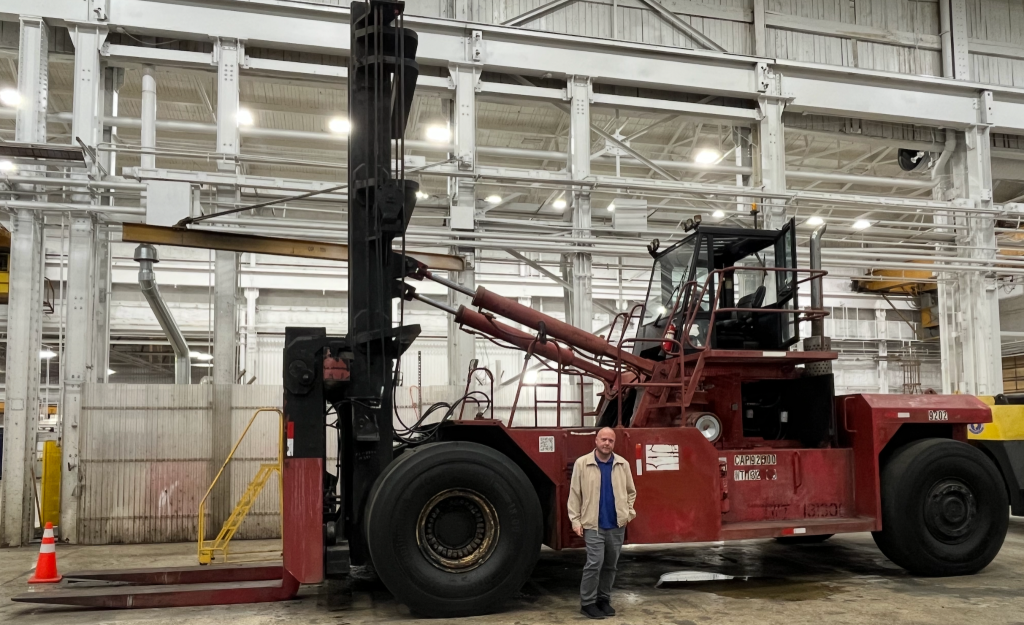
The photo above puts it into perspective. I’m 5’9″. The forklift behind me weighs more than many loaded semi-trucks. At that scale, you’re no longer talking about simply moving pallets. You’re managing massive forces, specialized equipment, and operational risks that don’t exist with standard warehouse forklifts. And that’s why moving up in forklift capacity requires an entirely different way of thinking.
A standard warehouse forklift might:
A high-capacity forklift may:
The dimensions change dramatically. Everything gets larger; tires, counterweights, engines etc. Wheelbases are longer and they have an increased turning radius. Take for instance, do you know what kind of weight your floor is rated to hold per sq inch? These are things you need to think about you might not have considered
Everything gets bigger and everything becomes more expensive.
One of the biggest mistakes I see is people focusing only on lifting capacity. “I need to lift 40,000 lbs, so I need a 40,000 lb forklift.” Not necessarily.
As capacity increases the load centers become more critical, attachments become more impactful and stability calculations become a lot more important. A steel coil, concrete product, machinery component, or transformer all behave differently. At high capacities the application matters more than the capacity rating itself.
Visibility Becomes a Major Challenge
As forklifts get larger. Hoods get taller, masts get wider & loads get larger. With all that the visibility changes dramatically and so the blind spots on a high-capacity forklift can be significant.
This is why operators need to have more planning, better communication & increased situational awareness. The margin for error shrinks as machine size grows.
A warehouse forklift can operate on surfaces that would never support a high-capacity truck.
Large forklifts, especially cushion tire trucks, can have a lot of weight on a tiny footprint. That matters if your floors are not rated to handle that much weight the forklift will completely destroy the floor.
Before deploying a high-capacity forklift, you often need to consider a few things. Mainly pavement condition, dock ratings, & yard conditions; which aren’t as large of a concern on standard heart of the line forklifts. These aren’t things most warehouse operators ever have to think about.
The purchase price is only part of the equation.
As capacity increases, everything grows more expensive. Tires, components, fuel costs and even transportation costs become more expensive. A single tire replacement on a large forklift can cost more than some small forklifts are worth. That’s simply the reality of operating equipment at this scale.
High-capacity forklifts aren’t typically serviced by the same technicians who work on every warehouse truck. These machines are completely different warehouse lifts and you need to make sure you have a specialized high capacity forklift technician working on your machine.
I have a customer who just called me this week looking for a rental unit because the one he owns went down. He hired his local mechanic to fix it. Instead they set his wire harness on fire and now are back to square one with no ETA on when the customer’s truck will be ready to go back into operation.
These machines specialized tooling, heavy lifting equipment, application-specific knowledge, but most importantly, manufacturer expertise.
Downtime becomes more expensive because replacement equipment isn’t always readily available. That same customer who called is going to have to pay $10,000 a month or more in rental cost just to keep his doors open and his operation producing.
You can’t always rent an 80,000 lb forklift tomorrow if yours goes down today.
This may be the most important point of all. A skilled warehouse operator isn’t automatically ready for high-capacity equipment. The fundamentals remain the same but the consequences become much larger.
At higher capacities the stopping distances increase, load momentum increases, blind spots increase all while recovery options decrease
Operator judgment becomes critical.
Standing next to a machine like the one in this photo is a reminder of just how much scale changes everything.
The equipment gets bigger.
The loads get heavier.
The responsibility grows.
And the importance of experience becomes impossible to ignore.
That’s why when operations move into the world of high-capacity forklifts, they’re not simply buying a bigger truck.
They’re entering an entirely different category of material handling.
Call – Text – WhatsApp
630-842-0779
Jasonf@forkliftexchange.com
www.Forkliftexchange.com
Special Note: If you’re still reading, like and share. It’s appreciated. If you’re shopping for a high capacity forklift and want an expert to go through your operation with you to make sure you dot your I’s and cross your T’s, send me a message.
#Forklifts #MaterialHandling #WarehouseOperations #Leadership #SupplyChain #UsedEquipment #Logistics #OperationsManager #Safety #UsedEquipment #IndustrialEquipment #highcapacity #heavyequipment
Comments are closed