
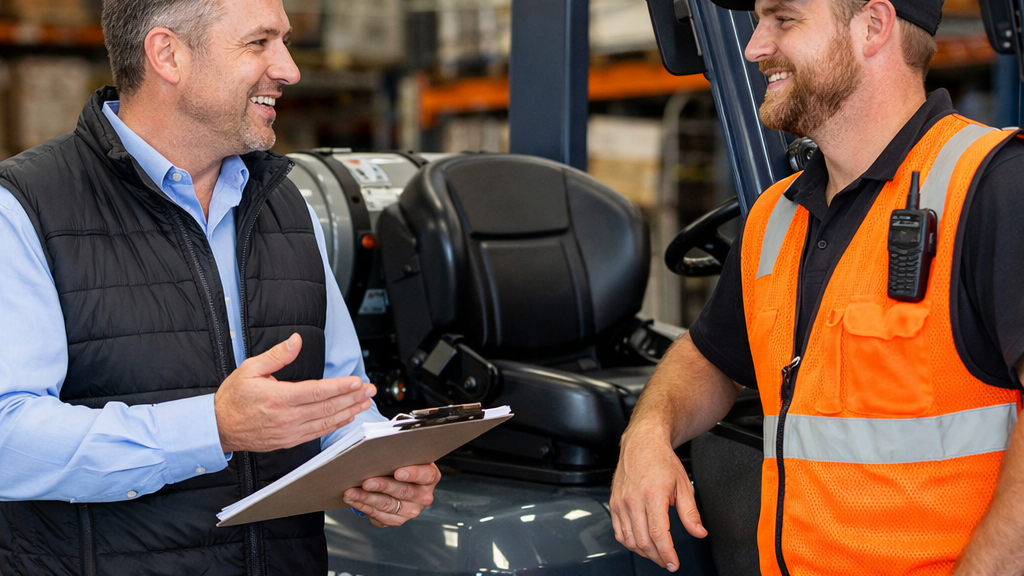
What Your Forklift Operators Wish Management Understood (But Rarely Say Out Loud)
After years in the used forklift business, I’ve had thousands of conversations with owners, managers, and operators. I’ll tell you this. The people actually driving the equipment often see problems long before leadership does.
But what’s the problem? No one asks them.
If you really want to improve productivity, reduce damage, and get more out of your equipment, here’s what your forklift operators wish you understood.
I’ve seen warehouses running 5,000 lb trucks when 3,000 lb units would be faster and more efficient and the operators feel it immediately.
Real-world example: A customer I worked with had oversized sit-down forklifts in tight aisles. Operators were constantly backing up, readjusting, and fighting for space. They struggled to pick up pallets stacked in wracking systems because their forklifts weren’t sized right for their aisles.
We switched part of their fleet to 3-wheel electrics.
Result: Faster cycle times, less product damage, and operators were noticeably less fatigued.
Operator perspective: “We’re not slow… the equipment is.”
Most management teams underestimate how strenuous forklift operation can be on the body with worn outdated equipment.
Real-world example: One facility had older cushion trucks with worn seats and stiff controls. Operators were rotating off equipment early due to discomfort.
After upgrading to newer electrics with better ergonomics the customer saw that productivity increased, operator complaints dropped & most importantly damage incidents went down because the operators were less focused on back pain and more focused on the task at hand.
Operator perspective: Comfortable operators are more focused
You can train operators all day — but if they can’t see, they can’t perform safely.
Common issues:
Real-world example: A warehouse I worked with had consistent rack damage. Management assumed it was operator error. It wasn’t. The trucks had limited visibility and no proper lighting for early morning shifts. Their Forklift Dealer had sold them a forklift with a Center Free Lift Cylinder. Its purpose is specifically for stacking pallets without raising the mast up so you can stack inside Van Trailers. HOWEVER, the customer did NOT do this and paid extra for this feature for no reason. Now they have minimal visibility with a load on the forks and damaged systems due to it.
Once corrected: Damage incidents dropped significantly without retraining a single operator.
Operators are incredibly good at adapting but that’s not always a good thing. They’ll compensate for weak brakes, work around steering issues and keep running trucks that should be down; either by continuing to use them while working around the issue or by avoiding the truck and refusing to use it so you have unused equipment you’re paying for.
Real-world example: I inspected a fleet where operators had learned to “feather” a failing transmission to keep a truck usable. Management had no idea. That truck eventually failed completely during peak operations and without a backup truck they were scrambling for a solution
Operator reality: “We’ll make it work… until we can’t.”
Mixed fleets can be a hidden productivity killer. Different brands, different controls, different responsiveness; Some standup units can even have opposite control schemes for steering. It all matters to the operators.
Real-world example: A distribution center had 4 different brands of forklifts. Operators constantly had to adjust between units. One operator even crashed the truck damaging both the forklift and the product it carried, all because he thought he would turn left when he turned right instead.
After standardizing part of the fleet their training time dropped, operator confidence increased and productivity became more consistent
Familiarity drives efficiency.
The next time you evaluate your forklift fleet, don’t just ask: “What does this cost?” Ask: “What are my operators dealing with every shift?” If you’re not asking them what equipment they like, you are ignoring a key component of your production pipeline and mistaking it for an inconsequential opinion.
They already know where the problems are. If you listen closely, they’ll tell you exactly what they need to do their job. The right changes aren’t always expensive, but they do require experience to spot.
Call – Text – WhatsApp 630-842-0779 Jasonf@forkliftexchange.com www.Forkliftexchange.com
Special Note: If you’re still reading, like and share. It’s appreciated. If you’re evaluating equipment or want a second set of eyes on your fleet, I’m always open to a conversation. Send me a message.
#Forklifts #MaterialHandling #WarehouseOperations #Leadership #SupplyChain #UsedEquipment #Logistics #OperationsManager #Manufacturing #B2BSales #SmallBusiness #forkliftsforsale #usedforklifts
Comments are closed