
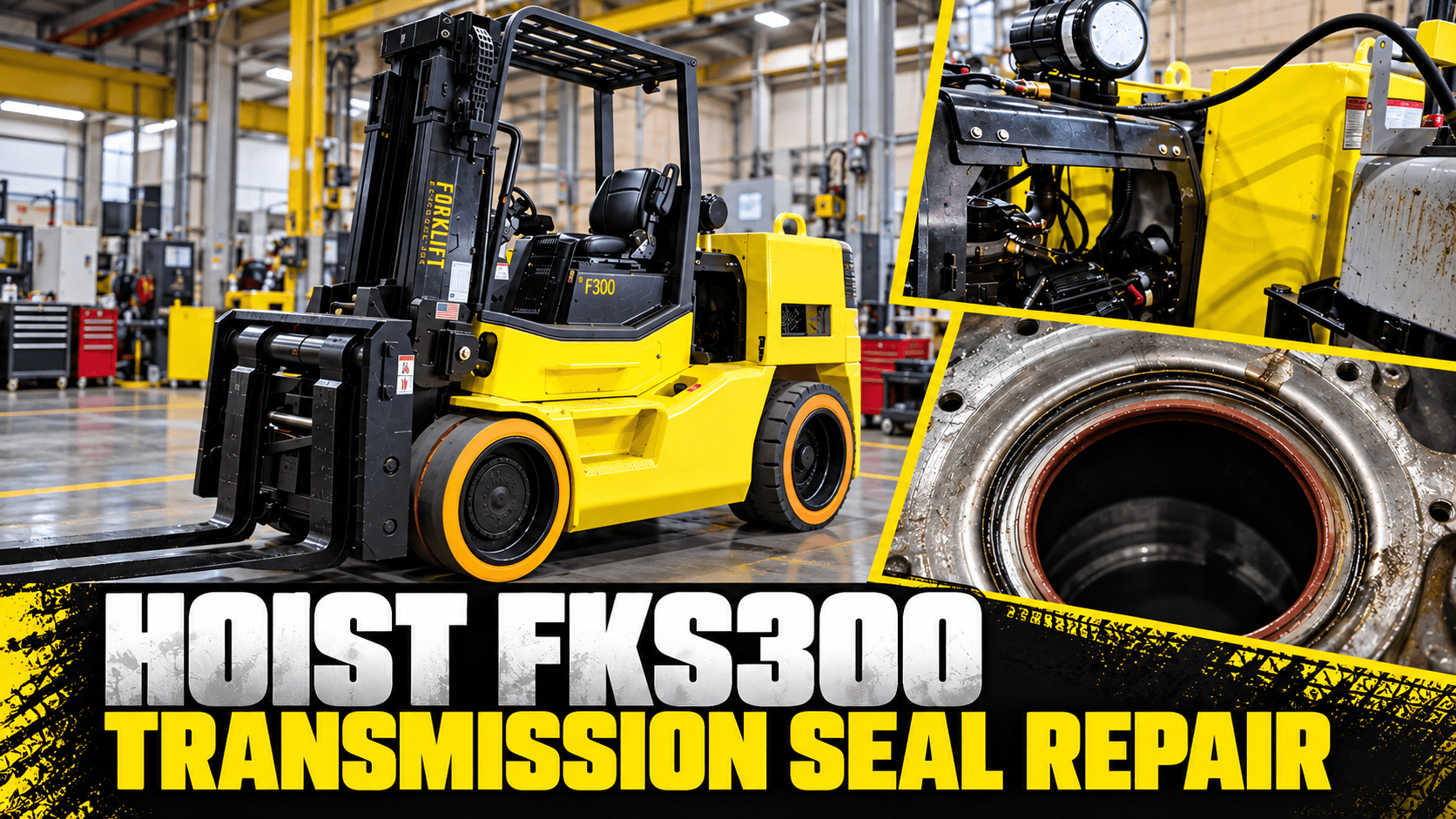
A Hoist FKS300 transmission seal repair can involve far more than replacing a small component. When a customer’s heavy-duty forklift developed a transmission fluid leak in New York, Forklift Exchange technician Jeremy traced the problem to a seal located behind the torque converter. Reaching that seal required four days of field work, including pulling the engine, removing the torque converter, replacing the failed seal, and carefully reassembling and inspecting the truck.
This repair is a strong example of why the location and cause of a leak matter more than the size of the failed part. A seal may be inexpensive compared with a major drivetrain component, but accessing it can demand extensive disassembly, the right equipment, and an experienced technician. Simply cleaning the visible fluid or replacing an easy-to-reach part would not have corrected the underlying problem.
Transmission fluid can travel along housings, hoses, and other components before it drips to the ground. That means the first wet area a technician sees is not always the true source of the leak. A correct diagnosis begins by inspecting the equipment, identifying the fluid, tracing the leak path, and determining which component has failed.
On this Hoist FKS300, the leak was traced to a transmission seal positioned behind the torque converter. The seal itself was buried deep inside the drivetrain. There was no direct route to remove and replace it from outside the truck. The engine and torque converter had to come out before Jeremy could access the failed component.
That is the difference between treating a symptom and completing a lasting repair. The visible symptom was leaking transmission fluid; the actual problem was the failed seal behind the torque converter.
The first step was to confirm where the fluid was coming from. Accurate leak diagnosis helps prevent unnecessary parts replacement and repeated downtime. With a large-capacity forklift, it is especially important to understand the problem before removing major components.
Jeremy’s inspection identified the transmission seal behind the torque converter as the source. That diagnosis established the repair plan and showed why a quick external fix would not solve the problem.
Leaks should never be dismissed as a cosmetic issue. Fluid loss can affect equipment performance, contaminate the work area, and indicate a condition that may worsen with continued operation. OSHA’s powered industrial truck standard states that a truck needing repair or found unsafe must be removed from service until it is restored to a safe operating condition. Operators should follow their company procedures, the manufacturer’s guidance, and all applicable safety requirements.
Once the source was confirmed, the next step in the Hoist FKS300 transmission seal repair was removing the engine. Pulling an engine in the field is a substantial job. Connections, hoses, wiring, mounts, and related components must be disconnected methodically so the engine can be lifted without damaging the truck or creating new issues.
Careful organization also matters during disassembly. Every removed component has to return to its proper position during reassembly. An experienced field technician plans for the full process—not only how to take the equipment apart, but how to put it back together correctly and efficiently.
With the engine out of the way, Jeremy removed the torque converter to reach the failed seal. The torque converter transfers engine power into the transmission, making it a central part of the drivetrain. Its location was the reason this repair required so much access work.
Removing the torque converter exposed the seal and allowed the technician to inspect the surrounding area. This stage is also an opportunity to look for related wear, contamination, or damage that could affect the completed repair. Replacing a seal without checking the components around it could leave another issue undiscovered.
After the engine and torque converter were removed, the failed seal was finally accessible. Jeremy removed it and installed the replacement, taking care to prepare the sealing area and position the new component correctly.
This is the smallest physical step in the job, but it is the reason every earlier step was necessary. A seal must fit and seat correctly to contain the fluid under operating conditions. The quality of the installation matters just as much as the quality of the replacement part.
Forklift Exchange supports repairs with an extensive parts operation and experience sourcing components for heavy material-handling equipment. Customers looking for replacement components or service support can review the company’s parts and service FAQ or contact the parts team directly.
Replacing the seal did not finish the job. The torque converter and engine had to be reinstalled, all disconnected systems had to be restored, and the truck had to be inspected before returning to operation.
The final stage included checking the reassembled components and testing the equipment for leaks. This verification step is critical: it confirms that the original leak has been corrected and helps identify anything that needs attention before the technician leaves the customer’s facility.
After four days of work in New York, the Hoist FKS300 was ready to return to service.
Heavy forklift repairs do not always happen near a fully equipped dealer shop. The equipment may be several states away, difficult to transport, or essential to a customer’s daily operation. In those situations, the ability to diagnose and complete complex work on-site can reduce logistical challenges and help the customer move toward a safe return to operation.
Forklift Exchange provides nationwide forklift repair and field service for major brands and models. Its field technicians use equipped service trucks and support repairs ranging from preventive maintenance to engine and transmission work. For this New York job, that capability meant bringing the technician and repair expertise to the Hoist FKS300 instead of treating distance as a barrier.
Experienced field service contributes at every stage of a deep repair:
The goal is not to replace the most obvious part. It is to find the actual failure, repair it correctly, and verify the result.
A fluid leak is a warning that deserves prompt attention. The source may be a seal, hose, fitting, gasket, housing, or another component, and the repair can vary significantly depending on the location. Continuing to operate equipment without understanding the leak can increase the risk of further damage and unplanned downtime.
If a forklift begins leaving fluid on the floor, operators should report the issue and follow established shutdown and inspection procedures. A qualified technician can identify the fluid and determine whether the truck should remain out of service. The OSHA powered industrial truck requirements provide federal safety requirements for the operation and maintenance of this equipment; site policies and manufacturer instructions may add further requirements.
Early inspection does not guarantee a simple repair, but it gives the service team the best opportunity to identify the cause before the condition progresses.
The New York Hoist FKS300 transmission seal repair came down to one failed seal, but solving it required a technician prepared for a deep drivetrain repair. Jeremy diagnosed the source, pulled the engine, removed the torque converter, replaced the seal, reassembled the truck, and checked the completed work.
Big truck. Deep repair. One failed seal. Problem solved.
If your forklift has a transmission fluid leak, drivetrain issue, or another problem that requires more than a quick fix, contact Forklift Exchange. Our field-service team travels to customer facilities across the continental United States and works to get material-handling equipment back into operation. Request forklift service to discuss the equipment, symptoms, and location with our team.
The leak was traced to a failed transmission seal located behind the torque converter. Reaching the seal required removal of the engine and torque converter.
The on-site repair took four days. The work included diagnosis, major component removal, seal replacement, reassembly, inspection, and leak testing.
The failed seal was located behind the torque converter, deep inside the drivetrain. Removing the engine created the access needed to remove the torque converter and reach the seal.
Yes. Forklift Exchange provides nationwide field service for material-handling equipment, including engine and transmission repairs, preventive maintenance, inspections, and emergency service for major brands and models.
Report the leak immediately and follow the employer’s shutdown, inspection, and safety procedures. Equipment needing repair or considered unsafe should remain out of service until authorized personnel restore it to a safe operating condition.
Comments are closed