
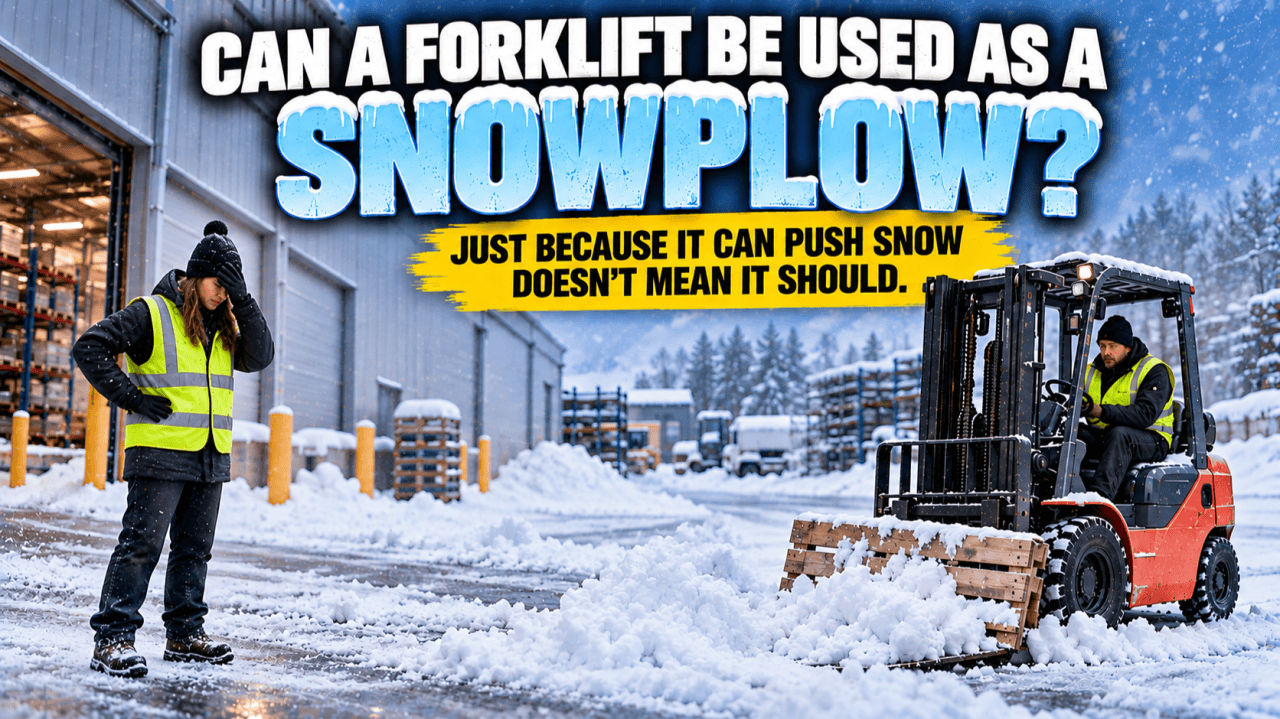
A forklift snowplow can handle certain snow-removal jobs, but only when the truck and attachment are suitable for the application, required approvals are in place, and conditions allow safe operation. Having enough horsepower to push snow does not establish that a forklift can do the job safely.
Picture a Monday morning in January. Six inches of snow fell overnight, the parking lot hasn’t been plowed, and delivery trucks are starting to arrive.
Someone looks at the forklift inside the warehouse and asks, “Why don’t we just use that?”
It’s a reasonable question. Forklifts are powerful, heavy machines, and purpose-built snowplow attachments do exist. But there’s a substantial difference between using a suitable attachment and pushing snow with bare forks or a wooden pallet.
Before turning your forklift into winter cleanup equipment, consider these seven mistakes.
An attachment that fits over the forks is not automatically suitable for that forklift.
Fork dimensions are only one part of compatibility. The attachment’s weight, mounting system, operating forces, and intended application also matter.
For U.S. general industry workplaces, OSHA’s powered industrial truck standard, Section 1910.178(a)(4), requires prior written manufacturer approval for modifications and additions affecting capacity and safe operation. It also requires corresponding changes to capacity, operation, and maintenance instruction plates, tags, or decals.
Section 1910.178(a)(5) addresses identification markings for trucks equipped with certain nonfactory front-end attachments.
Before using a forklift snowplow, confirm the applicable approval and marking requirements for the specific truck and attachment. Review both manufacturers’ instructions and restrictions.
“Fits on the forks” is the beginning of the evaluation, not the final answer.
A forklift rated to lift 5,000 pounds is designed to handle that load under specified conditions. That rating does not tell you how much snow the truck can safely push.
During lifting, the mast, carriage, forks, hydraulics, and counterweight work together to support the load. Plowing introduces horizontal resistance and potential impacts.
Fresh powder, heavy wet snow, and a frozen snowbank create very different working conditions. A blade catching a curb can produce a sudden force that ordinary lifting capacity does not describe.
The same principle applies to high-capacity equipment.
At Forklift Exchange, we work with forklifts used in steel mills, machinery moving, precast concrete, and heavy manufacturing. A machine capable of lifting 100,000 pounds still needs a separate evaluation before being used for snow removal.
A larger capacity number does not establish approval for a different application.
Bare forks are not a substitute for a snow blade. Neither is a wooden pallet placed in front of the truck.
Fork tips can catch pavement joints, curbs, or obstacles hidden beneath the snow. An improvised pushing surface can shift, break, or transfer forces into components that were never evaluated for that setup.
Purpose-built forklift snowplow attachments use mounting and retention arrangements designed for the task. Depending on the model, they may also include adjustable blade angles, replaceable cutting edges, or impact-management features.
For example, KAUP’s snowplow blade designs include fork-pocket mounting options and spring-loaded flaps on certain models to help protect the carriage and mast when encountering obstructions.
Those features do not eliminate every hazard or establish compatibility with every forklift. They demonstrate why attachment design matters.
Saving money on an attachment is a poor trade if the improvised alternative damages the truck.
A forklift can have plenty of engine power and still struggle to move itself on snow or ice.
The tires need enough grip to transfer that power to the ground. The operator also needs sufficient traction to steer and stop.
Cushion-tire forklifts are generally suited to smooth, improved surfaces. Many have limited ground clearance and tire configurations that make snowy yards a poor match.
Pneumatic-tire forklifts are generally better candidates for outdoor applications. Toyota’s pneumatic forklift guidance explains their traction and shock-absorption advantages on outdoor terrain. That does not mean every pneumatic tire provides suitable grip on ice.
A rough-terrain forklift may offer additional clearance or four-wheel drive, depending on the model. Neither feature makes winter operation automatically safe.
Before considering a forklift snowplow, evaluate the actual truck, tires, surface, and conditions. Do not improvise ballast or change tire configurations simply to gain traction.
For more on winter travel conditions, read our guide: Can a Forklift Drive Through Snow?
Imagine pushing snow across a parking lot when the blade catches a concrete parking stop.
The attachment stops suddenly while the truck is still moving. Depending on the design and mounting arrangement, that impact can load the attachment hardware, forks, carriage, or mast.
Snow can conceal:
Inspect and identify hazards before snowfall when possible, then reassess the area before clearing it.
A forklift snowplow with a trip mechanism or flexible blade components still has operating limits. Follow the attachment instructions and stop if conditions prevent controlled operation.
A hidden obstacle can turn a short cleanup job into equipment damage, downtime, or an injury.
Repeatedly driving into a snowbank, spinning the tires, backing up, and trying again is a warning that the equipment or conditions may be unsuitable.
Heavy pushing resistance, traction loss, and repeated direction changes can place additional demands on the drivetrain. An older truck with worn components may have even less margin for an unfamiliar workload.
Do not treat wheelspin or repeated stalling against a pile as a reason to apply more force.
The appropriate response is to stop and reassess the job against the equipment’s instructions and limitations. A forklift snowplow is not automatically a replacement for dedicated equipment after every storm.
Mechanical condition matters, too. Address concerns with brakes, steering, tires, attachment retention, or other safety-related components before operation.
Our forklift service team can help assess maintenance and repair needs.
The cheapest snow-removal option is not always the machine you already own.
Suppose a company hopes to save $500 by using its forklift instead of hiring a contractor. That is a hypothetical saving, but the business decision is familiar.
An attachment repair, damaged carriage, or transmission problem could erase that saving. Losing the forklift while trucks wait to be loaded could cost even more.
Every hour spent plowing is also an hour the machine is unavailable for shipping, production, or inventory handling.
For recurring snowfall or large areas, compare a forklift snowplow with a properly configured skid steer, compact wheel loader, or professional snow-removal service. Evaluate attachment suitability, site conditions, staffing, and the full operating cost.
The right choice should keep the site accessible while protecting the equipment your business depends on.
Before assigning the work, confirm that:
If those questions cannot be resolved, do not proceed with the job.
Yes, certain forklifts can perform snow removal with a suitable purpose-built attachment. The specific application must meet manufacturer requirements, applicable approval requirements, and safe operating conditions.
Bare forks should not be used as an improvised snow blade. They can catch hidden obstacles and expose the truck and operator to avoidable hazards.
They are generally better suited to outdoor work than cushion-tire warehouse forklifts. However, tire type alone does not establish adequate winter traction or approval for plowing.
Yes. Impacts, unsuitable attachments, and excessive pushing resistance can damage equipment. The risk depends on the truck, attachment, operating conditions, and how the work is performed.
A forklift snowplow may be practical for limited work when the equipment, approvals, operator preparation, and conditions support it.
But moving snow once does not prove that a forklift should spend the winter clearing a parking lot.
I’ve always believed the right equipment is the machine that can complete the job safely, efficiently, and without unnecessary operating costs.
Sometimes the most expensive snowplow is the forklift you already own.
At Forklift Exchange, we help customers evaluate equipment for their applications, from warehouse forklifts to outdoor pneumatic-tire machines and specialized high-capacity equipment.
If you’re considering a purchase or questioning whether your current truck fits the work, contact me to discuss the application.
Jason Flaska
Forklift Exchange, Inc.
Phone: 630-842-0779
Email: jasonf@forkliftexchange.com
Comments are closed