
If you’ve ever shopped for a forklift, you’ve probably come across a spec sheet that reads something like: “5,000 lb capacity at a 24-inch load center.” Most buyers skim right past that second part — and that’s a mistake that can cost them in damaged equipment, failed loads, or the wrong machine for the job entirely.
Let’s break down what load center actually means, why it matters, and why the smartest thing you can do before purchasing a forklift is talk to a specialist.
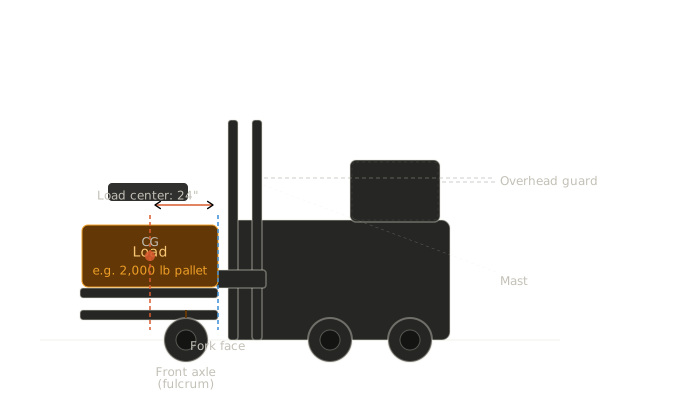
The load center is the horizontal distance from the face of the forks to the center of gravity of the load being carried. In North America, the industry standard is 24 inches — meaning a forklift’s rated capacity assumes the load’s weight is balanced at a point 24 inches back from where the forks begin.
Think of the front axle as a fulcrum on a seesaw. The forklift’s counterweight sits behind the axle, and the load sits in front of it. For that seesaw to stay balanced — and for the forklift to safely lift the load — the weight distribution has to fall within the machine’s engineered limits.
When the load center shifts further from the fork face (say, to 36 or 48 inches), the effective capacity of the forklift drops significantly. A machine rated at 5,000 lbs at 24 inches might only safely handle 3,500 lbs at 36 inches. Overloading this threshold doesn’t just risk dropping the load — it can tip the entire forklift.
Here’s where things get complicated for buyers: the loads you’re handling in the real world rarely conform to the standard 24-inch specification.
Oversized or oddly shaped loads — long steel pipes, wide machinery, extended pallets — often push the center of gravity much further out. If your operation regularly handles loads like these, you need a forklift rated for a higher load center, or you risk chronically exceeding safe limits.
Load height matters too. As a load rises on the mast, the forklift’s stability decreases. The rated capacity on the nameplate reflects ground-level performance. Once you’re lifting to elevated racking, the margin narrows further.
Attachment use changes everything. Clamps, rotators, side-shifters, and other fork attachments add weight of their own and move the load center outward. Attachments are one of the most overlooked factors — each one technically requires a new, amended capacity nameplate on the machine.
Online spec sheets are useful, but they’re snapshots of ideal conditions. A forklift rated at 5,000 lbs at 24 inches sounds capable on paper, but if your pallets are 60 inches deep, your real-world capacity may be a fraction of that.
This is the trap many buyers fall into — especially when purchasing used equipment or shopping by price and lift capacity alone. They get a machine to the floor, start loading it to the spec, and discover the hard way that their actual workflow operates well outside those rated parameters.
A qualified forklift dealer or material handling specialist does something a spec sheet can’t: they look at your operation. Before recommending equipment, a good specialist will want to know:
A specialist can also walk you through the full capacity data plate — not just the headline number — and help you understand exactly where your real-world loads fall on the capacity curve. They can model out load center scenarios specific to your product, so you’re buying a machine for your actual operation, not a hypothetical one.
Load center is one of the most important — and most misunderstood — concepts in forklift selection. The rated capacity on a machine’s nameplate is only valid under specific, standardized conditions. Move outside those conditions, and you’re operating in territory the machine may not be designed to handle safely.
Before signing anything, get a specialist involved. Bring your real load specs, your facility dimensions, and your operational workflow to the conversation. The right forklift for your operation isn’t necessarily the one with the highest capacity or the lowest price — it’s the one engineered to handle your specific loads, in your specific environment, safely and efficiently.
A few hours with the right expert before purchase can prevent years of costly mistakes after it.
For more information, contact Gene Bayer – Big Trucks Specialist at:
847-707-1316 | gbayer@forkliftexchange.com
Comments are closed