
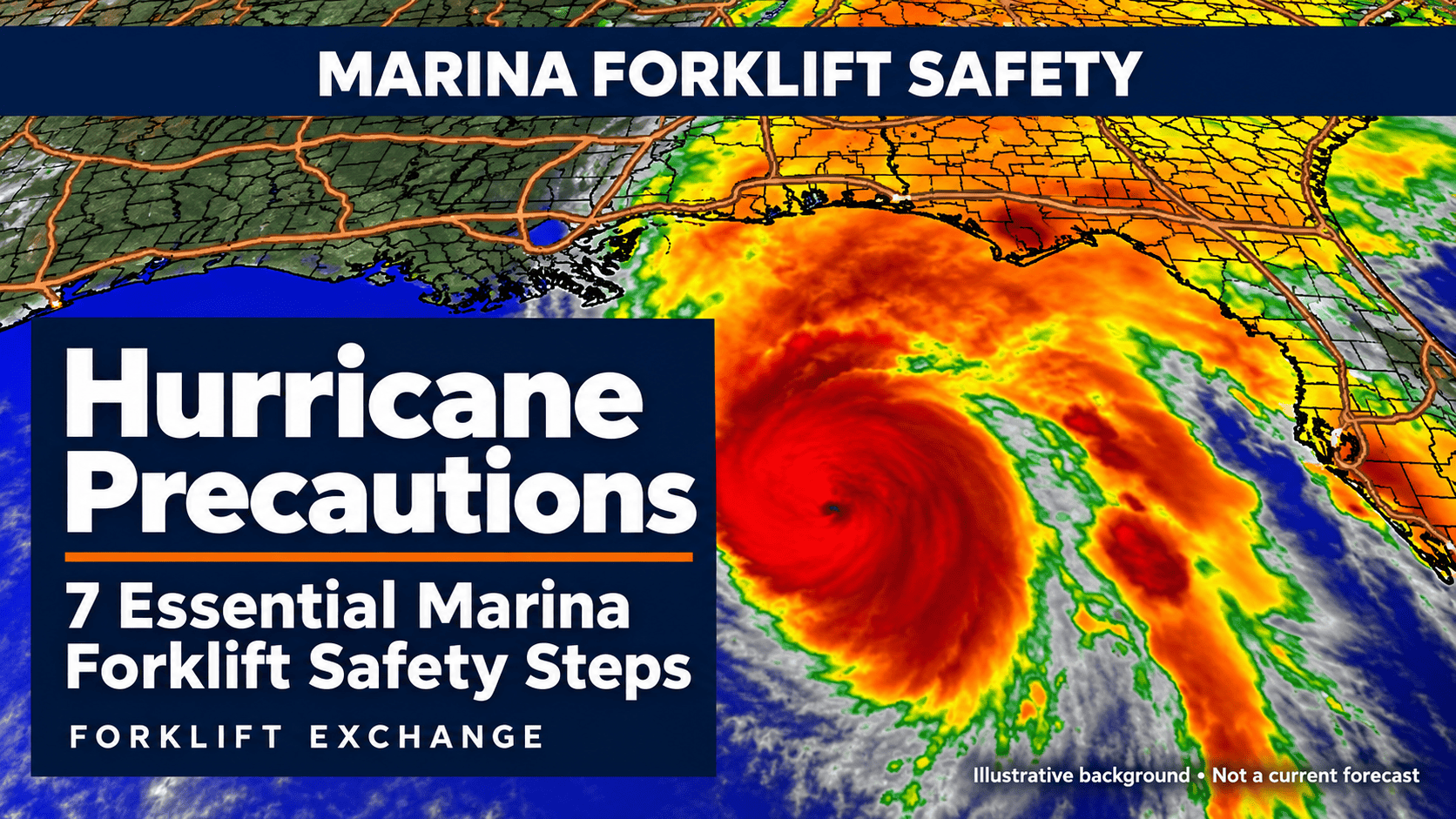
Hurricane precautions help marina owners and operators prepare their forklifts before a storm and respond safely afterward. Flooding and storm surge can expose equipment to water, contamination, and damage that may not be visible from the outside.
If your marina forklift has been flooded, or you suspect flood exposure, contact Forklift Exchange promptly to arrange an on-site inspection. Keep the machine out of service until a qualified technician has inspected it and cleared it for use.
Complete storm preparation while conditions are safe. Follow your emergency plan, original equipment manufacturer (OEM) instructions, local evacuation guidance, and applicable safety requirements.
Include equipment relocation in your marina’s emergency plan so operators know where to park and when to stop work. Do not delay evacuation to move equipment once conditions become dangerous.
Identify a solid, level parking location above anticipated flood and storm-surge levels. Move the forklift there before weather conditions make operation unsafe.
After moving the forklift, fully lower the unloaded forks to the ground, neutralize the controls, set the parking brake, shut off power, and remove the key. Block the wheels if the machine must be parked on an incline.
Maintain normal operator training, inspection, and site safety procedures throughout storm preparation. OSHA’s powered industrial truck standard addresses safe unattended parking and removing unsafe equipment from service:
https://www.osha.gov/laws-regs/regulations/standardnumber/1910/1910.178
Battery precautions depend on the forklift’s design and the manufacturer’s requirements. After final parking and shutdown, have trained, authorized personnel perform any required battery disconnection according to the OEM procedure.
Allow required shutdown and purge cycles to finish before disconnecting power. For Tier 4 engines, follow the manufacturer’s specified waiting period rather than assuming one interval applies to every machine.
If submersion is strongly likely, arrange any necessary battery removal before flooding occurs. Authorized personnel should follow OEM handling and storage procedures and use a suitable location above anticipated flood levels.
DO NOT START OR OPERATE A FLOOD-EXPOSED FORKLIFT.
If exposure is known or suspected, do not start the engine, energize the electrical system, reconnect batteries, or operate any functions. Remove the key and post a DO NOT OPERATE notice, following your site’s isolation procedures.
If the machine has already been started, stop using it safely. Tell Forklift Exchange how long it ran and whether anyone charged it, operated its functions, or moved it after flooding.
Wait for local re-entry guidance before accessing the marina. Stay clear of damaged docks, unstable ground, electrical hazards, and compromised storage racks. Do not handle flooded or damaged batteries.
From a safe location, photograph the forklift, serial plate, visible damage, and highest visible waterline before cleanup. Retain photos or video showing submersion, along with available service records.
Notify your insurance carrier promptly. Ask what documentation and authorizations are required before repairs or disposal.
A dry exterior does not establish that the machine is safe. Avoid restarting, flushing fluids, towing, or attempting a recovery move until a qualified technician provides direction.
Contact your Forklift Exchange service coordinator or account representative as soon as possible. On-site inspections will be coordinated as safe access and scheduling allow.
Include the following information with your request:
Do not power up the forklift to read its hour meter.
Technicians will assess the drive axle and brakes, transmission and engine, hydraulics, electrical systems, batteries, mast, forks, and structure. Their findings will guide cleaning, testing, lubrication, fluid and filter changes, and component repairs or replacement under applicable manufacturer procedures.
A waterline alone cannot establish which systems are safe. Likewise, an oil change or routine preventive maintenance visit does not establish that a flooded forklift is ready to return to service.
Include long-term reliability in your recovery decisions. Hidden corrosion or contamination may cause later failures even when equipment can initially be made operational.
Review inspection findings, repair costs, expected reliability, and downtime when deciding whether to repair or replace the forklift. Check the warranty terms applicable to your specific Hoist Neptune or Wiggins MarinaBull machine with your dealer; do not assume storm or flood damage is covered.
Forklift Exchange can help coordinate inspections, repairs, transport, and replacement options. If you need a temporary marina forklift or cleanup equipment, let us know. We will review equipment availability, site access, and delivery options with you.
For more information about marina forklift brands and equipment selection, visit our Marina Equipment FAQ:
https://forkliftexchange.com/marina-equipment-faq/
Putting hurricane precautions into practice means preparing early and keeping potentially damaged equipment out of service until it has been assessed. Contact Forklift Exchange to report suspected flood exposure and discuss the next steps for your marina forklift:
https://forkliftexchange.com/contact-us/
Albert F. Paradela
Account Director
Cell: (786) 436-5393 | Albert@ForkliftExchange.com
Michael Kaser
General Manager
Cell: (239) 413-3386 | MKaser@ForkliftExchange.com
Tom Duane
Customer Service Representative
Cell: (413) 446-4044 | Tom.Duane@ForkliftExchange.com
Jessica Cassidy
Service Coordinator
Cell: (201) 233-8846 | Jessica@ForkliftExchange.com
Comments are closed