
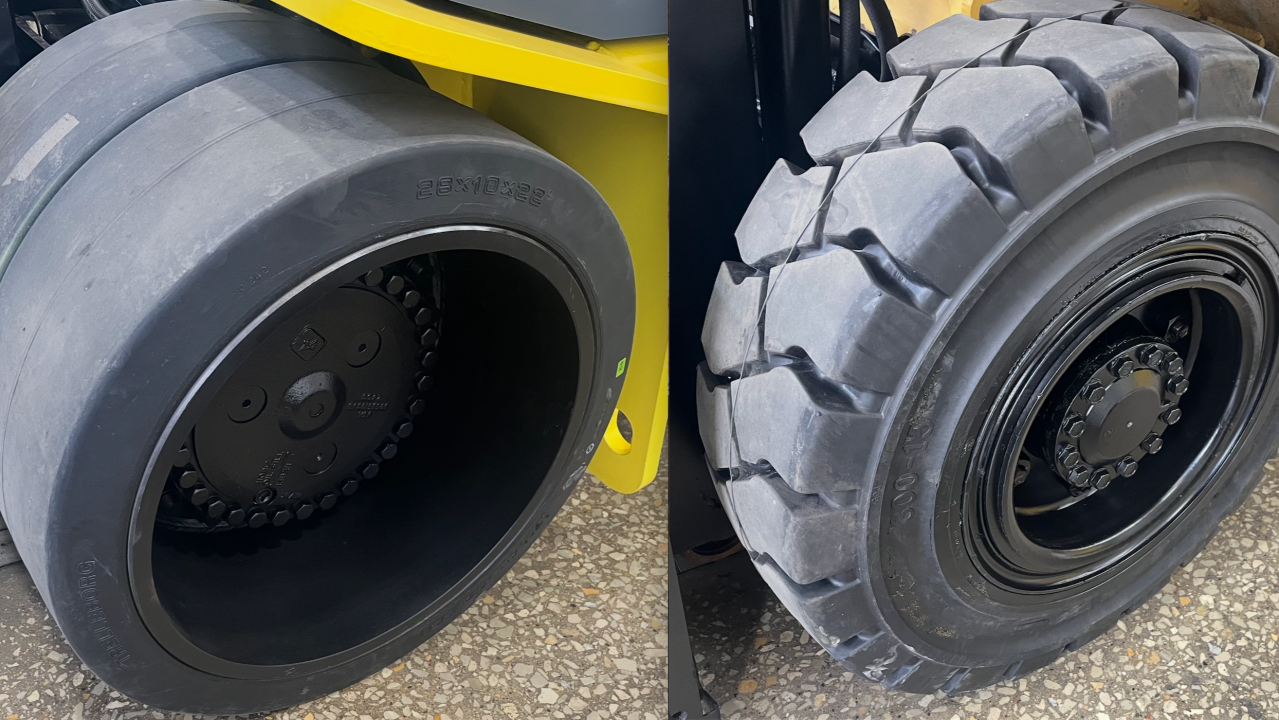
If you’re in the market for a forklift, one of the most overlooked—but critical—decisions you’ll make is choosing between cushion tires and pneumatic tires.
This isn’t just a spec on a data sheet. It directly impacts your operating costs, productivity, safety, and long-term equipment lifespan.
After years working with fleets across warehousing, manufacturing, and outdoor operations, I’ve seen firsthand how choosing the wrong tire type can quietly cost companies thousands.
Here’s what you need to know
Cushion tire forklifts use solid rubber tires pressed onto a metal band. They’re designed primarily for smooth, indoor environments and they excel in warehouses with finished concrete floors, narrow aisle applications, high-density storage operations and loading docks with consistent surfaces
Cushion forklifts struggle outdoors. Uneven surfaces, gravel, potholes, or inclines quickly reduce performance and increase wear. Nothing destroyed a good condition smooth tire forklift faster than gravel and potholes.
Bottom line: Cushion trucks are about efficiency and precision in controlled environments.
Pneumatic forklifts use air-filled (or solid pneumatic) tires similar to what you’d find on a truck. They’re designed for mixed or outdoor use and they excel on construction sites, lumber yards, outdoor storage yards and facilities with rough or uneven terrain.
Size. A pneumatic tire forklifts is typically larger than a cushion tire forklift of the same capacity. Pneumatics have a larger turning radius and require more space. Using one indoor means they’re less efficient in the tighter environment. This isnt the truck you use for tight spaces, its the one you use in rough applications
Bottom line: Pneumatic trucks are about durability and adaptability in unpredictable conditions.
This choice goes far beyond “indoor vs outdoor.”
Using a pneumatic forklift in a tight warehouse slows everything down. Using a cushion forklift outdoors leads to constant inefficiencies and operator frustration.
Cushion tires on rough terrain means accelerated tire wear, structural stress. On the other hand, pneumatic tires in clean indoor environments means unnecessary fuel and maintenance costs
Your forklift should match your layout—not fight against it.
I’ve seen operations regain 15–20% efficiency simply by aligning the right equipment with the environment.
Don’t ask: “Which forklift is better?”
Ask: “What environment will this forklift operate in 90% of the time?”
That answer determines everything.
If your operation is split (indoor + outdoor), don’t automatically default to pneumatic.
In many cases, the best solution is dedicated cushion units for warehouse work and dedicated pneumatic units for yard work
Yes, it’s two machines—but it’s also: ✔ Faster cycle times ✔ Lower long-term costs ✔ Less wear and tear ✔ Safer operations
My name is Jason Flaska. I don’t just sell forklifts, I help people realize and decide what their application calls for.
Call – Text – WhatsApp 630-842-0779 Jasonf@forkliftexchange.com www.Forkliftexchange.com
#Forklift #MaterialHandling #forkliftsforsale #usedforklifts #WarehouseOperations #Logistics #SupplyChain #OperationsManager #Manufacturing #B2BSales #SmallBusiness
Special Note: If you’re still reading, like and share. It’s appreciated. If you’re interested in receiving a free Tire Rating to determine how much life is still left on them, send me a message.
Comments are closed