
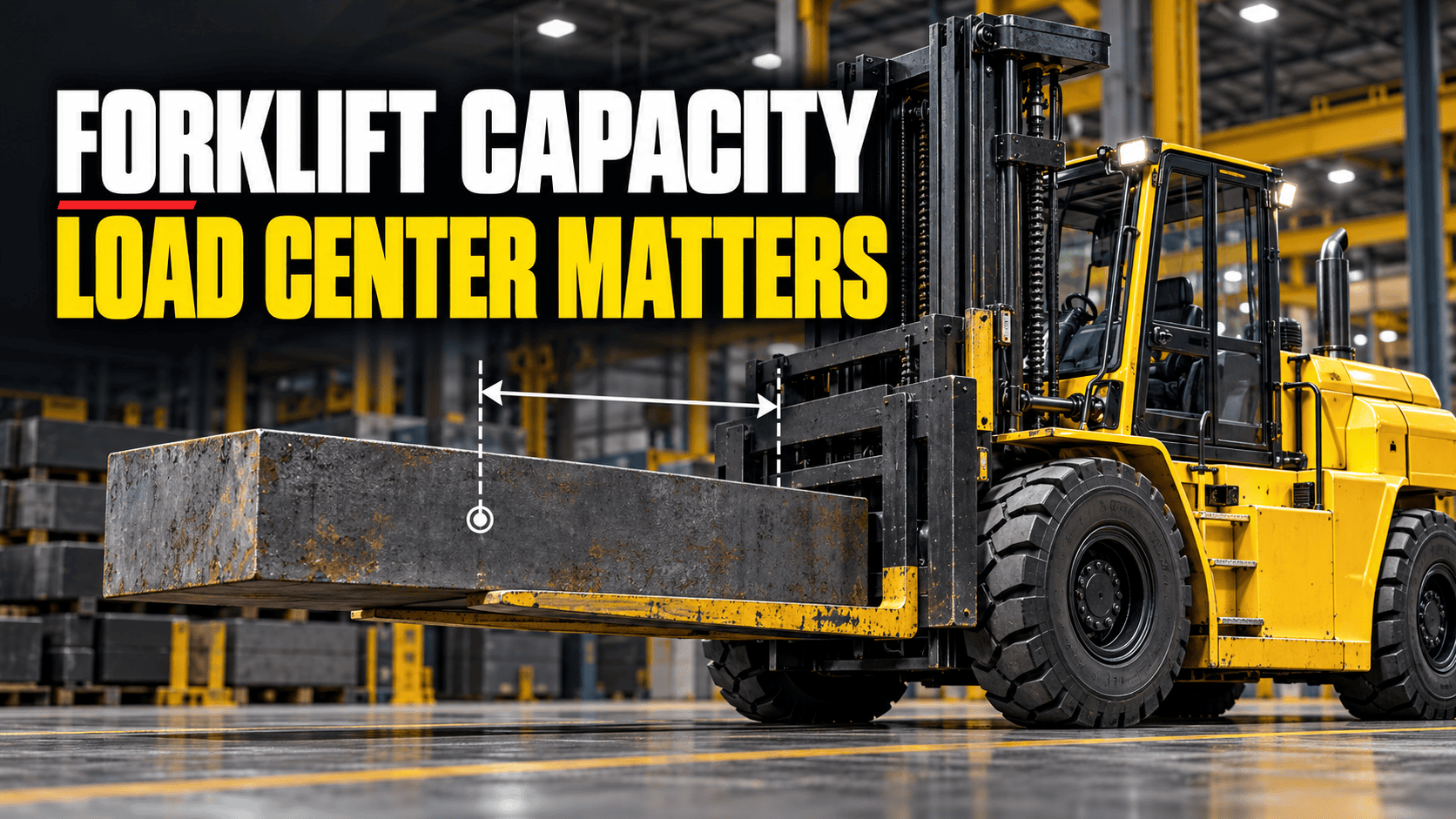
A forklift load center can make the difference between a lift that is within the truck’s rated limits and one that requires a higher-capacity machine. The number shown on a forklift’s data plate is not a universal lifting limit. It applies under defined conditions—including a specified load center, mast height, and equipment configuration.
That distinction is especially important when moving dies and molds, CNC machinery, heavy castings, steel and aluminum products, or large industrial components. A load may weigh 20,000 lbs., but that does not automatically mean a 20,000-lb. forklift is the right truck.
The forklift load center is the horizontal distance from the vertical face of the forks or attachment to the load’s center of gravity. For a uniformly distributed 48-inch-deep load positioned against the carriage, the load center is commonly 24 inches.
When that distance increases, the load creates more leverage on the truck. Think of the forklift and load as a balance system: moving the same weight farther forward increases the overturning force. As a result, the forklift’s effective lifting capacity can decrease even though the load itself has not become heavier.
OSHA’s powered industrial truck guidance confirms that forklift capacity is rated for a specified load center and that the truck’s data plate identifies the approved capacity and configuration.
The data plate reflects a particular set of operating conditions. Change those conditions, and the listed capacity may no longer describe the application accurately. These five factors deserve careful review.
Long, deep, or irregular loads often place their center of gravity farther from the carriage. A steel block that is deeper than a standard pallet can create a longer forklift load center, while machinery with uneven weight distribution may have a center of gravity that is not at its geometric center.
A load positioned tight against the carriage generally has a shorter load center than the same load sitting near the fork tips. Fork length, load orientation, and required clearance can all change how far forward the load must be carried.
Sideshifters, fork positioners, coil rams, clamps, rotators, and other attachments add weight and may move the load farther forward. Both effects can reduce available capacity. OSHA notes that attachments can change capacity and that the truck’s markings should reflect the equipped configuration.
Some forklifts have different capacity ratings at different lift heights. Capacity may decrease as the load is raised, particularly with tall masts or demanding load centers. The correct truck must meet the application’s requirements at the actual maximum lift height—not only at floor level.
A complete application review also considers aisle width, floor condition, ramps, overhead clearance, indoor or outdoor use, travel path, and how the load will be picked and placed. These conditions influence truck configuration and safe operating procedures even when they do not change the weight of the load.
Consider the same load handled at two different distances. At a 24-inch load center, a forklift may have sufficient rated capacity. Move that load outward to a 48-inch load center, and the leverage on the truck increases substantially. The correct allowable capacity must come from the manufacturer-approved data plate, capacity chart, or qualified application review—not from load weight alone.
A simple rule of thumb should never replace the truck manufacturer’s rating. If the attachment, load center, mast, or configuration has changed, confirm that the data plate matches the truck as equipped.
Forklift capacity planning becomes especially important for:
These loads are frequently oversized, offset, unusually shaped, or handled with specialized attachments. Selecting equipment by weight alone can overlook the factors that determine whether the complete application falls within the forklift’s approved capacity.
Before selecting a forklift, gather the following information:
With this information, an equipment specialist can compare the application with the forklift’s capacity data and identify an appropriate configuration. Forklift Exchange offers high-capacity extendable-counterweight forklifts and rental equipment for specialized industrial applications.
Not necessarily. The required capacity depends on the forklift load center, attachment, lift height, load dimensions, and truck configuration. An oversized or forward-positioned 20,000-lb. load may require a forklift rated above 20,000 lbs. for the actual application.
They often do. An attachment adds weight and may increase the load center by moving the load forward. Confirm the truck’s approved capacity with the attachment installed and make sure the data plate reflects the equipped configuration.
Capacity is shown on the forklift data plate or nameplate. Operators should be able to read it, understand the listed load center and lift height, and verify that it matches the truck and attachment configuration. See OSHA’s guidance on the forklift nameplate and load composition.
With more than 30 years in the material handling industry, Nick Marshall has worked with specialized and high-capacity applications across a wide range of industries. Share the load weight, dimensions, load center, attachment, lift height, and operating conditions to begin identifying the right equipment for the job.
Nick Marshall | Forklift Exchange, Inc.
Phone: +1 630-235-4802
Email: nick.marshall@forkliftexchange.com
Website: www.forkliftexchange.com
Comments are closed