
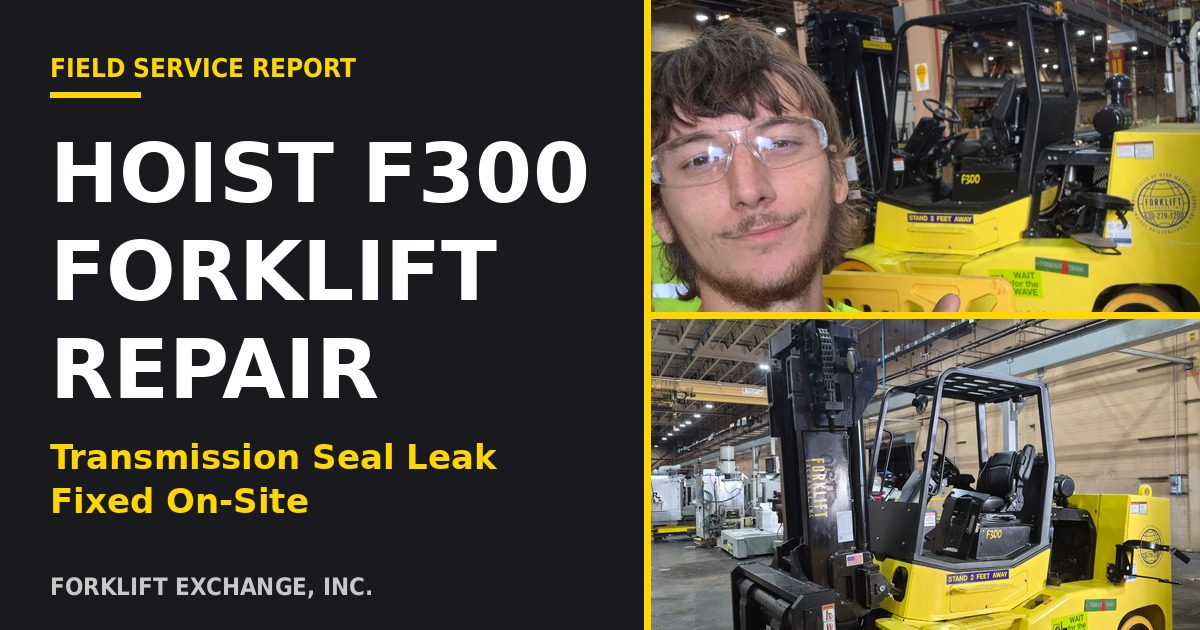
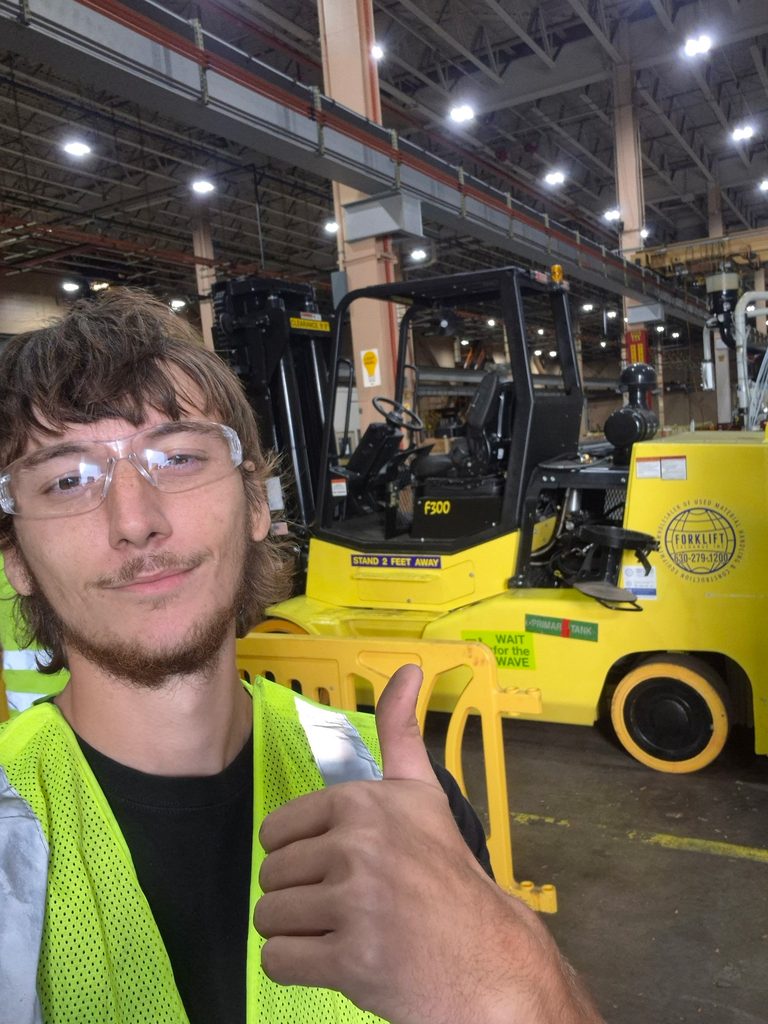
When a Hoist F300 Forklift, a 30,000 lb truck starts leaking fluid, downtime gets expensive fast. That is why Hoist F300 forklift repair is a big part of what our field service team does every week. Last week, Forklift Exchange service technician Jeremy spent four days at an automotive manufacturing plant in New York, tracking down and fixing a transmission seal leak on a Hoist F300.
Here is what the job involved, why it took more than a quick swap, and what plant managers should watch for on their own high-capacity forklifts.
The customer’s Hoist F300 is an LP-powered cushion tire forklift built for heavy loads in a busy plant. It had developed a leak coming from the transmission seal. A small leak may not stop a truck today, but on a high-capacity forklift running full production shifts, it rarely stays small.
Low transmission fluid can lead to overheating, slipping, and damage to the transmission and torque converter. In other words, a forklift transmission leak is much cheaper to fix early than after a failure. Because the truck was needed on the floor, the customer called for on-site help instead of sending it away for repair.
The leak traced back to the seal behind the torque converter. Reaching it is not a bolt-on job, so Jeremy worked through the repair in stages:
The work ran from Monday through Thursday. It is a good example of why a forklift transmission seal replacement is a job for an experienced technician with the right tools.
Some leaks can be fixed from the outside. A seal behind the torque converter is not one of them. It sits between the engine and the transmission, so there is no shortcut around removing the engine and the converter first.
The upside is that everything is open once the truck is apart. That gives a technician a chance to inspect the surrounding components before closing it back up. By contrast, a patch that skips the root cause usually brings the leak back, along with a second service call.
Catching a leak early keeps a repair small. Watch for these signs on any high-capacity forklift:
If you see any of them, schedule an inspection right away. Repairs like this should also follow proper OSHA lockout/tagout procedures, so the truck is de-energized and safe before anyone works on it.
Forklift Exchange technicians work from fully equipped service trucks and travel to your facility, so a Hoist F300 forklift repair does not have to mean weeks without your truck. Our service department covers engine, transmission, and general repairs, plus preventative maintenance and 24/7 emergency support, across the continental U.S. Our parts department keeps common components on hand.
Not sure what you are running? Take a look at our Hoist F300 forklift, or browse our full Hoist forklift lineup. You can also learn more about the manufacturer at Hoist Material Handling. Operators and technicians should always follow OSHA’s powered industrial truck requirements as well.
If your truck is leaking, slipping, or running hot, do not wait for a breakdown. For questions about scheduling, see our Parts/Service FAQ, or contact our team to request a Hoist F300 forklift repair.
Forklift Exchange, Inc. Service Department 📞 708-497-5844 🌐 www.forkliftexchange.com
#HoistF300 #ForkliftRepair #ForkliftTransmission #TorqueConverter #ForkliftService #FieldService #HighCapacityForklift #ForkliftExchange
Comments are closed