
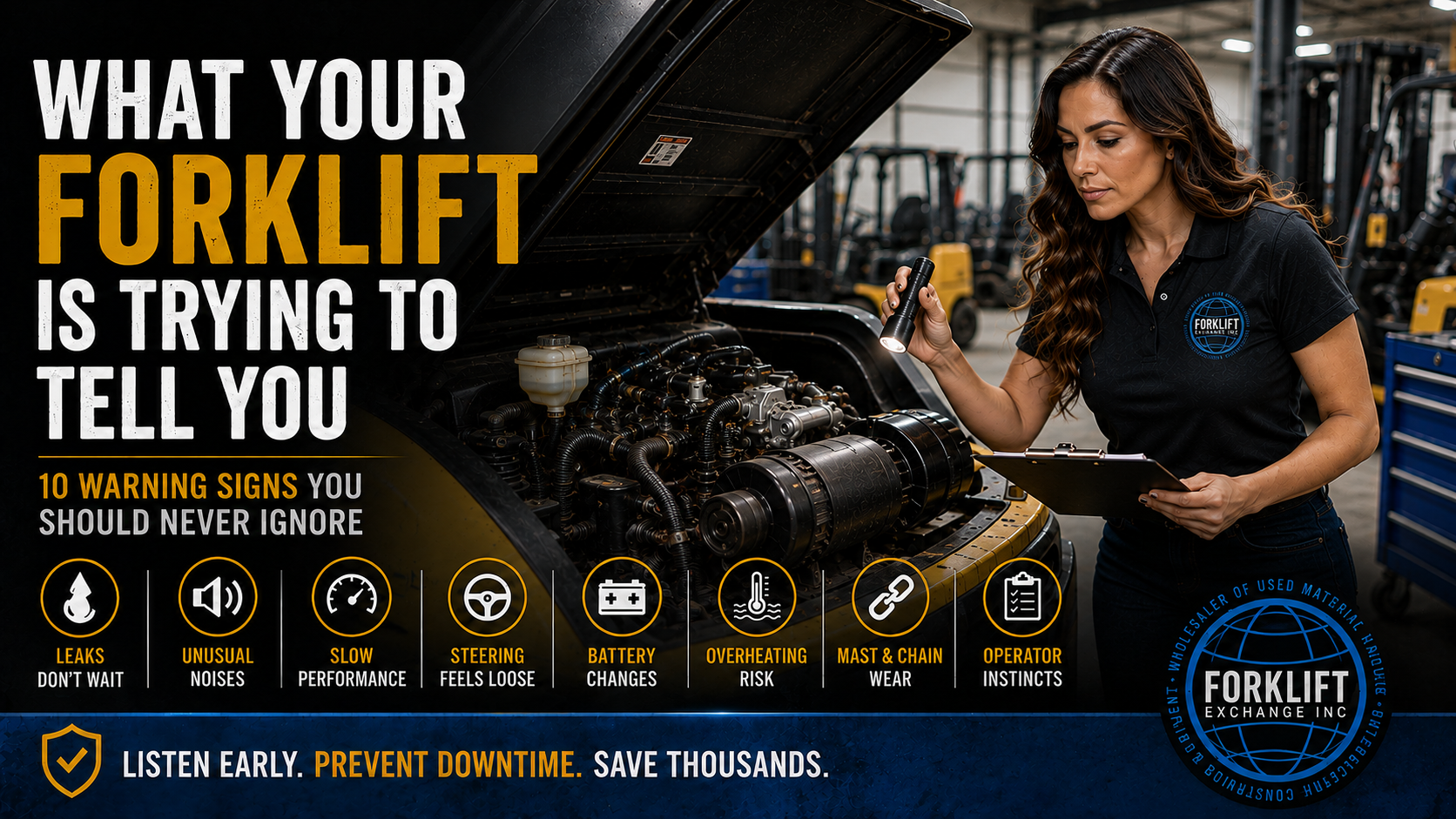
Don’t ignore forklift warning signs! One of the biggest mistakes I see forklift owners make isn’t buying the wrong equipment—it’s ignoring the warning signs their current forklift is giving them. Forklifts rarely fail without warning. In most cases, they start “talking” long before a major breakdown. A strange noise, a slight vibration, a hydraulic leak, or steering that doesn’t feel quite right are often early indicators that something needs attention.
The companies that listen to those warning signs usually avoid expensive repairs and unplanned downtime. The companies that ignore them often end up with a forklift that stops working at the worst possible time. After more than 20 years in the forklift industry, here are ten warning signs I never ignore.
A small puddle under your forklift may not seem like a big deal… until it becomes one.
Hydraulic leaks can indicate:
Ignoring a small leak can eventually lead to:
If you notice fresh hydraulic oil, investigate it sooner rather than later. Just last week someone showed me spots underneath their truck and they indicated that management would likely ignore the issue. Doing so will only exacerbate the issue while adding unnecessary risk to the work environment.
Forklifts shouldn’t suddenly start making new sounds.
Listen for:
Every sound tells a story. Sometimes it’s nothing more than a worn belt. Other times it’s a failing transmission, hydraulic pump, wheel bearing, or mast component. Don’t turn the radio up louder! Find the source, or at the very least, report the noise to management so they can deal with the issue.
If your forks seem slower than they used to be, your forklift is trying to tell you something.
While it could be as simple as being low on hydraulic fluid or dirty filters, it could indicate something more urgent, like a worn pump or internal cylinder leakage. If you’re using an electric forklift, this could indicate that your battery is starting to go bad and may need to be replaced.
Reduced lift speed often develops gradually, making it easy to overlook until productivity starts suffering. Try to be mindful of things like this while operating your unit.
Forklifts should feel predictable.
If steering begins to wander, feels loose and sloppy, requires constant correction, and/or develops excessive play, don’t assume it’s normal wear. Steering components are critical safety items and should be inspected promptly.
For LP and diesel forklifts especially, difficult starting usually means something is changing.
Possible causes include:
Even if it starts today, tomorrow it might not. These problems do not go away on their own and only continue to get worse.
For electric forklifts, the battery tells its own story.
Watch for:
A healthy battery should provide consistent performance shift after shift.
Changes usually indicate it’s time for testing, not guessing. Just keep in mind that lead-acid batteries (the most common forklift battery) will have reduced lifting power as the battery loses its charge. Lithium batteries will still continue to maintain the same lift power even as the battery depletes.
Tires reveal a surprising amount about a forklift’s health.
Uneven wear can point to:
Replacing tires without fixing the underlying cause usually means you’ll be replacing another set sooner than expected.
The mast should operate smoothly throughout its travel.
Warning signs include:
The mast handles every load your forklift lifts. Ignoring mast problems isn’t just expensive; it can become a serious safety issue.
Many people assume overheating only happens during hot weather. Not true.
Overheating can result from:
Heat is one of the fastest ways to shorten the life of an engine or hydraulic system. It’s also the issue that’s most often ignored with forklifts.
This may be the most valuable warning sign of all. Experienced operators spend hundreds or even thousands of hours behind the wheel. When they tell you, “Something doesn’t feel right.”
Believe them.
Many major failures begin with subtle changes that experienced operators notice long before anyone else. Listening to your operators can prevent costly downtime.
One of the biggest misconceptions in maintenance is that delaying repairs saves money. In reality, small issues have a habit of becoming expensive ones. A leaking hydraulic hose can damage a pump. A worn bearing can destroy an axle. A neglected cooling system can lead to a complete engine overhaul.
Addressing problems early almost always costs less than waiting for a failure.
The companies with the fewest breakdowns usually aren’t lucky. They simply have good maintenance programs.
Routine inspections help identify:
Preventive maintenance isn’t just about keeping forklifts running. It’s about protecting productivity.
Your forklift is constantly communicating its condition. The question is whether anyone is listening.
Most major breakdowns don’t happen without warning. They begin with small changes: new noises, slower performance, unusual wear, or subtle differences that are easy to ignore. The companies that pay attention to those forklift warning signs usually experience fewer breakdowns, lower repair costs, and longer equipment life.
Special Note: At Forklift Exchange, we don’t just help customers buy forklifts. We help them maximize the life of the equipment they already own. Whether you’re deciding if a repair makes sense, evaluating a used forklift, or determining if it’s time to rebuild or replace a machine, we’re always happy to offer a second opinion.
Jason Flaska
Forklift Exchange, Inc.
📞 630-842-0779
📧 jasonf@forkliftexchange.com
#HighCapacityForklifts #HeavyLifting #Rigging #MachineryMoving #SteelCoilHandling #BulkMaterialHandling #SteelCoilHandling #Transloading #MachineryMovingAndRigging #HighCapacityForklifts #HoistMaterialHandling #HoistForklifts
Comments are closed